
 0


 English
 Español
 中文简体
 عربى
Industry News
Home / News / Industry News / What Are Ball Bearings? Types, Materials, Seals, and Selection Guide for Engineers

2026-10-05
A small pump motor on a packaging line stops without warning. The maintenance team removes the shaft and finds a ball bearing with spalled raceways, blackened grease, and a rough, grinding feel. Replacing it costs less than a dollar in parts, but the unscheduled downtime costs the line four hours of output. This scene plays out in thousands of factories every year, and in nearly every case, the failure can be traced back to one decision: the wrong bearing type, the wrong material, the wrong seal, or a mismatch between the actual load and the bearing’s capacity.
Ball bearings are among the most widely used machine elements in industrial and consumer products, yet specifying them is rarely as simple as reading a part number. This guide explains what ball bearings are, how they carry load, which types and materials are available, how seals and shields change performance, how to choose the right component for a given application, and what to check when you are sourcing them in quantity.
A ball bearing is a rolling-element bearing that uses spherical balls to separate two concentric rings: an inner ring and an outer ring. The inner ring is normally pressed onto a shaft, while the outer ring is held in a housing. As the shaft rotates, the balls roll between the rings inside raceway grooves, which keep the balls aligned and provide the contact surfaces that transfer load between the rotating and stationary parts.
The rolling motion is the entire point of the design. Sliding contact generates friction, heat, and wear; rolling contact reduces friction dramatically, allowing shafts to spin at high speeds for years with minimal energy loss. A typical deep groove ball bearing running under radial load has a coefficient of friction in the range of 0.001 to 0.0015, compared with 0.1 or more for plain sliding bearings. That difference in friction translates into lower operating temperatures, lower power consumption, longer component life, and simpler lubrication requirements.
| Component | Function | Common Materials |
|---|---|---|
| Inner ring | Fits onto the shaft and rotates with it | Chrome steel, stainless steel, carbon steel |
| Outer ring | Fits into the housing and stays stationary | Chrome steel, stainless steel, carbon steel |
| Balls | Roll between the rings and transmit the load | Chrome steel, stainless steel, ceramic |
| Cage / retainer | Spaces the balls evenly and prevents ball-to-ball contact | Steel, brass, polyamide |
| Shield | Keeps coarse particles out while allowing grease to escape slowly | Carbon steel, stainless steel |
| Seal | Blocks dust, moisture, and washdown water from entering the bearing | NBR rubber, Viton, PTFE |
When a radial load is applied to a shaft, only a portion of the balls shares the load at any instant. The ball positioned directly under the load carries the highest stress; the balls to either side carry progressively less. This load zone typically spans an arc of 60 to 90 degrees, and under normal conditions three to five balls support the majority of the force. The load distribution across those balls determines the contact stress and ultimately the fatigue life of the bearing.
Radial load distribution in the loaded zone of a ball bearing
Each time a ball rolls through the loaded zone, it experiences a compressive stress cycle. Over millions of revolutions, these repeated cycles generate subsurface fatigue at the depth of maximum shear stress. When the fatigue threshold is reached, a microscopic crack propagates to the surface and a flake of material spalls away. Once a spall appears, vibration and noise increase, grease contamination accelerates, and the bearing eventually seizes or locks up. This is why bearing life is not expressed as a fixed number of hours, but as a statistical value. The bearing industry uses the L10 life: the number of hours that 90 percent of a group of identical bearings will reach or exceed before fatigue failure occurs.
Ball bearings are not a single product family. Differences in ring geometry, base material, flange design, and outer surface treatment define distinct families that answer different engineering problems. Choosing the right family is the first step in any bearing specification.
The most common rolling bearing. Deep raceway grooves match the ball curvature, allowing both radial and moderate axial loads in a compact package. Available in metric series 60, 62, 63, 68, 69 and in miniature or inch sizes.
Made from AISI 304, AISI 440C, or other stainless grades. They resist corrosion, tolerate washdowns and humid environments, and are used in food processing, medical devices, marine equipment, and chemical exposure.
A steel ball bearing over-molded with a nylon, polyethylene, or PU outer layer. The coated surface runs quietly, absorbs light shocks, and provides either sliding friction or rolling grip for windows, drawers, and conveyors.
The outer layer is cast polyurethane with a defined Shore durometer. These bearings offer good wear resistance, shock absorption, low noise, and resistance to many oils and solvents for material handling.
The outer ring has an integral flange that serves as a locating shoulder. A thin sheet-metal housing with a plain bore can then hold the bearing without snap rings, machined shoulders, or circlips, saving assembly time.
Modified bores, extended inner rings, double-row constructions, special outer profiles, or unusual widths. These are made in small or large series when a standard catalog size does not fit the product design.
Deep groove ball bearings are the workhorse of rotating equipment. The raceway grooves are ground to a radius slightly larger than the ball diameter, forming a continuous track that captures the balls and keeps them aligned under combined radial and axial loads. Because of their simple construction, deep groove bearings can be produced in very large volumes with tight tolerances and low running noise. That is why they are the default choice for electric motors, fans, pumps, compressors, gearboxes, household appliances, and power tools.
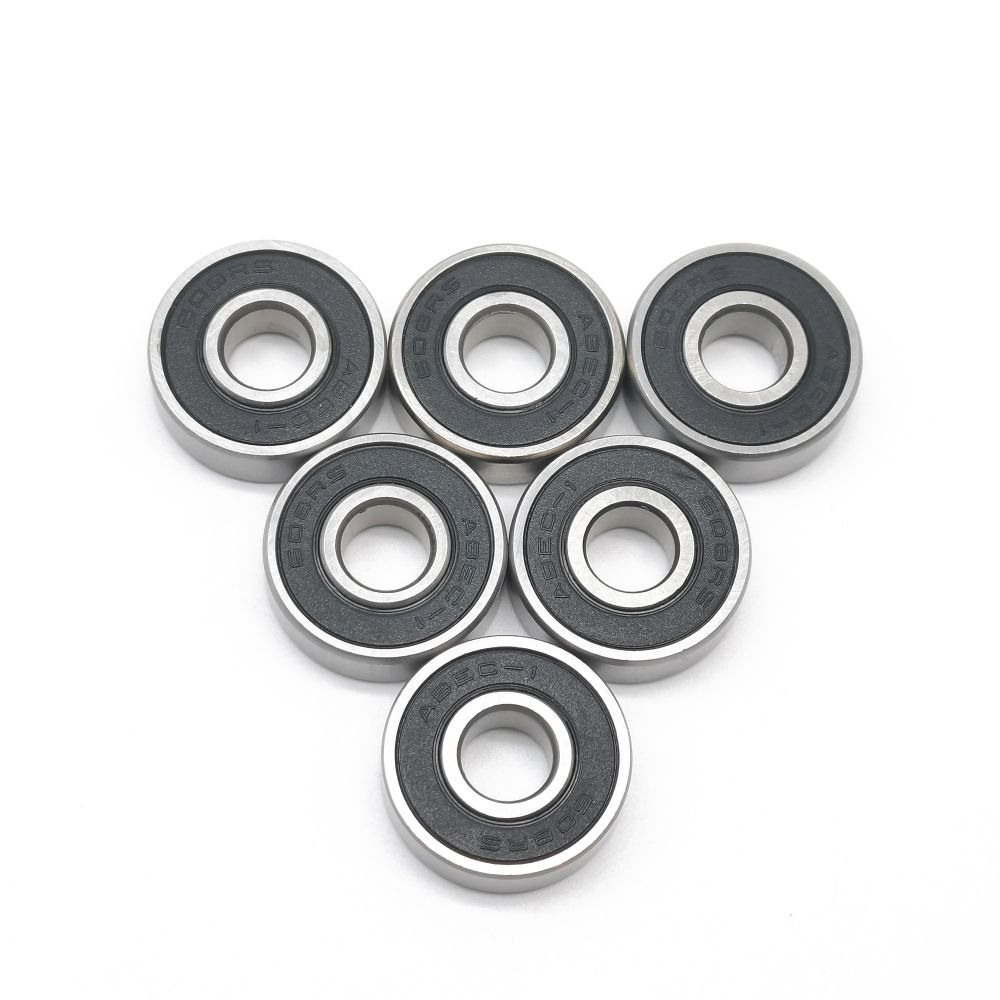
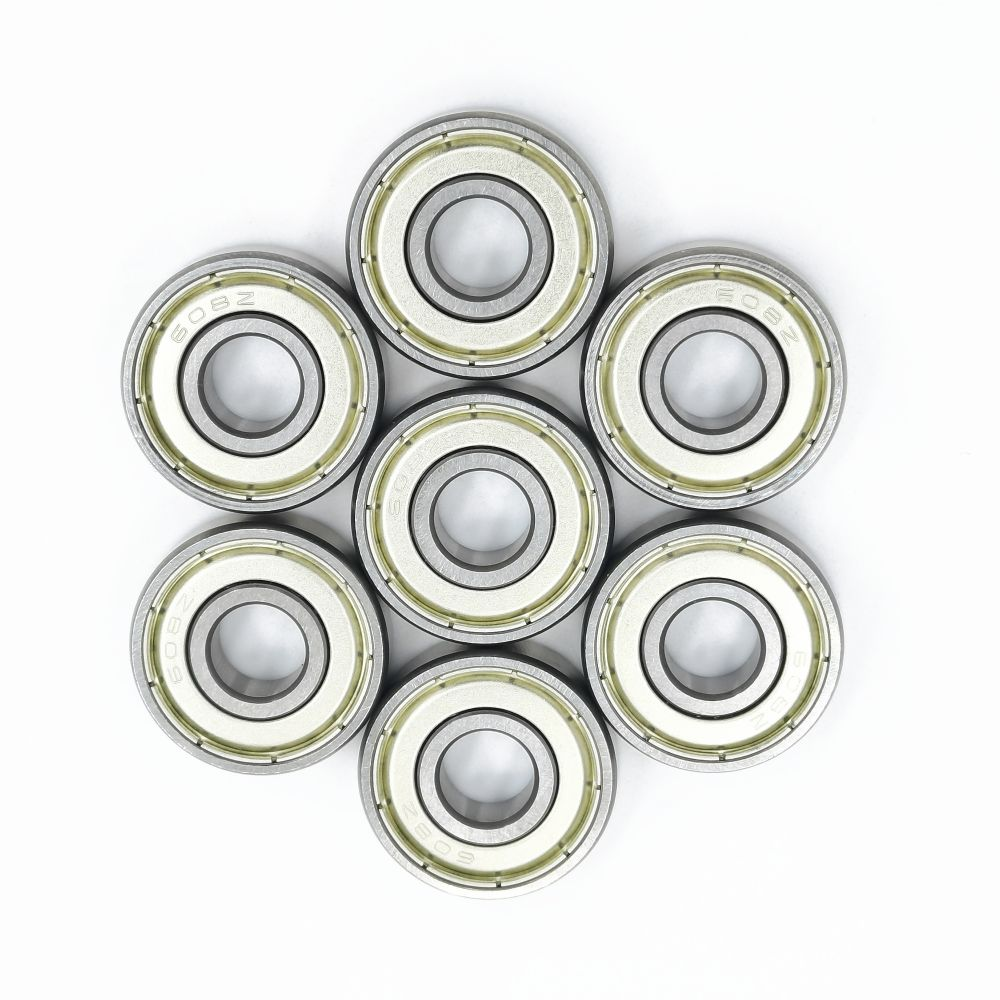
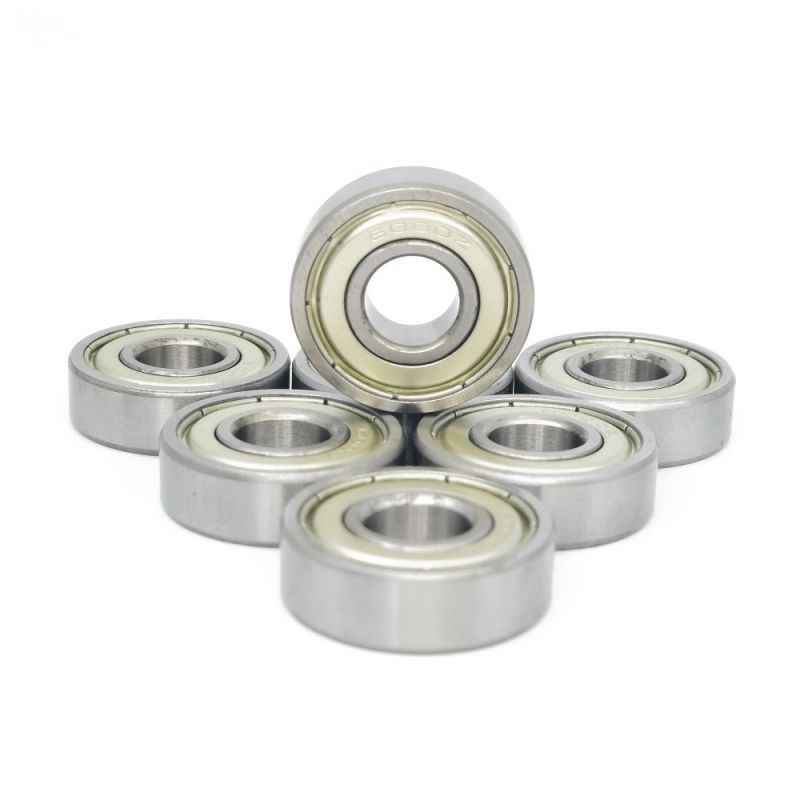
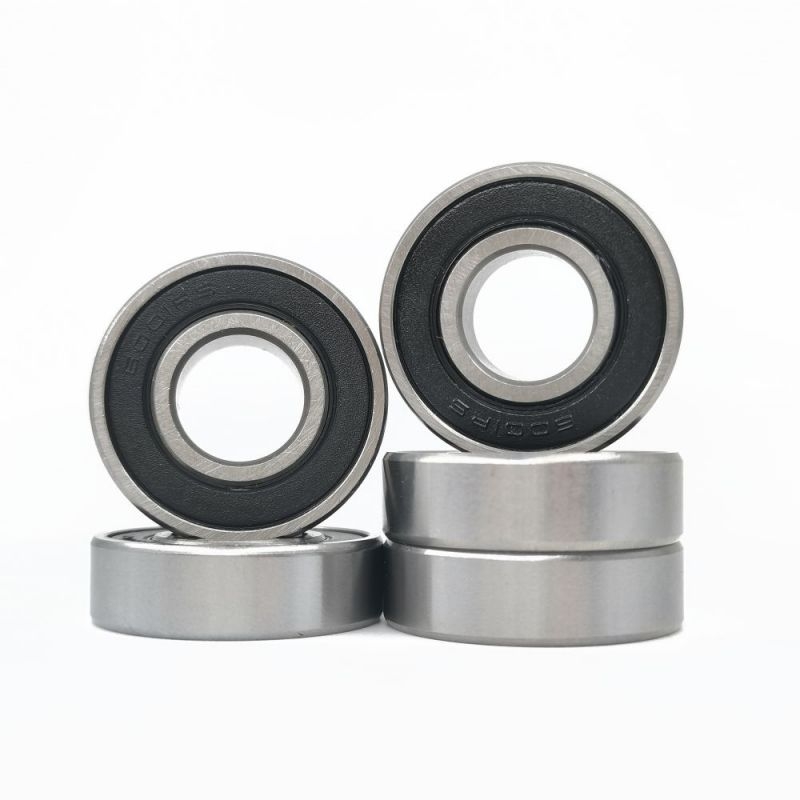
Within a given series, the main dimensions follow ISO standards. A 608 bearing, for example, has an 8 mm bore, a 22 mm outer diameter, and a 7 mm width. The common versions are open (no shield), Z or ZZ (single or double metal shield), and RS or 2RS (single or double rubber seal). The ZZ version keeps grease in and coarse dust out with no contact friction, while the 2RS version adds a contacting rubber seal for wet or heavily contaminated conditions. For motor shafts and small drive trains, deep groove ball bearings for motors are usually selected with C3 clearance and a low-noise grade grease.
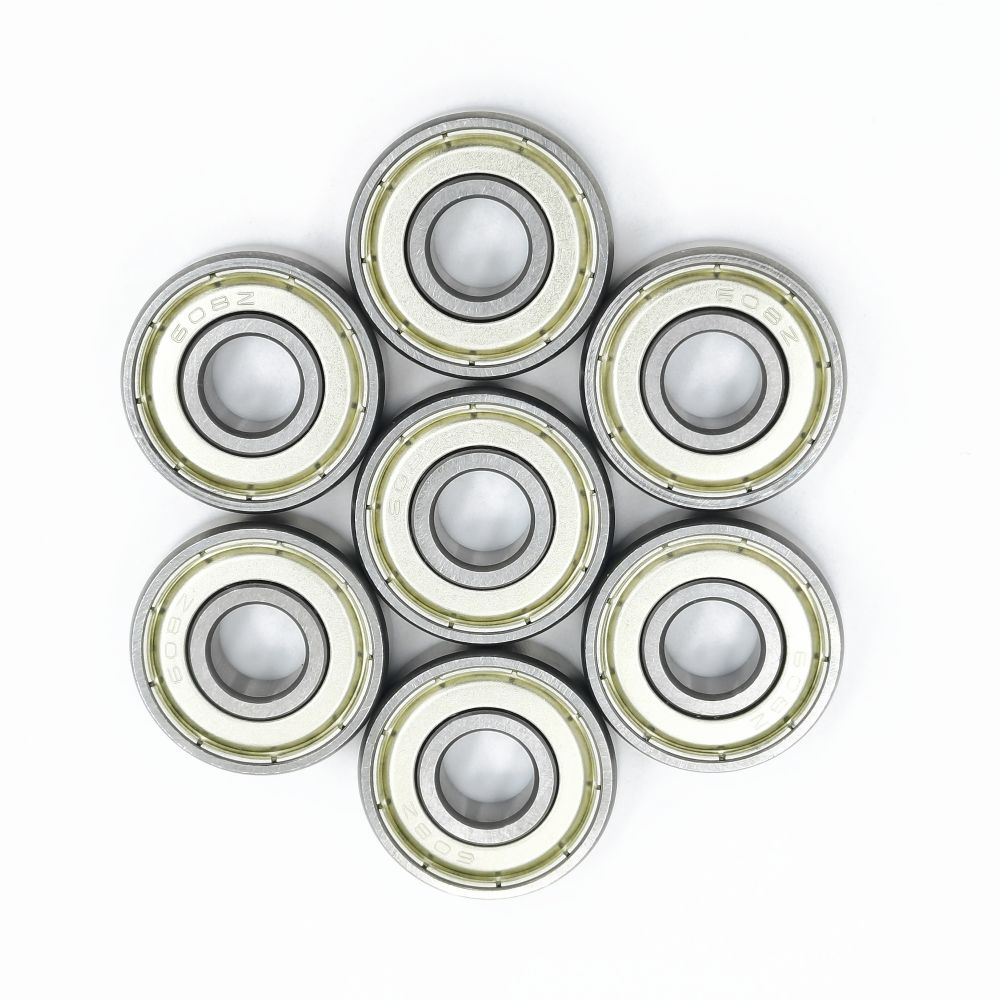 608ZZ Double Metal Shielded Deep Groove Ball BearingThis 8x22x7 mm bearing uses double metal shields for low-friction operation while keeping grease in and coarse dust out, making it a practical choice for motor shafts and small drive trains needing moderate clearance.View Product →
When the correct clearance, lubricant, and seal are matched to the operating speed and temperature, a deep groove bearing can run at ten thousand rpms or more. Under moderate load, the same bearing can deliver an L10 life of tens of thousands of hours. The limiting factors are almost always external: misalignment, contamination, poor lubrication, or an incorrect fit between the shaft, housing, and ring.
Standard chrome steel bearings are extremely hard, but they are not immune to corrosion. When moisture, washdown chemicals, salt air, or food acids reach the bearing, the raceways rust quickly and the corrosion products act as an abrasive that accelerates wear. Stainless steel bearings eliminate this failure mode by replacing the ring and ball material with corrosion-resistant grades. For packaging lines, food processing equipment, marine winches, and outdoor automated systems, corrosion-resistant stainless steel bearings are usually the only sensible option.
The two most common stainless grades are AISI 304 and AISI 440C. AISI 304 offers excellent corrosion resistance but moderate hardness, so it is suitable for lightly loaded, wet, or hygienic applications where the bearing is not expected to carry high forces. AISI 440C is a high-carbon martensitic stainless steel that can be hardened to a level comparable with bearing steel, making it the preferred choice when a bearing needs both corrosion resistance and real load-carrying capacity. Food-grade stainless bearings add the requirement of cleanability: smooth surfaces, washdown-friendly seals, and food-compatible grease.
 S608RS Stainless Steel Double Rubber Sealed BearingMade from 304 or 316 stainless steel with double rubber seals, this corrosion-resistant bearing suits food processing, medical, and agricultural equipment where cleanability, low noise, and protection from moisture matter.View Product →
Not every application wants bare steel. Sliding doors, drawer runners, conveyor rollers, fitness equipment, and window systems often need a bearing that is quiet, gentle on the track, and able to absorb minor shocks. Plastic-coated and polyurethane-coated bearings add an outer layer over a standard steel bearing, converting a hard metal contact into a conforming surface that distributes pressure and dampens vibration.
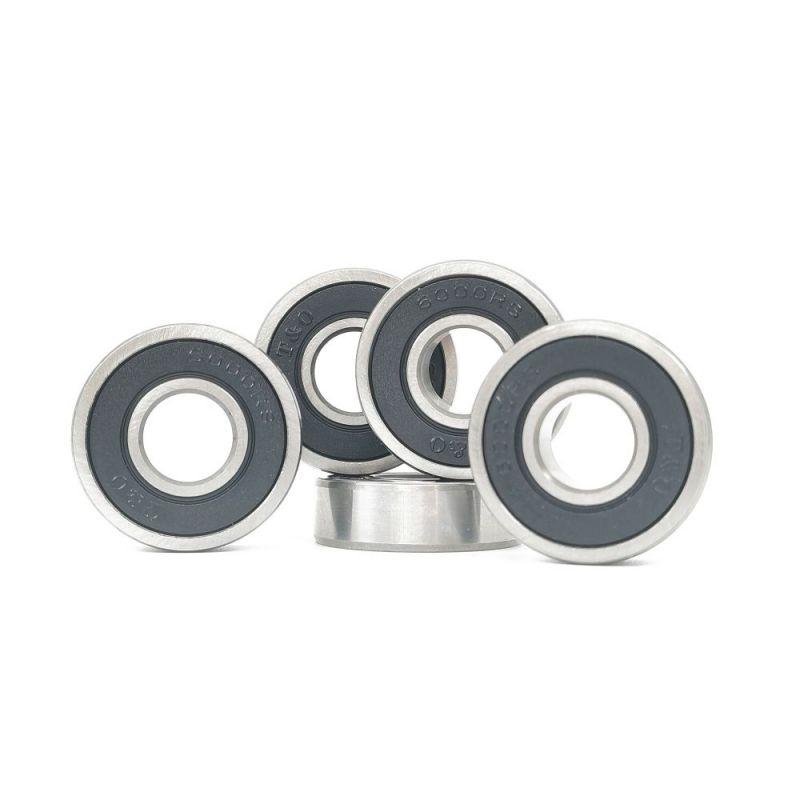
Nylon-coated bearings are hard-wearing and have a low friction surface, which makes them a good fit for furniture slides and sliding-door tracks. Polyurethane (PU) bearings come in different Shore durometers, so the designer can tune the softness for noise absorption, grip, or load distribution. The PU layer also resists many oils, solvents, and chemicals better than natural rubber, which is why PU-coated rollers are common on conveyor systems and packaging lines.
 PU60826-7 Polyurethane-Coated Bearing with Built-in 608ZZAdding a polyurethane outer layer over a 608ZZ core, this bearing provides wear resistance, chemical tolerance, and noise damping for conveyor rollers, furniture slides, and motorcycle components operating in harsh or wet conditions.View Product →
A flanged bearing is a deep groove or miniature bearing with an integral flange on the outer ring. The flange acts as a locating shoulder, so a sheet-metal housing punched with a plain hole can hold the bearing without an additional shoulder, snap ring, or machined recess. Flange bearings save assembly time and reduce part count, which is why they appear in office equipment, small fans, and precision instruments where axial space is limited.
Standard catalogs cover thousands of sizes, but not every project fits inside them. Non-standard bearings include extended inner rings for simple shaft mounting, double-row designs for higher radial capacity, V-groove or U-groove outer profiles for track guidance, special bore tolerances, and shaft-bearing assemblies. These are common in material-handling components, custom rollers, and specialized OEM equipment. Because non-standard parts require dedicated tooling and process development, working with a manufacturer that can design and machine the geometry in-house shortens lead times and lowers the unit cost.
The material grade decides hardness, corrosion resistance, and cost. The table below summarizes the most common ring and ball materials used in ball bearings.
| Material | Hardness (HRC) | Corrosion Resistance | Load Capacity | Typical Price | Typical Applications |
|---|---|---|---|---|---|
| Chrome steel 52100 | 60–66 | Low | Excellent | Low | General industrial bearings, motors, conveyors |
| Carbon steel | 50–60 | Low | Good | Very low | Light-duty, low-speed bearings |
| AISI 304 stainless | Soft | High | Limited | Medium | Food-contact, washdown, light load |
| AISI 440C stainless | 56–62 | High | Good | Medium-high | Corrosive environments with load |
| Ceramic (hybrid balls) | Higher than steel | Very high | Excellent | High | High-speed spindles, electrical insulation |
Chrome steel SAE 52100 is the default material for most ball bearings because it combines high hardness, excellent fatigue life, and moderate cost. Carbon steel is less hard and less fatigue-resistant, but it is acceptable for light-duty, low-speed products where the purchase price is the main constraint. For food-contact parts, the stainless grade also determines whether the bearing can be cleaned with aggressive detergents without surface damage. AISI 440C is generally the first choice for stainless steel bearings that must carry a real load; AISI 304 is limited to very light loads and low contact stress.
The seal or shield is the first line of defense between the bearing’s internal raceways and the outside world. It also influences the speed limit and the operating temperature, so the choice is a tradeoff, not a detail.
| Sealing Type | Contact Friction | Speed Limit | Level of Protection | Typical Applications |
|---|---|---|---|---|
| Open | None | Highest | No protection | High-speed spindles with separate lubrication |
| Z or ZZ (metal shield) | None | High | Keeps out coarse particles, retains grease | Motors, fans, general industrial |
| RS or 2RS (rubber seal) | Light to moderate | Reduced | Blocks dust, moisture, washdown water | Outdoor equipment, wet and contaminated conditions |
Metal shields run with a tiny gap and no contact friction, so they preserve speed while giving up a small amount of protection. Rubber seals contact the inner ring directly, providing a complete barrier, but the contact friction increases torque and reduces the maximum permissible speed. For humid, dusty, or wet environments, the speed penalty of a double rubber seal is usually a fair price for the reliability gain.
Relative speed limit by sealing type (indicative comparison)
Selecting a bearing is a sequence of tradeoffs. The process starts with operating conditions and moves down to material, seal, and lubricant details. The order below works well for most design projects.
The speed and load values marked on a bearing are not independent. High loads reduce the permissible speed, and high speeds reduce the permissible load. The manufacturer’s catalog normally provides separate speed ratings for grease and oil lubrication, and both are lower than the theoretical geometric limit.
Common purchasing mistakes to avoid:
Ball bearings appear in almost every rotating machine, from tiny dental drills to large industrial motors. The application determines which type, material, and seal are the most economical choice.
Deep groove bearings in the 60, 62, and 63 series handle the radial load of the rotor plus axial forces from helical gears or magnetic centering effects. Low-noise grades are specified for quiet-running machines.
Washing machines, fans, vacuum cleaners, and kitchen mixers use shielded or sealed bearings that keep grease inside and lint or moisture outside the raceway.
Treadmills, elliptical trainers, and exercise bikes expose bearings to sweat, humidity, and cyclic loads. Stainless steel or double-sealed bearings are common in these products.
Water pumps, accessory drives, steering columns, and small electric actuators rely on sealed bearings with long grease life and resistance to engine-bay temperature.
Plastic-coated and nylon-coated bearings slide smoothly in aluminum and PVC profiles for windows, sliding doors, and drawer runners, with no metal-on-metal noise.
Washdown-resistant, acid-alkali-resistant, and food-grade stainless bearings keep production lines running despite high-pressure cleaning and aggressive media.
The difference between a bearing that runs quietly for five years and one that fails in five months is often invisible to the eye. Several factors that are not visible in a catalog photo decide the actual service life.
These factors are part of the process, not optional extras. A manufacturer that documents raw material verification, grinding inspection, assembly cleanliness, grease filling, and noise testing can deliver the same bearing performance in every batch.
Standard bearings cover most applications, but two situations push buyers toward custom bearings. The first is dimensional: the standard outer diameter, width, or bore does not fit the product design. The second is functional: the standard material or outer profile cannot produce the required noise, friction, or motion characteristics.
Custom non-standard bearings can include extended inner rings for simple shaft mounting, double-row construction for higher radial load, V-groove or U-groove outer rings for track guidance, and special tolerances on the bore or outer diameter. They can also combine a standard steel core with a molded nylon or polyurethane outer layer to create a complete roller or wheel. When the manufacturer controls the entire process, from material selection to grinding and final assembly, customization becomes faster and more cost-effective than adapting a standard part.
Even the best bearing fails prematurely if it is mounted incorrectly. Press the bearing onto the ring that has an interference fit, apply the mounting force to that same ring only, and never transmit force through the balls. Use a properly sized sleeve or an arbor press, and avoid skewing during mounting.
The outer ring temperature is a useful health indicator. A steady temperature rise of 10 to 20 degrees above ambient is normal; a sudden spike usually signals lubrication failure, overloading, or an internal defect. Periodic vibration measurement can detect incipient spalls long before the bearing locks up, which turns an emergency breakdown into a scheduled maintenance stop.
Ball bearings use spherical balls with point contact, so they have lower friction and run well at high speeds, but they carry less load than roller bearings, which use cylindrical or tapered rollers with line contact. For moderate radial and axial loads at higher speeds, ball bearings are usually the right choice; for very heavy loads and lower speeds, roller bearings are stronger.
608 is the size series: 8 mm bore, 22 mm outer diameter, and 7 mm width. ZZ means two metal shields. The 608ZZ is one of the most common miniature deep groove bearings in the world, used in skateboards, rollers, printers, and small electric motors.
Yes, if the dimensions are standard and the load and speed are within the rating of the stainless bearing. The main tradeoffs are cost and hardness. If the load is high, choose AISI 440C stainless steel rather than AISI 304. If the environment is not corrosive, chrome steel generally provides the lowest cost per hour of service life.
The L10 life is calculated from the dynamic load rating and the equivalent applied load. For a typical small motor bearing under moderate load, the L10 life ranges from 10,000 to 50,000 hours. Actual life depends strongly on lubrication, alignment, contamination control, and operating temperature.
With standard grease, the continuous operating limit is typically around 120 °C. With high-temperature grease and an appropriate internal clearance, specially selected bearings can run at up to about 200 °C. Above that range, steel hardness begins to drop significantly and bearing life degrades rapidly.
Use Z or ZZ shields when the operating environment is relatively clean and the speed is high. Use RS or 2RS rubber seals when dust, moisture, washdown water, or chemical mist is present. Rubber seals reduce the speed limit because of contact friction, but they offer much stronger protection.
Yes. Grease or oil lubricates the balls and raceways, protects against corrosion, and reduces friction. Most sealed and shielded bearings are grease-filled at the factory and require no re-lubrication during their service life. Open bearings in industrial equipment are usually lubricated externally through grease fittings or an oil circulation system.
Material grade, tolerance class, sealing type, order quantity, and whether the part is standard or custom are the main factors. Standard deep groove bearings in carbon or chrome steel are the most economical; stainless steel, non-standard dimensions, and smaller order quantities increase the unit price.
When you specify a bearing for a new product, the manufacturing capability of the supplier matters as much as the part number. A factory that controls raw material selection, grinding quality, assembly cleanliness, and final testing can deliver consistent performance across thousands of pieces. Ask for material certificates, dimensional reports, and noise test results. If the project involves a non-standard size or an over-molded outer layer, look for a manufacturer that does the machining and finishing in-house.
Ningbo Kaifei Machinery Technology produces ball bearings from validated chrome steel, carbon steel, and stainless steel, with grinding, assembly, grease filling, and noise testing controlled in a single facility. Whether the project calls for a standard sealed bearing, a food-grade stainless steel component, or a plastic-coated roller for a conveyor system, the starting point is always the same: understand the load, the speed, the environment, and the expected life of the application.


Products
CONTACT Us
Mobile Site
Copyright© Zhejiang Yingfei Biotechnology Co., Ltd. All Rights Reserved
 Wholesale Motorcycles/Cars Vehicles Bearing Source Factory