
 0


 English
 Español
 中文简体
 عربى
Industry News
Home / News / Industry News / What Are Deep Groove Ball Bearings and How Do You Choose the Right Type

2026-10-12
Deep Groove Ball Bearings carry more of the world's rotating load than any other rolling bearing type. Open a washing machine, a cooling fan, a pump motor or an electric scooter hub, and chances are that one or more Deep Groove Ball Bearings sit on the shaft. This technical reference is written from the factory floor. It explains how Deep Groove Ball Bearings are built, how the numbers on a drawing translate into real performance, how to choose between series, seals, cages, clearances and greases, and what is checked before a bearing leaves production.
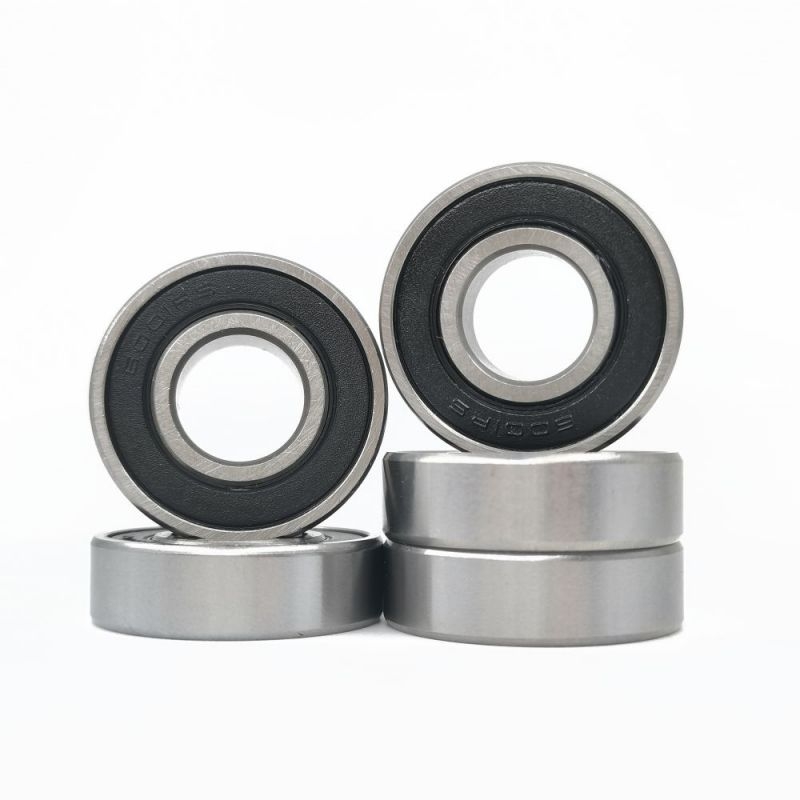
A deep groove ball bearing is a single-row radial rolling bearing whose inner and outer rings both carry a continuous, deep raceway groove. The grooves match the ball radius closely, so the bearing supports radial load, axial load in either direction, and combined load at high speed with low friction, low noise and almost no maintenance. It is non-separable, available open, shielded or sealed, and is the default choice for general-purpose rotating machinery.
Because the raceway grooves are deep and closely matched to the balls, Deep Groove Ball Bearings tolerate modest axial forces without any special arrangement. One bearing at each end of a shaft is often enough to locate a complete rotor. That simplicity explains why designers keep returning to Deep Groove Ball Bearings, from compact miniature sizes to large industrial sizes.
Every Deep Groove Ball Bearing is built from an inner ring, an outer ring, a set of balls and a cage. Seals or shields are added for protection. Each element offers choices that change cost, life, speed and noise, so a drawing that looks identical from the outside can behave very differently in service.
Turned from forged or rolled tube blanks, hardened, then ground on bore, faces and raceway. Bore accuracy and raceway roundness set how smoothly the bearing runs and how well it seats on the shaft.
Carries the outer raceway and, on sealed versions, the seal groove. Its outside diameter must hold tight tolerance to give a uniform fit in the housing. Variants include plain, snap ring groove and flanged outer rings.
Normally chromium steel balls in grades G10 to G28. A lower grade number means better sphericity and size consistency. Premium quiet-running motor bearings generally use G10 or better.
Separates the balls and guides them evenly around the raceway. The cage material controls friction, noise, temperature limits and how the bearing responds to vibration.
The groove radius in Deep Groove Ball Bearings is typically about 52 percent of the ball diameter. A tighter groove increases the contact area and raises load capacity, but it also increases friction and sensitivity to misalignment. Most designs settle close to the 52 percent value because it balances capacity with low torque. Assembly follows the eccentric (Conrad) method. The inner ring is shifted to one side, balls are loaded into the crescent-shaped gap, the balls are spread evenly, and the cage is fitted. This method limits the number of balls that fit, which is why Deep Groove Ball Bearings carry less radial load than filling-slot designs of the same size. In return, the uninterrupted raceway gives smoother running and better axial strength.
| Cage type | Temperature limit | Speed capability | Noise level | Typical use |
|---|---|---|---|---|
| Pressed steel (riveted or snap) | Up to 300 °C, limited by grease | Medium to high | Moderate | General machinery, pumps, gearboxes |
| Polyamide PA66-GF25 | -40 to +120 °C, peaks to 150 °C | High | Low | Household appliances, small motors, fans |
| Machined or pressed brass | Up to 250 °C | Medium to high | Moderate | Vibrating equipment, compressors, heavy-duty motors |
| PEEK | Up to 200 °C or higher | Very high | Low | Chemical exposure, high-speed spindles |
The designation printed on a bearing is a compact specification. The first digit gives the bearing type, where 6 means Deep Groove Ball Bearings. The next digit gives the dimension series (width and diameter series combined). The last two digits give the bore. From code 04 upward, multiply by 5 to get the bore in millimetres, so 05 means 25 mm, 08 means 40 mm and 12 means 60 mm. Four codes break this rule: 00 equals 10 mm, 01 equals 12 mm, 02 equals 15 mm and 03 equals 17 mm.
| Suffix | Meaning | Practical effect |
|---|---|---|
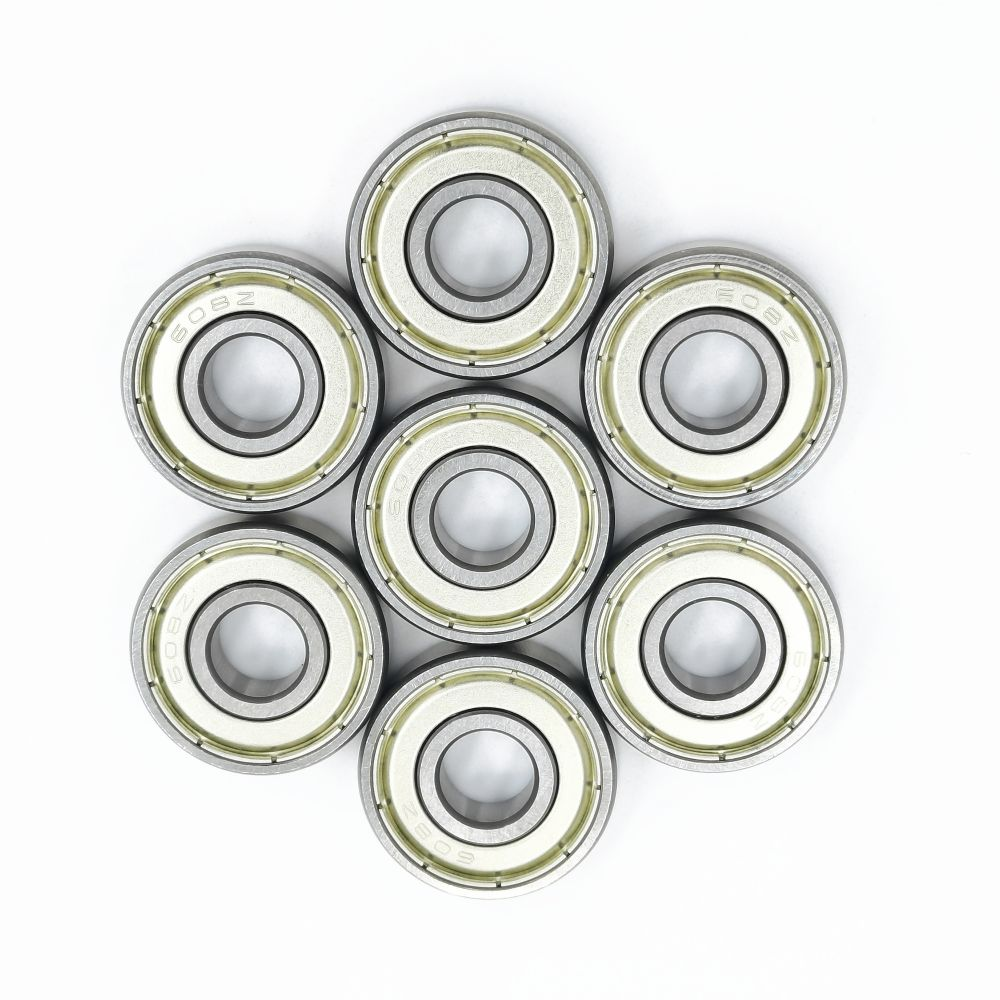
| Z / ZZ | Metal shield on one / both sides | Low friction, protection against coarse particles, no contact with the inner ring |
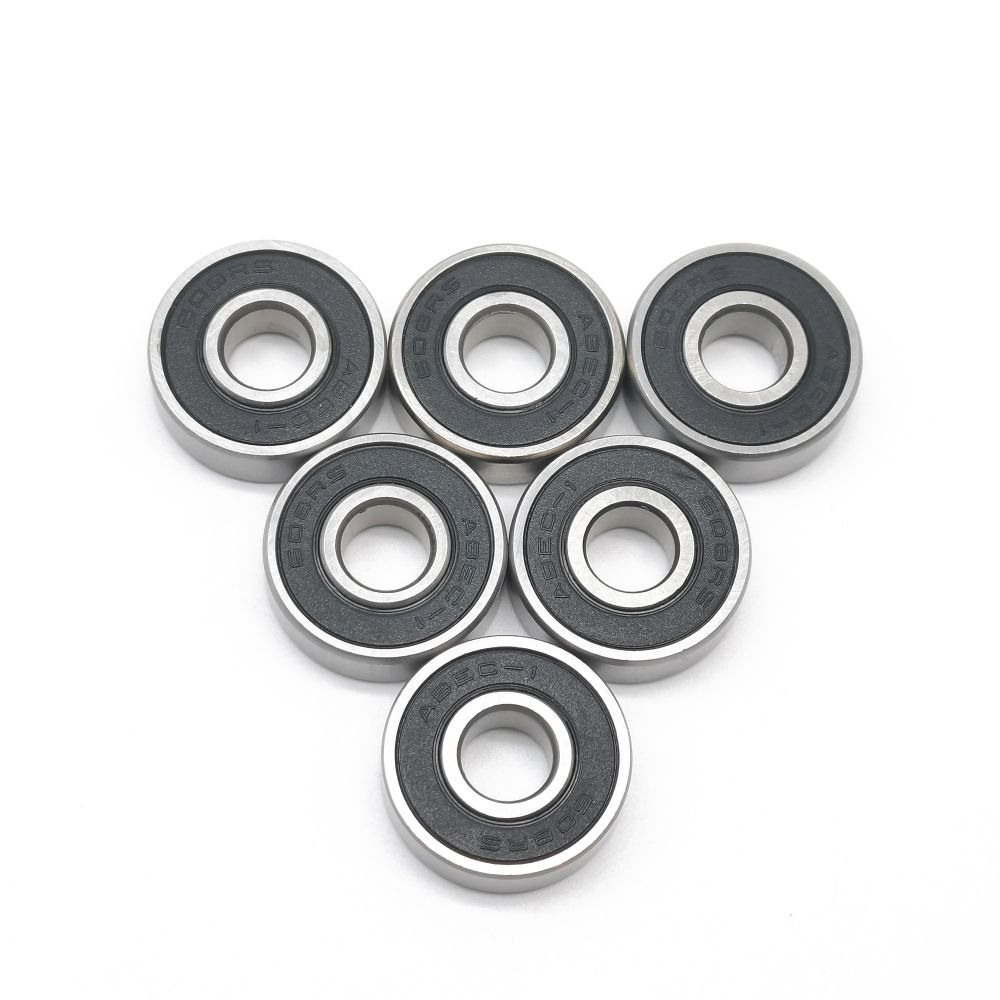
| RS / 2RS | Contact rubber seal on one / both sides | Better exclusion of dust and splash water, higher friction, lower speed limit |
| RZ / 2RZ | Non-contact rubber seal on one / both sides | Compromise between sealing and friction |
| C2, C3, C4 | Radial internal clearance smaller or larger than CN | Adjusts to fit, temperature and load conditions |
| P6, P5, P4 | Higher dimensional and running accuracy | Lower runout, quieter operation, higher achievable speed |
| N / NR | Snap ring groove / groove with snap ring | Axial location in the housing without a shoulder |
| Z3, V3 | Low-vibration grade marking | Selected for quiet applications |
| F prefix | Flanged outer ring | Simplifies housing design and axial positioning |
Deep Groove Ball Bearings, 02 diameter series, 20 mm bore, contact seals on both sides, clearance larger than normal. A very common specification for small electric motors and agricultural machinery.
03 diameter series, 25 mm bore, metal shields on both sides, tighter running accuracy. Suitable for gearbox input shafts and machine tool auxiliaries where speed is moderate and precision matters.
00 dimension series with 30 mm bore, non-contact seals on both sides. Chosen for blowers and fans that need a balance of sealing and low torque.
Many shaft sizes accept several Deep Groove Ball Bearings of different outer diameters. Moving to a heavier series increases ball size and width, which lifts load capacity, but it also increases mass, friction and the housing space required. The table below compares five series at a 25 mm bore. Values are typical catalogue-level reference figures; confirm against the approved drawing before final design.
| Designation | Series | d × D × B (mm) | Cr (kN) | C0r (kN) | Grease limiting speed (r/min) | Mass (kg) |
|---|---|---|---|---|---|---|
| 6905 | 69 extra light | 25 × 42 × 9 | 7.02 | 3.55 | 18000 | 0.06 |
| 6005 | 60 light | 25 × 47 × 12 | 10.1 | 5.85 | 16000 | 0.08 |
| 6205 | 62 medium | 25 × 52 × 15 | 14.0 | 7.88 | 13000 | 0.13 |
| 6305 | 63 heavy | 25 × 62 × 17 | 22.5 | 11.6 | 11000 | 0.23 |
| 6405 | 64 extra heavy | 25 × 80 × 21 | 38.0 | 23.2 | 8500 | 0.53 |
Dynamic capacity rises by more than five times from the 69 to the 64 series, while the limiting speed roughly halves. That trade-off drives the selection logic. Choose the 69 or 60 series where space is limited and loads are light. Choose the 62 series as the all-round default. Move to the 63 or 64 series when the calculated life of a 62 series is too short or when shock loads are expected.
The 60 series is widely used in appliance motors, power tools and compact gear units. The table lists commonly requested sizes.
| Designation | d (mm) | D (mm) | B (mm) | Cr (kN) | C0r (kN) | Mass (kg) |
|---|---|---|---|---|---|---|
| 6001 | 12 | 28 | 8 | 5.4 | 2.36 | 0.022 |
| 6002 | 15 | 32 | 9 | 5.6 | 2.8 | 0.030 |
| 6003 | 17 | 35 | 10 | 6.0 | 3.25 | 0.039 |
| 6004 | 20 | 42 | 12 | 9.4 | 5.0 | 0.069 |
| 6006 | 30 | 55 | 13 | 13.2 | 8.3 | 0.12 |
| 6007 | 35 | 62 | 14 | 16.0 | 10.3 | 0.16 |
| 6008 | 40 | 68 | 15 | 17.0 | 11.6 | 0.19 |
| 6010 | 50 | 80 | 16 | 22.0 | 16.2 | 0.26 |
Two load ratings appear on every datasheet for Deep Groove Ball Bearings. The basic dynamic load rating Cr is the constant radial load at which a group of identical bearings reaches a rating life of one million revolutions. The basic static load rating C0r is the load that produces a permanent deformation at the most heavily loaded contact of about 0.0001 times the ball diameter. Dynamic rating governs fatigue life. Static rating governs shock and standstill loading.
L10 = (Cr / P)³ × 10⁶ revolutions
L10h = L10 / (60 × n) hours
Cr = basic dynamic load rating, P = equivalent dynamic load, n = speed in r/min. The exponent 3 applies to ball bearings.
When only radial force acts, P equals Fr. When axial force is present, compare Fa/Fr with the factor e. If Fa/Fr is not greater than e, then P = Fr. Otherwise P = 0.56 Fr + Y Fa. The factors e and Y depend on the ratio f0·Fa/C0r, where f0 is a calculation factor listed in the product data.
| f0·Fa / C0r | e | X (when Fa/Fr > e) | Y (when Fa/Fr > e) |
|---|---|---|---|
| 0.172 | 0.19 | 0.56 | 2.30 |
| 0.345 | 0.22 | 0.56 | 1.99 |
| 0.689 | 0.26 | 0.56 | 1.71 |
| 1.03 | 0.28 | 0.56 | 1.55 |
| 2.07 | 0.34 | 0.56 | 1.31 |
| 3.45 | 0.38 | 0.56 | 1.15 |
| 6.89 | 0.44 | 0.56 | 1.00 |
The chart plots calculated L10 hours for a 6205 bearing (Cr = 14.0 kN) running at 1500 r/min. Because life follows a cubic relationship, a small increase in load cuts life sharply. Doubling the equivalent load from 2 kN to 4 kN reduces life by a factor of eight, from about 3,800 hours to about 480 hours. The vertical axis is logarithmic.
The viscosity ratio κ compares actual oil viscosity at operating temperature with the viscosity needed for a full film. Below κ = 1 the surfaces touch, and life drops below the calculated value. Between 1 and 4 a full film forms and life can exceed the basic rating. Clean oil or grease with a high-quality film is therefore worth as much as a larger bearing.
Balls skid instead of rolling when the load is too low, which smears the raceways. A practical guideline is to keep the radial load at or above about 1 percent of C0r. Lightly loaded fan and motor shafts often add a wave spring to provide this.
For continuous operation, keep axial load below about half of the radial load. Short peaks can be higher, but only if the static safety factor stays above 2 and the bearing is not already operating near its speed limit.
Speed capability in Deep Groove Ball Bearings depends on size, cage, lubricant and sealing. The speed factor dm·n, which is the pitch diameter in mm multiplied by r/min, is a convenient comparison number. Grease-lubricated steel-cage designs commonly run up to 400,000 to 600,000 mm·r/min. Oil mist, light preload and higher precision grades can raise that figure significantly.
The load-dependent friction torque of Deep Groove Ball Bearings can be estimated as M = 0.5 × μ × P × d, where μ is the friction coefficient (about 0.0015 for this bearing type), P is the equivalent load and d is the bore diameter. For a 6205 carrying 1.4 kN, M ≈ 0.5 × 0.0015 × 1400 N × 0.025 m ≈ 0.026 N·m. At 3000 r/min, this represents about 8 W of heat from load-related friction. Seal drag and grease churning add to the total, which is why sealed bearings run warmer than open ones at the same speed.
A stable operating temperature is usually 20 to 40 °C above ambient. Temperature that keeps climbing after the first hour of operation points to over-greasing, insufficient clearance, a seized seal or misalignment.
Radial internal clearance is the total distance one ring can move relative to the other in the radial direction before mounting. Interference fits on the inner ring expand the ring and the temperature gradient between the rings reduces clearance further. As a rule, operating clearance shrinks by about 70 to 80 percent of the effective interference at the inner ring seat. A bearing that has comfortable clearance on the bench can therefore run with almost none once mounted.
| Bore range (mm) | C2 (µm) | CN (µm) | C3 (µm) | C4 (µm) |
|---|---|---|---|---|
| 10 to 18 | 0 – 9 | 3 – 18 | 11 – 25 | 18 – 33 |
| 24 to 30 | 0 – 10 | 5 – 20 | 13 – 28 | 23 – 41 |
| 30 to 40 | 1 – 11 | 6 – 20 | 15 – 33 | 28 – 46 |
Typical radial clearance values for Deep Groove Ball Bearings following ISO 5753 groups. Verify against the drawing for the specific design.
| Operating condition | Shaft tolerance | Housing tolerance |
|---|---|---|
| Rotating inner ring, normal load | k5 or k6 (up to 100 mm) | H7 or J7 |
| Rotating inner ring, light load or small bores | j5 or js5 | H7 |
| Rotating inner ring, heavy or shock load | m5 or m6 | J7 or K7 |
| Stationary inner ring, load fixed in direction | g6 or h6 | H7 |
| Rotating outer ring (wheel hubs, idlers) | g6 or h6 | N7 or P7 |
| Floating bearing in a motor end shield | k5 or k6 | H7 or G7 |
Precision grade controls dimensional tolerance and running accuracy. Most Deep Groove Ball Bearings are supplied in P0 (normal) class. Higher classes P6, P5, P4 and P2 tighten bore deviation, radial runout and face runout. The values below apply to the 18 to 30 mm bore range.
| Grade | Bore deviation Δdmp (µm) | Inner ring radial runout Kia (µm) | Typical use |
|---|---|---|---|
| P0 (Normal) | 0 to -10 | 13 | General machinery, appliances, conveyors |
| P6 | 0 to -10 | 8 | Quiet motors, gearboxes, pumps |
| P5 | 0 to -8 | 4 | Machine tool auxiliaries, high-speed fans |
| P4 | 0 to -6 | 2.5 | Precision spindles, measuring equipment |
| P2 | 0 to -2.5 | 1.5 | Ultra-precision instruments |
The closure on Deep Groove Ball Bearings determines how long the grease stays in and how long contaminants stay out. The choice affects speed, torque and service life more than most users expect.
| Variant | Contact with inner ring | Dust protection | Moisture protection | Friction | Best application |
|---|---|---|---|---|---|
| Open | None | None | None | Lowest | Oil-lubricated gearboxes, clean enclosed housings |
| ZZ shield | No | Good for coarse dust | Poor | Very low | Electric motors, fans in clean environments |
| 2RZ | No (narrow gap) | Very good | Fair | Low | Blowers, medium-speed appliances |
| 2RS | Yes (lip) | Excellent | Good against splash | Moderate to high | Agricultural machinery, conveyors, outdoor equipment |
Oil-resistant, economical, with continuous service from about -30 to +100 °C and short peaks to 120 °C. The standard choice for most sealed Deep Groove Ball Bearings.
Handles continuous operation up to about 200 °C and resists many chemicals and synthetic lubricants. Chosen for high-temperature motors and aggressive environments.
Very low friction with strong chemical resistance. Suited to high-speed applications that still need a contact barrier against fine dust.
Factory-filled grease is the most common lubricant for Deep Groove Ball Bearings because it keeps the design simple and avoids oil circuits. The right grease depends on temperature, speed and exposure to water or chemicals.
| Grease type | Temperature range | Speed suitability | Characteristics |
|---|---|---|---|
| Lithium soap, mineral oil | -30 to +110 °C | Medium to high | General purpose, good water resistance |
| Lithium complex, mineral oil | -30 to +130 °C | Medium to high | Higher dropping point, suited to continuous duty |
| Polyurea, synthetic ester or PAO | -40 to +150 °C | High | Low noise, long life in sealed motors |
| Calcium sulfonate complex | -20 to +140 °C | Low to medium | Excellent water and corrosion protection |
| PFPE with PTFE thickener | -30 to +250 °C | Medium | Chemically inert, for extreme environments |
| H1 food-grade white grease | -20 to +120 °C | Medium | Incidental food contact allowed |
Filling the free space to 30 to 50 percent is typical. High-speed bearings usually work best with the lower end of that range, since too much grease raises churning losses and temperature. Sealed Deep Groove Ball Bearings are filled for life and should not be re-greased. Open bearings need periodic replenishment. The rule of thumb is that grease life halves for every 15 °C above 70 °C, as the chart shows.
Standard Deep Groove Ball Bearings use high-carbon chromium steel GCr15, equivalent to SAE 52100. For special environments, other materials trade hardness and capacity for corrosion resistance, weight savings or electrical insulation.
| Material option | Typical hardness | Corrosion resistance | Key characteristics |
|---|---|---|---|
| GCr15 / SAE 52100 | HRC 60 to 64 | Low (needs protective grease) | Highest load capacity, standard choice |
| Stainless steel 440C | HRC 58 to 60 | Good | Capacity roughly 20% lower than chrome steel, suited to washdown and humid areas |
| Hybrid, Si3N4 ceramic balls | Balls above HV 1500 | Good in the balls, rings still steel | Ball density 3.2 g/cm³ against 7.8 g/cm³, lower centrifugal force, electrical insulation |
| Insulated outer ring (Al2O3 coating) | As base steel | Same as base steel | Typically rated to 1000 V DC, protects against current passage |
A collar on the outer ring locates the bearing against the housing face. It reduces machining and simplifies axial positioning in small gear units and appliances.
A groove on the outside surface accepts a retaining ring, removing the need for a housing shoulder and shortening the assembly.
The inner ring is wider than the outer ring, giving more shaft contact and room for set screws or locking collars, a layout common in agricultural and conveyor units.
Bore sizes from 3 mm, used in medical devices, small motors and precision instruments. Light preload and low-torque grease are typical.
Stabilized rings, heat-resistant cage and special grease allow continuous operation above 200 °C, used near ovens, dryers and kilns.
Selected balls, refined raceway finish and quiet grease reach Z3 vibration grade, intended for household appliance and HVAC motors.
The table gathers typical starting specifications for common machines. Actual selection should be confirmed by load, speed and environment calculations.
| Application | Typical series | Closure | Clearance | Cage | Lubricant |
|---|---|---|---|---|---|
| Electric motor (0.75 to 7.5 kW) | 62, 63 | ZZ or 2RS | C3 | Steel or PA66 | Polyurea, ester oil |
| Centrifugal pump | 62, 63 | 2RS or open with oil | C3 | Steel or brass | Lithium complex |
| Cooling fan | 60, 62 | 2RZ | CN or C3 | PA66 | Low-noise ester grease |
| Gearbox input shaft | 62, 63 | Open or ZZ | CN or C3 | Steel or brass | Gear oil bath |
| Washing machine drum | 62, 63 | 2RS | CN | Steel | Water-resistant grease |
| Electric scooter hub | 60, 62 | 2RS | C3 | Steel | Lithium soap |
| Power tools | 60, 62 | ZZ | C3 | Steel or PA66 | Polyurea |
| Conveyor idler rollers | 62, 63 | 2RS | C3 | Steel | Calcium sulfonate |
Consistency in Deep Groove Ball Bearings comes from process control at every stage. The flow below follows a typical factory route from raw material to export packing.
Vacuum-degassed GCr15 bar is checked for chemistry, carbide network and non-metallic inclusions before ring blanks are forged or cut.
CNC lathes cut the ring profiles with controlled grinding allowance so that finishing removes a consistent layer.
Rings are quenched and tempered in controlled-atmosphere furnaces, and hardness and microstructure are sampled every batch.
Faces, bore, outer diameter and raceways are ground, then superfinished to reduce waviness and roughness that cause noise.
Rings and balls are matched into sets, cages are fitted, grease is dosed by weight and seals are pressed or crimped in place.
Vibration and torque checks, visual inspection, rust-preventive treatment and export packing complete the line.
| Inspection item | Method | What it protects |
|---|---|---|
| Bore, outside diameter, width | Air gauging and coordinate measuring | Correct fit on shaft and in housing |
| Roundness and waviness of raceways | Roundness tester and profilometer | Low vibration and noise |
| Hardness | Rockwell hardness tester | Fatigue life and wear resistance |
| Radial internal clearance | Clearance gauge with measuring load | Temperature rise and running smoothness |
| Vibration level | Anderon-type vibration tester | Z1, Z2 or Z3 grade confirmation (Z3 is the quietest) |
| Grease quantity | Weighing before sealing | Consistent torque and life |
| Starting and running torque | Torque tester | Seal drag and cleanliness |
| Appearance and rust protection | Visual and sample inspection | Condition on arrival after long transit |
When a standard part does not meet a specific machine requirement, Deep Groove Ball Bearings can be adapted in several areas without redesigning the whole bearing.
Special bore, outside diameter or width, extended inner rings and modified chamfers to fit existing shafts and housings.
Non-standard clearance windows and matched classes such as P6 running accuracy with C3 clearance.
Choice of grease type, fill level and low-noise or low-torque variants, including food-grade and high-temperature options.
Alternative seal materials and lip designs, plus PA66, brass, PEEK or steel cages.
Laser marking of designation, batch code, logo or customer part number on the ring face.
Individual boxes, tubes, plastic sleeves, bulk cartons, VCI anti-rust wrap and palletized loads suitable for sea or air shipment.
Most early failures are traced back to mounting rather than manufacturing. These steps address the most frequent mistakes.
Measure the shaft and housing with a micrometer and bore gauge. Remove burrs and check shoulder squareness before opening the package.
Do not wash greased bearings. Open the package only at the moment of mounting, and keep the work area clean.
Use an induction heater at 80 to 100 °C. Never exceed 120 °C, and never use an open flame.
Apply force to the ring that carries the interference fit. A sleeve contacting the whole ring face prevents force passing through the balls.
Turn the shaft by hand. It should rotate freely without catching, with no gritty feel and no axial play beyond design.
Track temperature, noise and vibration during the first running period. Temperature should plateau within an hour or two.
| Observation | Likely cause | Corrective action |
|---|---|---|
| Flaking on the raceway | Overload, contamination dents, or normal fatigue at end of life | Recalculate L10, improve sealing, move to a heavier series |
| Dull, smeared tracks | Thin lubricant film, low κ | Use a higher viscosity base oil and shorten the regreasing interval |
| Skid marks on balls | Load below minimum or sudden acceleration | Add spring preload, use lower-viscosity grease |
| Blue or brown discoloration | Overheating from tight fit or over-greasing | Select C3 clearance, reduce grease fill, check shaft and housing fits |
| Washboard pattern on raceways | Shaft currents from variable-frequency drives | Insulated bearings, shaft grounding |
| Cracked inner ring | Excessive interference or ring creep | Check shaft tolerance and avoid overheating during mounting |
| Cage damage | Vibration, misalignment or overspeed | Brass or PA66 cage, improve alignment |
| Rust spots | Moisture entering during idle periods | Contact seals, corrosion-protective grease, stainless option |
Gathering the following details at the start shortens the selection process and avoids repeated revisions.
Radial and axial forces, direction, peak and continuous values, and whether shock is present.
Normal and maximum r/min, and whether the machine starts and stops frequently.
Ambient range, expected housing temperature and any nearby heat sources.
Dust, water, chemical vapour, washdown or vacuum conditions.
Materials, tolerances, shoulder dimensions and axial space.
Required vibration or sound level, and any preload spring in the design.
Required hours, duty cycle and acceptable maintenance interval.
Presence of inverter drive, shaft voltage or need for insulated bearings.
ZZ means a metal shield that does not touch the inner ring, so friction is minimal and speed capability remains high. 2RS means contact rubber seals, which block fine dust and moisture more effectively but increase friction and lower the speed limit. ZZ suits clean, fast applications, while 2RS suits dirty or wet environments.
They accept axial load in both directions, but their strength is radial load. For continuous service, keep axial load below roughly half of the radial load. Where axial load dominates, angular contact ball bearings are the better choice.
C3 is the usual choice. Interference fit on the shaft and heat generated during running both reduce clearance, and C3 leaves enough room so that the operating clearance does not become negative.
Match bore, outside diameter and width first, then confirm closure type, clearance class, cage material, precision grade and grease type. Two parts with the same base number can behave very differently if these suffixes differ.
Common reasons are a misaligned housing, a bent shaft, hammering during mounting, dirt on the seat or excessive preload. Grease distribution noise during the first minutes of running is normal and usually fades quickly.
No. Sealed units are filled for life. Washing removes the factory grease and introduces contamination. When the grease is exhausted, the bearing should be replaced.
Yes. Retain the lubricant with seals and place a light spring preload on the lower or upper bearing to keep the balls under load and prevent skidding.
Use an insulated outer ring or ceramic-ball hybrid bearing on the non-drive end, and fit a shaft grounding ring on the drive end. This stops current passing through the rolling contact and prevents fluting.
P6 has tighter running accuracy. For a 25 mm bore, inner ring radial runout is limited to 8 µm instead of 13 µm. The result is smoother operation and slightly higher usable speed, which matters in quiet gearboxes and precision motors.


Products
CONTACT Us
Mobile Site
Copyright© Zhejiang Yingfei Biotechnology Co., Ltd. All Rights Reserved
 Wholesale Motorcycles/Cars Vehicles Bearing Source Factory