
 0
0

 English
 Español
 中文简体
中文简体 عربى
عربى
Industry News
Home / News / Industry News / What Are Ball Bearings Used For? Applications, Materials, and Selection Guide

2026-09-28
Ball bearings are used wherever a machine needs something to spin smoothly under load: electric motors, washing machines, refrigerators, power tools, car alternators, water pumps, conveyor rollers, office chair casters, sliding doors, baby strollers, skateboards, and toys. In every one of these products the bearing does the same two jobs. It cuts rotational friction to a small fraction of what sliding contact would produce, and it carries radial and axial loads so that shafts, wheels, and drums stay precisely positioned while they turn.
This guide is written from the factory floor rather than from a textbook. We produce deep groove ball bearings in chrome steel, carbon steel, AISI 304 and AISI 440C stainless steel, together with plastic-coated, polyurethane-coated, and flanged versions, at an annual output of roughly 30 million sets under an ISO 9001:2015 certified quality system. The sections below explain where ball bearings are actually used, why certain materials and seals appear in certain environments, and how to match a bearing to a real application before placing an order.
A ball bearing is a simple assembly: an inner race, an outer race, a set of hardened and ground steel balls, usually a cage to keep the balls evenly spaced, and in most designs a shield or seal on each side. Because the balls roll instead of slide, the friction inside a well-made rolling bearing typically sits around a coefficient of 0.001 to 0.005, roughly two orders of magnitude lower than dry sliding contact between steel surfaces. That single difference is why an electric motor can run for years, a treadmill roller stays cool, and a stroller can be pushed with one hand.
The second job is load support. A radial load pushes perpendicular to the shaft, like the weight of a conveyor roller or the belt pull on a motor. An axial load pushes along the shaft, like the thrust of a fan blade or a helical gear. A deep groove ball bearing, the most widely used type in the world, carries both at once, which is a major reason it has become the default choice for everything from household appliances to industrial gearboxes.
The fastest way to understand the question "what are ball bearings used for" is to walk through the products around you. Almost every one of them hides several small bearings doing quiet work. The map below covers the application areas we ship into most often, and each one links back to a specific bearing family in our catalog.
Deep groove bearings support the rotor at both ends in fractional-horsepower and industrial motors. Low-noise grades and motor-grade speed capability decide how the finished motor sounds and how long it lasts.
Washing machine drums, refrigerator compressor motors, vacuum cleaners, ceiling fans, and range hoods all rely on sealed bearings sized around the 608, 6201, and 6203 families, selected mainly for quiet running.
Alternators, belt tensioners, idler pulleys, water pumps, and the growing fleet of auxiliary motors in electric vehicles use bearings built to survive heat, vibration, and mixed radial-axial loads.
Condensation and splash make moisture the main enemy here. Stainless rings, waterproof sealing, and the right grease matter more than raw load rating.
Treadmill rollers, exercise bike flywheels, rowing machine seats, and every skateboard wheel set use smooth-running bearings, often 608 size, where silence and consistency are felt directly by the user.
Plastic-coated bearings with U-groove or V-groove treads roll quietly along tracks, protect surfaces, and match interior colors while the steel core carries the weight.
Small sealed bearings in the wheel hubs keep strollers easy to push and quiet on pavement, with corrosion protection for outdoor storage and cleaning.
Printers, copiers, shredders, and projectors use miniature and flanged bearings in paper transport and cooling fans, where exact positioning and low noise are required in very compact spaces.
Gravity and powered roller conveyors consume bearings by the tens of thousands, typically 608 or 6201 with spring-loaded axles, plus polyurethane-coated versions where loads are heavy or noise limits are strict.
Fidget spinners, RC cars, and ride-on toys use miniature bearings, frequently in stainless steel so that moisture, handling, and outdoor play do not cause rust.
Washdown-rated stainless bearings and acid-and-alkali-resistant designs survive frequent cleaning, salt, and mild chemicals that would destroy ordinary chrome steel bearings quickly.
If you ask which application consumes the most ball bearings worldwide, small electric motors and household appliances sit at the top of the list. Deep groove ball bearings dominate here because they handle both radial and axial load in one compact ring set, they run with low starting torque, they can be sealed and greased for life, and they are economical at very high volumes.
In appliances, noise is usually the deciding specification, not load. A washing machine that hums at 2 a.m. gets returned; a drum bearing that is one vibration grade louder than its neighbor is a defect. This is why appliance makers specify low-noise and low-vibration bearing grades, often marked Z1, Z2, Z3 or V1, V2, V3, and why bearing factories measure every batch rather than sampling. Motors that spin fast, such as two-pole designs, additionally need motor-grade bearings with controlled internal geometry so that heat and centrifugal force do not shorten grease life.
Dimensionally, the industry is remarkably standardized. The table below shows the deep groove sizes that appear again and again in motors, appliances, and light machinery.
| Size | Dimensions (mm) | Typical applications |
|---|---|---|
| 608 | 8 x 22 x 7 | Small fans, skateboards, fidget spinners, caster wheels, toy drives |
| 6001 | 12 x 28 x 8 | Small electric motors, ceiling fans, light-duty pulleys |
| 6201 | 12 x 32 x 10 | Power tools, small gearboxes, exercise equipment, conveyor rollers |
| 6203 | 17 x 40 x 12 | Alternator-class components, treadmill rollers, larger appliance motors |
| 6302 | 15 x 42 x 13 | Water pumps, larger motors, gear drives with heavier radial loads |
The same size can carry very different loads depending on series. The chart below compares typical catalog dynamic load ratings of the sizes above, indexed to the 608 as 1.0, which is why a washing machine maker will not simply specify a 608 where a 6203 fits the shaft.
Typical dynamic load rating by size, indexed to 608 = 1.0
Approximate ratios based on typical catalog values for chrome steel, ZZ construction; exact ratings vary with seal, cage, and manufacturer.
Under the hood and inside factory machinery, the working conditions change. Temperatures climb, vibration never stops, and loads arrive in combination rather than in one clean direction. Alternators and cooling fan motors use medium deep groove sizes in the 6202 and 6203 class, sealed against splash and filled with grease that survives sustained heat. Belt tensioners and idler pulleys frequently use bearings with extended inner rings, so the pulley hub bolts onto a longer inner ring instead of pressing onto the bearing bore, which speeds assembly and protects the sealing faces.
Machine builders add their own demands. Gearboxes combine heavy radial load with axial load from helical gearing, so double row deep groove bearings or deep groove bearings paired in duplex arrangements appear where a single row would be marginal. Electric vehicles have quietly multiplied the number of small motor applications per car: coolant pumps, oil pumps, sunroof drives, seat adjusters, and turbo blower fans each carry one or two compact bearings chosen for low noise and long sealed-for-life service. In all of these cases the bearing material is usually hardened chrome bearing steel, because fatigue life under vibration matters more than corrosion resistance, and the closure system is engineered for the specific temperature and contamination profile of the location.
Ask any service technician what kills pump bearings first and the answer is rarely overload. It is water. Condensation forms inside housings overnight, splash enters through shaft openings, and outdoor fan motors drink humid air for years. Water washes the grease film off the raceways, and once metal touches metal without lubrication, microscopic welding and spalling follow within weeks. A bearing that is correctly sized for load can still fail early purely because the closure and material were chosen as if the environment were a clean, dry workshop.
This is why pump and fan applications split into two engineering paths. Where the environment is only moderately humid, a chrome steel bearing with rubber seals and a waterproof, well-adhered grease is usually enough. Where water, steam, or cleaning chemicals are constant, the rings and balls move to stainless steel, and heat-resistant stainless versions take over near ovens, dryers, and engine bays where ordinary seal material would harden and crack. Compressors add oil mist and elevated temperature to the mix, which pushes the selection toward shields combined with high-temperature grease rather than rubber lips that can swell in oil. The lesson for buyers is simple: define the moisture, chemical, and temperature profile of the installation before comparing prices, because those three factors, more than load, decide which bearing family will actually reach its rated life.
"Stainless bearing" is a phrase that hides a real engineering decision. Our two most common stainless grades behave very differently in service. AISI 440C is a hardenable stainless steel that reaches roughly 58 to 60 HRC after heat treatment, so it carries loads nearly like chrome bearing steel while resisting rust far better. It is the workhorse for pumps, marine equipment, and machinery exposed to frequent washdown. AISI 304, by contrast, cannot harden by heat treatment; it is softer and carries lighter loads, but its corrosion resistance, especially against many acids and chlorides, exceeds that of 440C. It suits food handling equipment, laboratory devices, and applications where chemical exposure matters more than heavy loading.
Beyond the bare material, coatings extend the concept. Plastic-coated and polyurethane-coated bearings put a corrosion-proof, quiet, non-marking layer over a steel core, which is why they appear in food conveyors where metal-to-product contact is unwanted, and in chemical dosing equipment where acid-and-alkali-resistant designs are specified. One purchasing note that is often missed: in true food contact areas, the lubricant matters as much as the steel, so food-grade bearings are normally supplied with appropriate food-compatible grease, not just stainless rings.
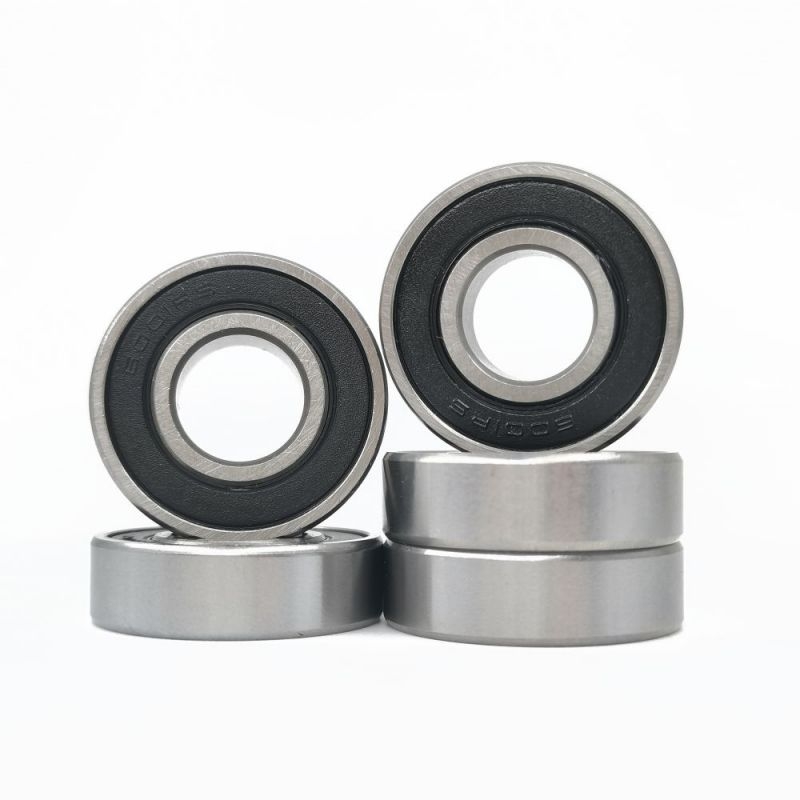
Typical part for this job S608RS Stainless Steel Double Rubber Sealed Deep Groove Ball Bearing Same 8 x 22 x 7 footprint as a standard 608, rebuilt in stainless steel with double rubber seals for pumps, washdown equipment, and humid outdoor locations. Stainless steel rings and balls - RS rubber seals both sidesSlide a glass wardrobe door or a well-built sliding window and you are feeling a ball bearing through a plastic tread. Furniture and architectural hardware is one of the most interesting application areas because the bearing itself is rarely visible; what the user experiences is the coating. Plastic-coated bearings in the BS series, with nylon or similar outer layers molded directly over a 608, 626, or 625 core, roll along U-groove tracks in sliding doors and V-groove tracks in window systems. The plastic layer damps vibration, so the door glides instead of rattling, and it protects aluminum and wood profiles from wear.
The same logic spreads across home hardware. Drawer and cabinet mechanisms use small coated bearings for silent travel. Furniture casters combine a steel bearing core with a soft outer layer so chairs move easily without scratching wooden floors. Shower doors and bathroom cabinets specify plastic or stainless combinations because constant humidity would corrode bare chrome steel. Color also becomes a functional choice in this market: white, black, and orange coated bearings let furniture and window manufacturers match hardware to the product design, something a bare steel bearing can never do. For these applications, load ratings are modest, but noise, coating adhesion, and dimensional consistency across tens of thousands of pieces are what separate an acceptable part from a good one.
Walk along any distribution center or production line and you are looking at hundreds of roller conveyors, each roller carrying one or two bearings, usually the 608 or 6201 size pressed onto a spring-loaded axle. The economics of material handling run on these small parts. Gravity rollers use double-shielded bearings greased for life, because a conveyor with 500 rollers cannot be maintained bearing by bearing; the parts must simply run until the line is serviced. Powered rollers and curves add polyurethane-coated bearings, where the PU tread grips driven belts, cushions the impact of packages landing on the line, and keeps noise inside warehouse limits.
Heavier duties move up the product ladder. High-load polyurethane bearings with thicker treads carry palletized goods and heavier cartons; abrasion-resistant formulations survive dirty, gritty environments where soft treads would wear away in months; shock-absorbing versions sit at loading docks and transfer points where impacts arrive constantly. Because coating thickness changes the effective outer diameter, conveyor builders order coated bearings by overall tread size, not by the steel core alone, which is a small detail that prevents assembly problems on the line. When a customer sends us a roller drawing, the questions that matter most are tread material, tread thickness, load per roller, and speed, in that order.
Typical part for this job PU608 267 PU Coated Deep Groove Ball Bearing A 608 core molded in a polyurethane tread for conveyor rollers, quiet wheels, and material handling points that need grip and surface protection. 608 steel core - polyurethane outer tread - multiple tread sizes availableConsumer products expose bearing quality directly to the end user, which makes this group unusually sensitive to consistency. A treadmill contains several bearings across its deck rollers and drive system, typically in the 6001 to 6203 range, and any vibration grade variation between rollers shows up as a rhythmic hum under the runner's feet. Spin bikes and rowing machines add high load cycles and, in the case of rowing seat rollers, plastic-coated bearings running on rails, where U-groove geometry must match the rail profile exactly or the seat will feel loose.
Baby strollers apply the same expectations to a different environment. Wheel hub bearings, often 608 or 695 sizes, must push smoothly with one hand, stay quiet on rough pavement, and survive rain, sidewalk grit, and storage in damp garages, so sealed stainless or well-sealed chrome versions are both common, and stroller brands treat corrosion stains as a warranty issue, not a cosmetic one. Toys round out the category: fidget spinners made the 608 a household part, RC cars run miniature bearings at surprisingly high rpm, and outdoor ride-on toys increasingly specify stainless steel bearings because rust from rain and dew produces both a performance failure and a safety complaint. Across all three markets, the purchasing pattern is the same: moderate loads, strict noise limits, and a premium on batch-to-batch consistency, which is exactly what a quality-system-controlled production line is designed to deliver.
Application area narrows the choice, but the final selection usually comes down to material. Each of the five families below has a clear economic and technical territory, and the most expensive option is not automatically the correct one. Carbon steel, for example, is the right answer for a light-duty caster; specifying AISI 440C there would raise cost without extending service life, because the failure mode in that caster is never corrosion.
| Material | What it offers | Typical applications | Watch-outs |
|---|---|---|---|
| Chrome bearing steel | High hardness and fatigue life, the standard for rotating machinery | Motors, power tools, automotive components, gearboxes, conveyor rollers | Rusts quickly when wet; needs seals and grease protection |
| Carbon steel | Economical, adequate hardness for light loads and low speeds | Light-duty casters, toys, furniture hardware, low-cost hand rotations | Shorter fatigue life; avoid high speed and heavy loads |
| AISI 304 stainless | Strong general corrosion resistance, washdown friendly | Food handling equipment, humid environments, chemical exposure areas | Softer than hardened grades; lower load capacity |
| AISI 440C stainless | Hardenable to roughly 58-60 HRC, combines load capacity with rust resistance | Pumps, marine equipment, outdoor machinery, corrosive process lines | Higher cost; chlorides can still attack it over time |
| Plastic or PU coating over steel core | Quiet running, surface protection, grip, color options | Sliding doors, windows, furniture casters, conveyor and stroller wheels | Temperature limits; tread wear is the life-limiting factor |
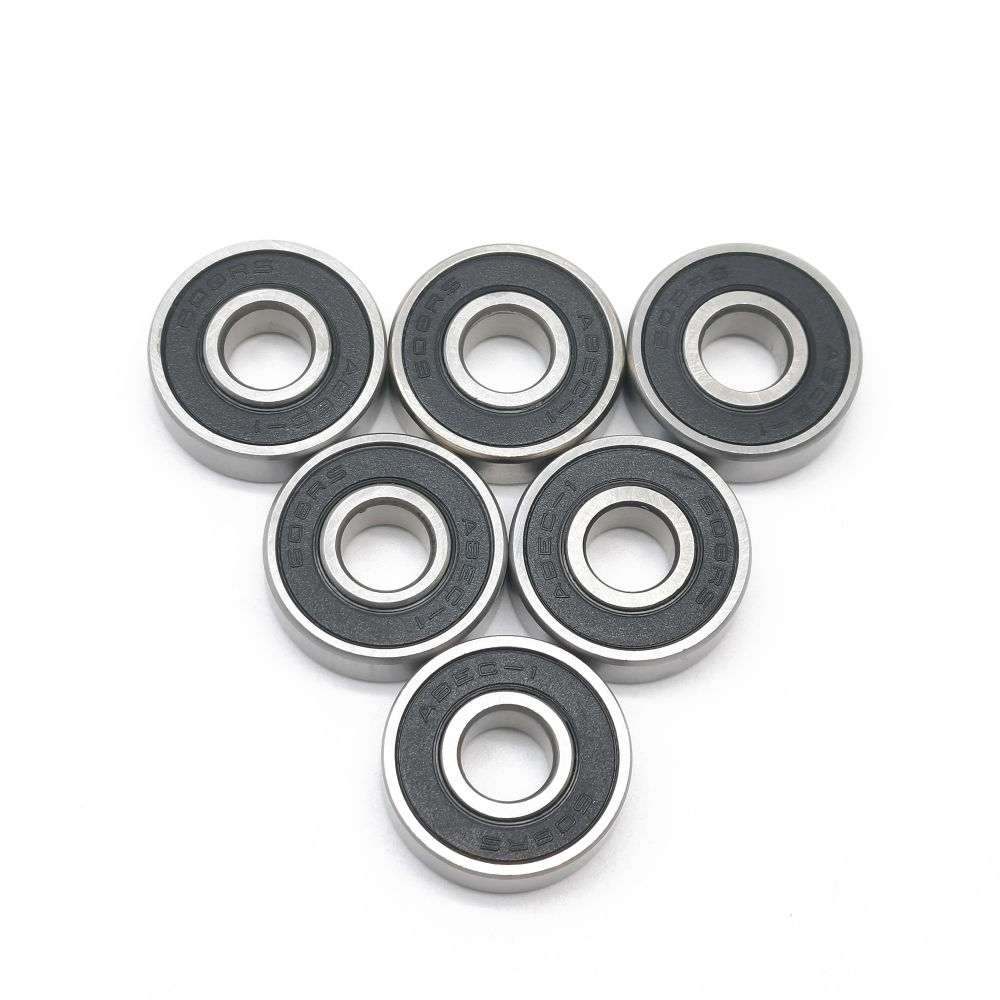
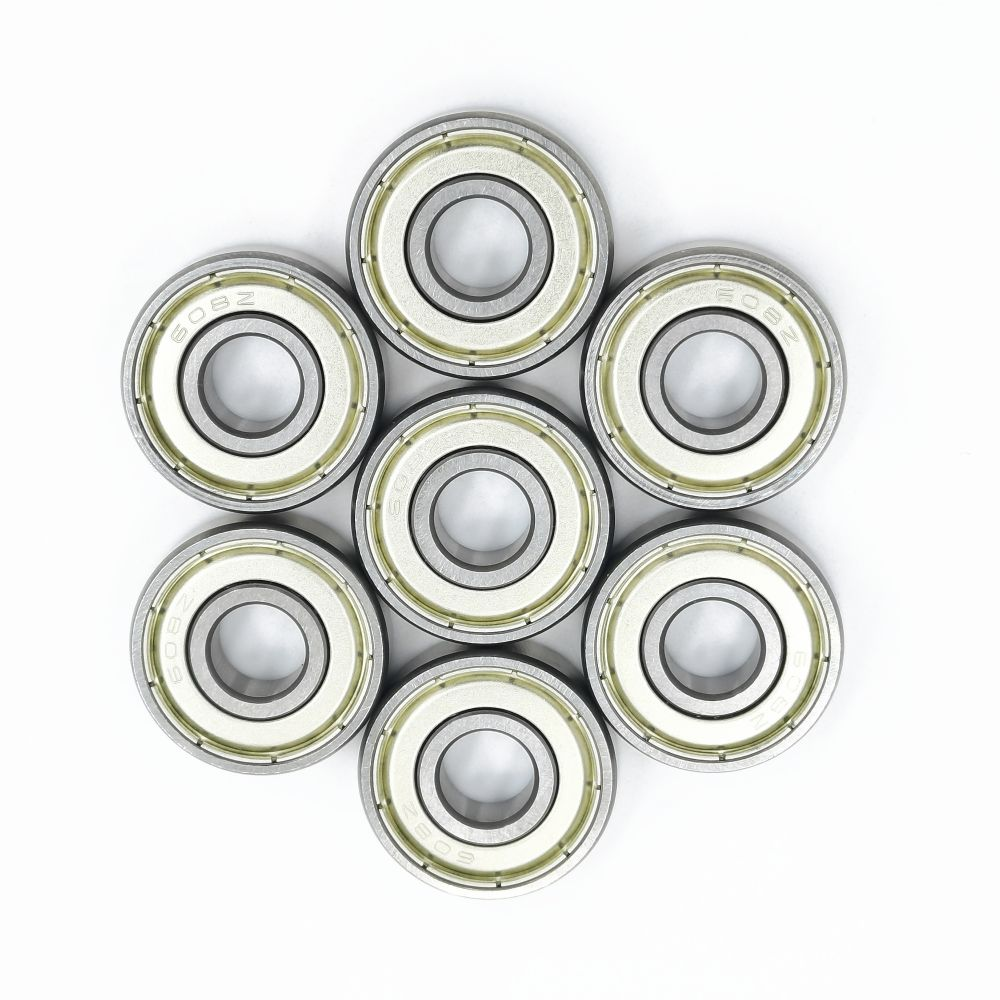
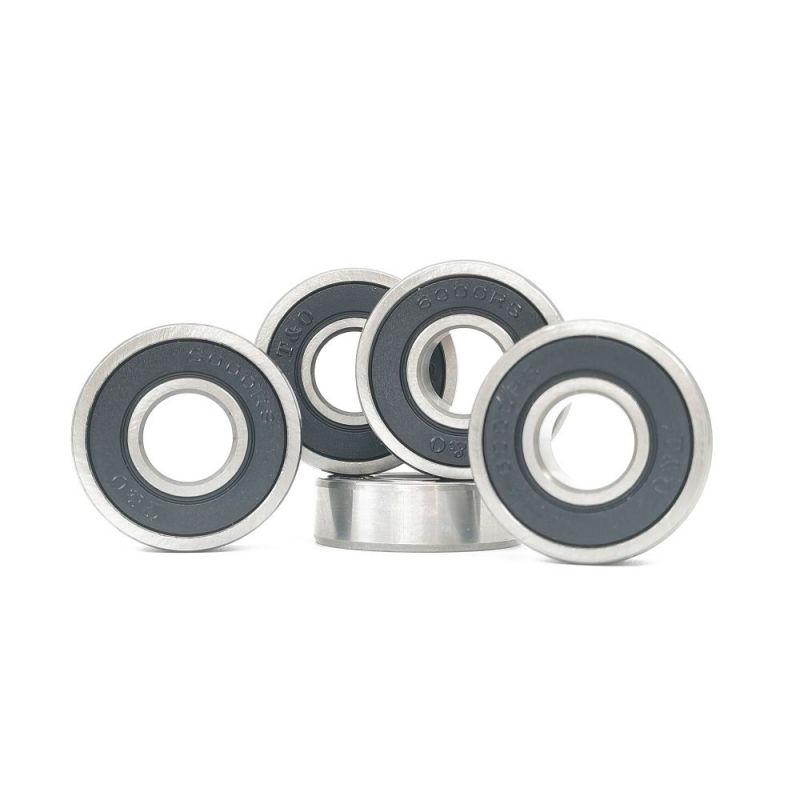
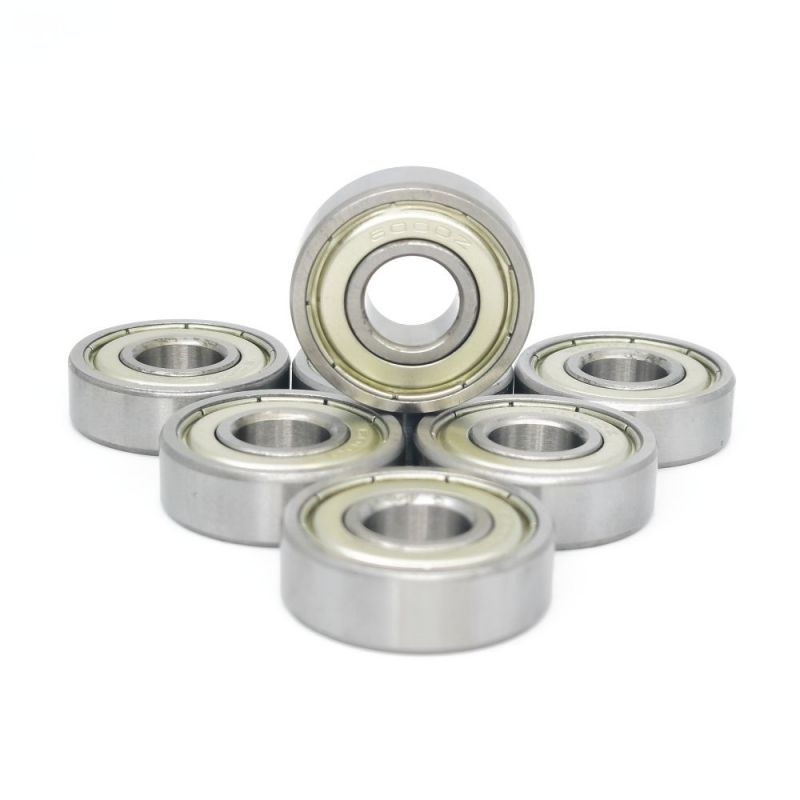
The suffix on a bearing part number tells you how the bearing defends itself, and this choice changes service life more than almost any other decision. Open bearings have no protection at all; they expect the machine to supply clean lubrication, as in gearboxes and machine tool spindles with oil systems. ZZ bearings carry pressed steel shields on both sides: grease stays in, large chips stay out, and fine dust can still pass the shield gap, but torque stays low and heat tolerance is high because nothing rubber is involved. RS bearings, or 2RS when double rubber sealed, use contact lips that exclude water and fine dust almost completely and hold grease for the life of the part, at the cost of slightly higher torque and a temperature ceiling set by the seal material, roughly between minus 30 and plus 120 degrees Celsius for standard nitrile rubber.
Appliance and automotive engineers frequently mix the two, specifying one shield and one seal where the contaminated side is known. If you want the deeper engineering detail, our article on how the sealing system in deep groove ball bearings prevents contamination and extends service life covers grease retention, lip contact, and contamination paths in full.
Lowest friction, needs external lubrication supply. Correct for oil-bath gearboxes and spindles where the machine handles cleanliness.
Grease for life, blocks large debris, tolerates higher temperatures, lowest sealed-type torque. Fine particles can still enter.
Best exclusion of water and dust, greased for life, slightly higher torque, limited by seal temperature range.
Relative starting torque by closure type, illustrative index
Illustrative comparison for small deep groove bearings; actual values depend on seal design, grease, and speed.
Four specifications turn an application description into an order. The first is load. Every bearing carries a basic dynamic load rating, usually written C, and ball bearing life follows a cubic law: if the equivalent load on the bearing is halved, the theoretical L10 life rises roughly eight times. This is why undersizing is so punishing in conveyor and fitness applications, and why a modest size increase is often the cheapest reliability upgrade available.
The second is speed. Speed capability depends on internal geometry, cage type, lubricant, and closure, and it is the reason motor-grade bearings exist as a distinct selection: two-pole motors and high-speed tools need controlled raceway geometry and grease that does not shear apart at high rpm. The third is noise and vibration, expressed in grades such as Z1, Z2, Z3 or V1, V2, V3. For appliances, strollers, and office equipment, the noise grade is effectively a functional requirement, not a bonus, and it is verified on vibration measuring equipment before shipment, batch by batch.
The fourth is internal clearance, the tiny designed slack between balls and raceways. Standard clearance suits ordinary conditions, but a bearing pressed onto a shaft and running hot, as in most motors, loses internal clearance as the inner ring expands, so clearance class C3 is commonly specified there. Precision classes such as P6 and P5 matter mainly for spindles and high-speed equipment. None of these numbers is exotic; they are simply the difference between ordering a part that works and ordering a part that fails at half its rated life.
A large share of real applications cannot be satisfied by a standard catalog part, and this is where working directly with a manufacturer changes the outcome. The most common modification is the extended inner ring: a pulley or roller manufacturer needs the inner ring to protrude on one or both sides so the component clamps onto the ring instead of the balls taking assembly stress. Our non-standard line includes exactly these parts, from a 608ZZ with the inner ring extended 1 mm on each side to a 6201ZZ extended 12 mm on one end and 6 mm on the other, and a 695ZZ with a 10 mm single-end extension for compact idlers.
Structure is the next lever. Double row configurations, such as our 6262Z non-standard bearing, combine higher radial capacity with better moment load behavior in one narrow package. Diecast aluminum parts bonded to a 608RS create ready-to-mount assemblies for door and appliance builders. Inch-dimension flanged bearings in the FR series drop into American-designed equipment where metric parts will not fit, and flanged bearings in general solve the mounting problem of attaching a bearing to a thin sheet-metal panel with screws. Coatings extend the same flexibility to surfaces: nylon, PU, and rubber treads in custom thicknesses, U-groove and V-groove profiles cut to match a customer's rail, and colors matched to a product line.
Behind these options sits the part buyers cannot see: grinding tolerance control for P6-class work, batch traceability under ISO 9001:2015, incoming material inspection of every steel supplier lot, and noise grading on measured production. For customers whose shafts and housings do not match any catalog dimension, our customized non-standard precision bearings program turns a drawing or a physical sample into a production part, with sample runs for validation before volume manufacturing. The practical advice for any buyer is to ask early what a factory can modify, because a 1 mm ring extension ordered with the bearing is far cheaper than a machined adapter ordered after the fact.
Most premature bearing failures trace back to a specification that was guessed rather than measured. Before ordering, work through the following list; it takes minutes and eliminates the majority of returns and warranty disputes we see.
Bearing failures are rarely mysterious; the damage pattern on the raceway usually names the cause. Dents and gray, matte patches indicate contamination, meaning the closure choice or surrounding sealing was inadequate for the dust in that environment. Flaking and spalling point to fatigue, either normal end of life or overload, and the cubic load-life relationship means a modest overload cuts life dramatically. Brinelling, round dents spaced at ball pitch, comes from impact or from hammering a bearing into place instead of pressing it, which is an assembly practice issue rather than a part defect.
Heat discoloration and stiff, darkened grease reveal lubrication breakdown, common when a standard-grease, rubber-sealed bearing was installed near a heat source that demanded a high-temperature version. Corrosion streaks trace directly to moisture that the material or sealing was never chosen to handle. One modern pattern deserves special mention: washboard-like fluting on raceways in inverter-driven motors, caused by electrical currents passing through the bearing, which machine builders address through grounding rings, insulated housings, or hybrid bearings at the design stage. Every one of these failure modes maps back to a selection decision in the checklist above, which is why we treat a customer's environment description as seriously as their dimensions.
Electric motors of every size, washing machines and refrigerators, power tools, ceiling fans, car alternators, water pumps, skateboard and stroller wheels, office chair casters, sliding doors, conveyor rollers, and fidget spinners all rely on ball bearings, most of them deep groove designs in standardized metric sizes.
Yes. This is the defining advantage of the deep groove ball bearing, which carries radial load plus a meaningful axial load in both directions. Thrust ball bearings handle axial load only, and angular contact designs handle combined load mainly in one axial direction, usually installed in pairs.
Quiet operation is the requirement. Appliance makers specify low-noise, low-vibration bearing grades, verified on vibration measuring equipment, because a drum or compressor bearing one grade too loud is audible in a quiet home. Sealed, greased-for-life construction is also standard since consumers never service these parts.
For splashing water, rain, and humidity, AISI 440C stainless steel with rubber seals is the usual choice because it keeps hardened-steel load capacity while resisting rust. For chemical exposure or frequent chemical washdown, AISI 304 or coated bearings often last longer due to stronger resistance to specific acids and alkalis.
ZZ means two metal shields: grease stays in, big debris stays out, torque stays low, and higher temperatures are tolerated. 2RS means two contact rubber seals: water and fine dust are excluded far better, at slightly higher torque and a temperature ceiling around 120 degrees Celsius for standard seals. Choose ZZ for clean, warm, fast locations and 2RS wherever moisture or dust is present.
At a constant load, life follows the cubic law: halving the load multiplies theoretical life by about eight. In practice, a correctly selected, sealed, greased bearing in an appliance or motor routinely runs for the life of the product, while contaminated, overloaded, or starved of grease fails in a fraction of rated life. The rating assumes clean lubrication and proper fitting, which is why application matching matters more than the catalog number.
Yes. Extended inner rings, double row constructions, special flanges, custom groove profiles, coated treads, and non-standard sizes are all standard factory work, usually starting from a drawing or a sample. Ask for a sample run first so the fit, noise, and coating can be validated on your line before volume production begins.
Every product listed above, from a bare 608ZZ to a custom grooved roller bearing, is manufactured on our own lines in chrome steel, carbon steel, and stainless steel, with batch inspection under ISO 9001:2015 and an annual capacity of about 30 million sets. If you are matching a bearing to a new design, or replacing a part that keeps failing in the field, send us the dimensions, the environment, and the load conditions. Our engineers will propose the correct series, material, closure, and any custom features, arrange samples for testing, and support shipments to Europe, the Americas, Southeast Asia, Africa, and domestic customers from a single production source.


Products
CONTACT Us
Mobile Site
Copyright© Zhejiang Yingfei Biotechnology Co., Ltd. All Rights Reserved
 Wholesale Motorcycles/Cars Vehicles Bearing Source Factory