
 0


 English
 Español
 中文简体
 عربى
Industry News
Home / News / Industry News / PU Bearings: Polyurethane Coated Bearing Types, Materials, and Selection Guide

2026-11-03
A PU bearing is a deep groove ball bearing with a polyurethane layer molded over the outer ring. The inner ring, balls, and cage carry the rated radial and axial load. The polyurethane shell does what steel cannot: it dampens noise, absorbs shock, protects the running surface, and increases the rolling diameter without adding a separate wheel. In practical terms, one PU bearing can replace one steel bearing plus one plastic or rubber wheel in conveyors, sliding doors, furniture, and light vehicle applications.
The internal load path is identical to a standard deep groove bearing. Chrome steel (GCr15/SUJ2) is the default core material; carbon steel cores are used for lower-load door rollers and furniture fittings, and stainless steel cores (304 or 440C) are available when the bearing must survive washdown or corrosive conditions. The polyurethane is molded directly against the outer ring, so the bond between steel and PU carries the contact pressure. A well-bonded layer does not peel under side loads, and the coating can wrap around the side faces as well as the outside diameter, increasing the total width compared with the bare bearing.
Part numbers usually tell you the dimensions. PU608-267 means a 608 series core with an 8 mm bore and a 22 mm steel outer diameter, a finished polyurethane outer diameter of 26 mm, and a finished width of 7 mm. PU608-3010 is the same 8 mm bore with a 30 mm PU outer diameter and a 10 mm width. Once you decode the model, you know the shaft size, the running surface size, and the envelope without opening a catalog.
Choose PU bearings when the track demands quiet operation, the product needs a soft contact surface, or the rolling diameter has to be larger than the steel bearing outer diameter. If neither of those factors matters, a standard steel bearing costs less and runs at higher speed.
Polyurethane occupies the middle ground between rubber and plastic. It has the elasticity to absorb impacts but far better resistance to tearing and wear than natural rubber. It offers the hardness options of thermoplastics but recovers from point loads that permanently dent nylon or polypropylene. That combination is why engineering teams select PU for roller treads, guide wheels, and caster coatings.
The most useful specification is Shore hardness. Soft compounds in the 60–70 Shore A range produce a quiet, high-grip contact that protects finished floors. Mid-range 75–85 Shore A compounds are the default general-purpose choice for conveyor rollers and sliding doors. Hard 90–95 Shore A compounds provide the lowest rolling resistance, the best chip resistance, and the longest service life in abrasive conditions such as metal stamping lines, box-handling conveyors, and outdoor material-handling carts.
Abrasion resistance is the main economic reason to choose PU. In comparative rolling wear tests, a 90A PU compound loses material at roughly one-fifth to one-tenth the rate of natural rubber against the same abrasive track. Against a steel or aluminum rail, PU also reduces wear on the rail itself, which is a key advantage when the track is an expensive extrusion.
Temperature and chemical limits matter in design reviews. Most PU bearing compounds run continuously from -20 °C to +80 °C, with short-term peaks to +110 °C for specific hard formulations. PU does not creep like rubber under sustained load, but it is attacked by strong ketones, esters, and concentrated acids. For food or packaging lines that are rinsed daily, the correct package is a stainless steel core together with a washdown-safe PU formulation.
| Material | Hardness range | Abrasion resistance | Noise damping | Chemical tolerance | Load capability | Typical use |
|---|---|---|---|---|---|---|
| PU 80A | 75–85 Shore A | Excellent | Very good | Good | Moderate | General rollers, sliding doors |
| PU 95A | 90–95 Shore A | Excellent | Good | Good | High | Heavy-duty rollers, AGV wheels |
| Natural rubber | 50–70 Shore A | Fair | Excellent | Fair | Low | Light caster wheels, dampers |
| Polyamide (nylon) | 55–70 Shore D | Good | Poor | Very good | High | High-speed dry runners |
| PP / PE | 60–70 Shore D | Fair | Poor | Very good | Moderate | Low-cost lightweight wheels |
When comparing offers, check four numbers before price: bore, finished outer diameter, finished width, and hardness. Bore drives shaft selection, finished OD and width define the physical space the roller occupies, and hardness sets the contact behavior on the track.
Load capacity still comes from the steel core. A chrome steel 608 core has a dynamic load rating around 3.3 kN and a static rating around 1.4 kN; the PU coating does not raise those numbers. What it adds is a larger contact patch, so surface pressure on the rail is lower and the system can carry the same shaft load with less track deformation. For high-load conveyor positions, a wider core such as 6000 or 6201 is a more direct solution than a thicker PU layer.
Maximum speed is lower than a bare bearing because the PU mass increases centrifugal force on the outer side. A 608 core with a 26 mm PU outer diameter is normally limited to roughly 8,000 rpm in continuous duty, while the same bare bearing would survive much higher speed. For high-speed material handling, specify the smallest PU outer diameter that fits the machine and keep the running surface ground to a concentric circle.
When the working environment includes water spray, chemicals, or outdoor humidity, choose a stainless steel core and keep the same PU tread. This prevents rust from bleeding onto the surface and extends inspection intervals. The stainless core changes the axial and radial play characteristics slightly, so always confirm the internal clearance class with the supplier before integrating the bearing into a precision track.
| Model | Bore (mm) | Steel OD (mm) | PU OD (mm) | Width (mm) | Core series | Typical duty |
|---|---|---|---|---|---|---|
| PU608-267 | 8 | 22 | 26 | 7 | 608 | Conveyor rollers |
| PU608-3010 | 8 | 22 | 30 | 10 | 608 | Guide wheels, light track |
| PU626-268 | 6 | 19 | 26 | 8 | 626 | Sliding doors, windows |
| PU6000-3511 | 10 | 26 | 35 | 11 | 6000 | AGV drive rollers |
| PU6201-4018 | 12 | 32 | 40 | 18 | 6201 | Heavy telescopic track |
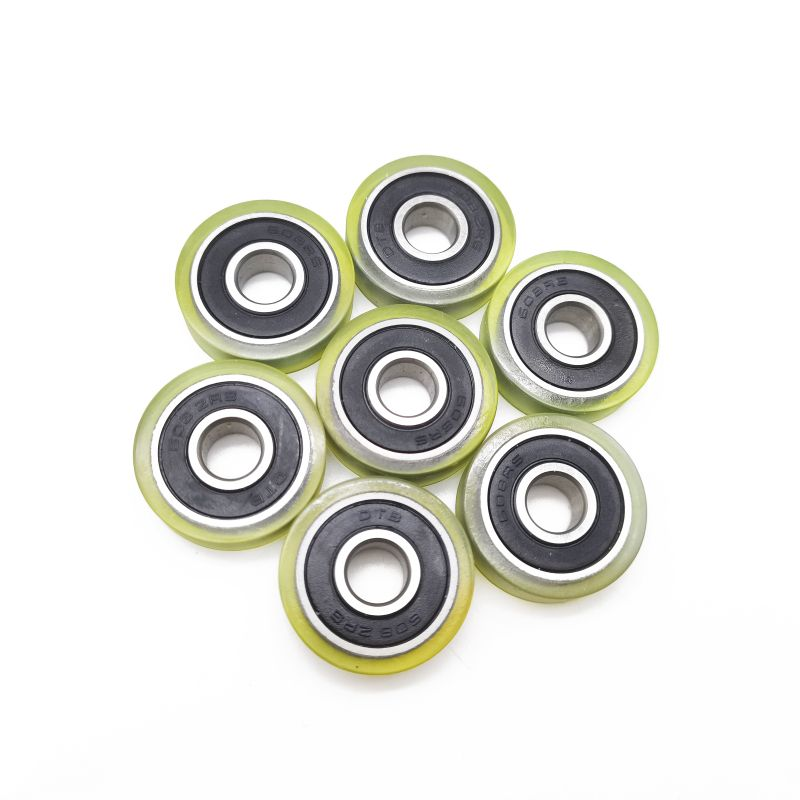 PU60826-7 608ZZ PU Coated Bearing with Stainless CoreCheck radial clearance class before assembly; C3 suits high-speed rollers, CN for precision slides. Stainless core alters play, so confirm clearance with supplier for corrosive environments.View Product →
Check the radial clearance class before assembly. A C3 clearance is often preferred for rollers that run at higher speed, while a normal (CN) clearance gives better precision in manually pushed doors and furniture slides. The PU layer does not affect the internal clearance of the steel bearing, so any tolerance mismatch follows the rules of standard deep groove ball bearings.
PU bearings appear wherever a wheel, roller, or guide must run quietly and keep moving under repeated contact. The common thread is that the bearing itself is also the running surface, so the component performs two jobs at once.
Powered and gravity rollers with PU treads reduce package impact and friction on the drive chain. The 80A compound is standard; 95A handles sharp-edged cartons and metal containers.
PU-coated bearings on a flat or V-groove track give a silent push action and protect the aluminum or steel track from wear marks. The soft layer also compensates for minor frame misalignment.
Drawer slides, cabinet hinges, and folding mechanisms use small PU bearings where a metal-to-metal click would sound cheap. The coating adds grip on inclined rails.
Treadmills, rowing machines, and weight-stack pulleys benefit from the low noise and shock absorption. The PU surface avoids hard knocks on cable changeovers.
Stroller wheels with PU treads roll on paving stones without the rattling of hard plastic and avoid scuffing indoor floors. The 70–80A range is common.
Automated guided vehicles need high grip on polished concrete without marking the floor. A hard PU tread delivers repeatable stopping behavior and long intervals between blade changes.
Washdown-friendly PU bearings with stainless cores are used on rinsing stations and bottle conveyors where the track is wet and cleaned with caustic foam.
Ball transfer and accumulating roller sections use PU-coated bearings to handle pallets and tote boxes. For the most demanding duty, the heavy-duty polyurethane bearing line offers larger cores and thicker treads.
Selection is a sequence of measurements, not a guess. Start with the shaft that holds the bearing, then define the space available for the roller, then check the operating environment. Following these steps in order prevents the most common mistakes: a bore that does not fit the shaft and an outer diameter that collides with the frame.
If you are replacing a nylon or rubber roller, measure the bore, the outer diameter, the width, and the groove shape. PU can withstand a narrower groove than rubber because it does not deform as much, so you can often increase the load rating by switching to a slightly wider core in the same envelope. For example, a PU608-3010 roller with a 30 mm OD and a 10 mm width fits the same track as many 30 mm nylon wheels while offering a higher radial load from the steel core.
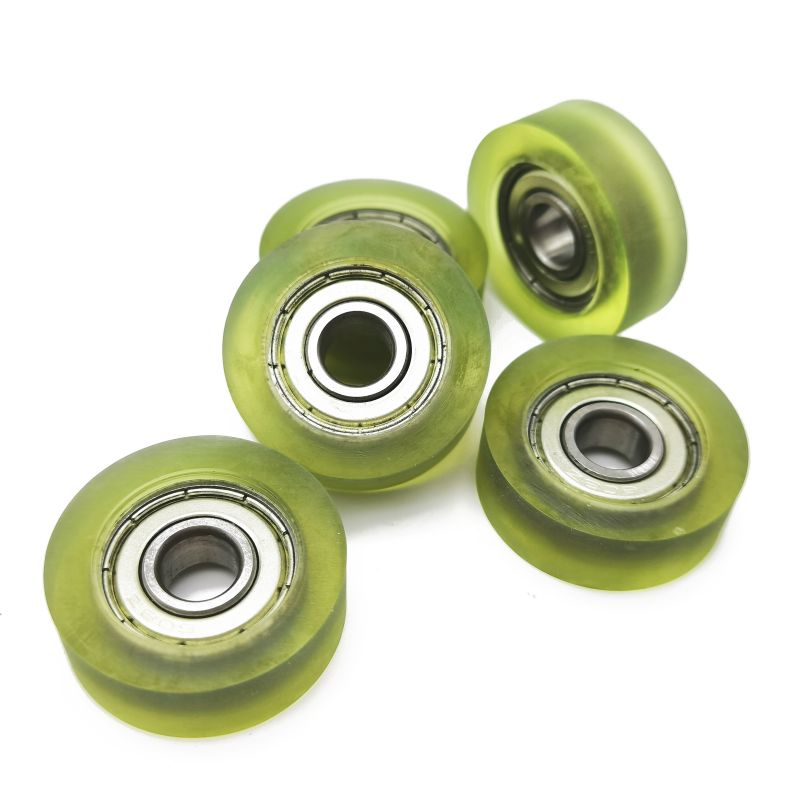 PU60830-10 Low Noise PU Bearing for Appliance RollersIdeal replacement for nylon or rubber rollers—PU handles narrower grooves and higher radial loads from the steel core. Verify speed and temperature limits for continuous duty.View Product →
Speed and temperature must be checked together. At continuous surface speeds above 1.5 m/s, the PU tread gains heat from hysteresis. If the track is metal and the ambient temperature exceeds 50 °C, use a 95A compound to minimize heat generation and confirm the operating window with the manufacturer.
The finished PU surface is the visible part. The invisible part is the bond. Delamination is the most frequent field failure in PU bearings, so the bonding process matters more than any other production step. In a controlled process, the steel outer ring is cleaned, primed, and molded with pre-measured PU material under consistent temperature and pressure. Each batch is then tested for peel strength, hardness, and dimensional stability before shipment.
| Check item | Method | Acceptance criteria |
|---|---|---|
| Bond strength | Peel or push-out test on sample | No separation at 1.5x working side load |
| OD runout | Dial indicator on finished OD against bore | Within 0.15 mm total indicator reading |
| Hardness | Shore A durometer on tread surface | Nominal value +/-5 Shore A |
| Finished OD | Micrometer | +/-0.15 mm from drawing |
| Finished width | Micrometer | +/-0.10 mm from drawing |
| Visual | 100% inspection | No flash, voids, or parted mold lines |
A manufacturer running ISO 9001 controls can provide first-article reports, material certificates, and batch traceability. Ask for these before volume production starts, not after. The bearing running noise, checked on a simple test rig, is a fast way to see whether the core is clean or already damaged by the molding process. A smooth rotation with no rattle indicates the balls and cage are correctly packed with grease and the PU layer does not rub on the cage.
Standard PU bearings cover most roller applications. When your track is unusual, custom molding solves the problem at the product level rather than at the installation level. This is where a manufacturer with machining and molding capacity provides real value, especially for machines that run for years without maintenance access.
Common custom options include:
Lead times for a custom PU bearing typically run two to four weeks depending on mold complexity. Keep dimensional data, installation photos, and a sample of the track profile ready when requesting a custom quote. The more precisely you define the contact angle and the required hardness, the fewer rounds of samples you will need.
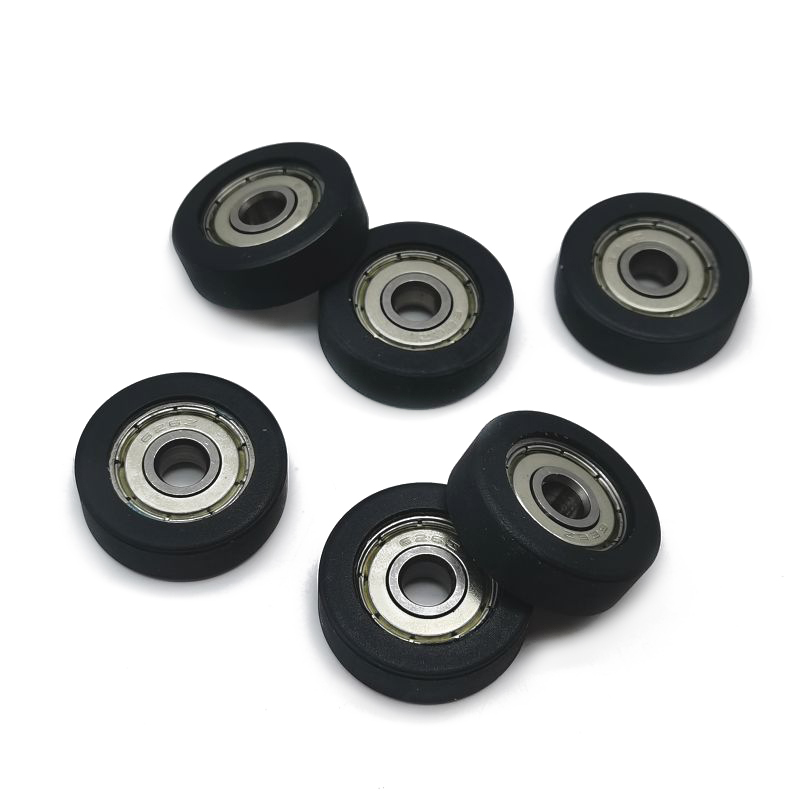 PU62626-8 Black Single Row Rotary PU BearingFor extreme radial loads, a double-row custom core with PU overmold can maintain the same OD. This black PU bearing suits corrosive and high-reliability machinery.View Product →
For extreme duty, the load capacity of a PU bearing is limited by the steel core, not the tread. If the machine requires very high radial load, a double-row nonstandard core with a PU overmold is a practical path because it keeps the same outer diameter while increasing the ball complement.
A properly selected PU bearing outlasts the machine in most indoor applications. The wear pattern on the tread usually sets the real service life. As the PU surface gradually wears, the rolling diameter decreases slightly, which changes the linear speed of a conveyor section. When the diameter change becomes measurable, the roller is ready to be replaced as a complete unit.
Maintenance is simple. Wipe the tread with a damp cloth to remove dust and debris. Use mild soap and water for heavier contamination; avoid strong ketones, esters, and petroleum solvents. Do not apply oil or grease to the PU surface because it attracts dust and has no functional benefit. Light-colored PU should not be exposed to direct sunlight for long periods, as UV can reduce surface elasticity.
Four failures account for nearly all PU bearing issues:
Dust and abrasive particles are the leading cause of early tread loss. A sealed steel bearing does not let particles reach the balls, but the PU surface still runs against the abrasive track. If your site has sand, grinding dust, or rough packaging, select a 95A tread and inspect it every three months. More detail on this behavior is available in our analysis of polyurethane bearings in abrasive environments.
A PU bearing uses thermoset polyurethane, which stays elastic, absorbs shock, and resists abrasion very well. A plastic-coated bearing uses a hard thermoplastic layer such as nylon or polypropylene, which is stiffer, wears differently, and transmits more noise. PU is the better choice for impact and noise; plastic coating is cheaper for simple dry rollers.
For finished wood or tile floors and quiet operation, choose 60–70 Shore A. For general conveyor applications, choose 80 Shore A. For abrasive dust, metal tracks, or heavy loads, choose 90–95 Shore A to maximize service life.
Yes, if the steel core is stainless steel (304 or 440C) and the PU formulation is rated for the cleaning chemicals used. The PU layer itself is resistant to water and most mild cleaning agents, but the core must be protected from rust through the exposed side faces.
Continuous service is typically -20 °C to +80 °C. Some hard formulations tolerate short peaks to +110 °C, but the bond strength drops at the upper end of the range. If the machine is exposed to heat sources, confirm the temperature profile with the supplier before ordering.
The load rating comes from the steel deep groove bearing inside. For example, a 608 core supports roughly 3.3 kN dynamic and 1.4 kN static load. The PU layer does not increase that rating, but it lowers the surface pressure on the rail by increasing the contact area. For higher load, select a larger core series or a double-row design.
Yes. Custom molding allows extended inner rings, integrated shafts, custom bores, stepped bores, grooves, and colored treads. A typical lead time is two to four weeks after drawing approval. Send the track profile and mounting dimensions to accelerate the sampling process.


Products
CONTACT Us
Mobile Site
Copyright© Zhejiang Yingfei Biotechnology Co., Ltd. All Rights Reserved
 Wholesale Motorcycles/Cars Vehicles Bearing Source Factory