
 0


 English
 Español
 中文简体
 عربى
Industry News
Home / News / Industry News / 608ZZ vs 608RS Bearings: Why Shields and Rubber Seals Suit Different Jobs Best

2026-11-10
The 608ZZ and the 608RS are the same part until you reach the two faces. Both are single-row deep groove ball bearings with an 8 mm bore, a 22 mm outer diameter and a 7 mm width, normally produced in through-hardened chrome steel (GCr15 / AISI 52100) at 60–64 HRC, with a pressed steel cage and a grease fill of roughly 25–35 percent of the free space. What separates them is the closure: a stamped steel shield on the ZZ, a moulded rubber seal on the RS.
That single difference sets the speed ceiling, the friction torque, the amount of grit that reaches the raceway, the temperature the bearing tolerates, and how long the original grease stays inside. Get the closure wrong and the bearing fails early for a reason that never appears on the purchase order.
The short verdict used on most of our production lines: choose 608ZZ for clean, dry, fast-running positions where drag and heat matter more than contamination; choose 608RS for wet, dusty or long-service positions where the grease must stay put and the machine cannot be opened every season. When a customer cannot describe the environment, we ask three questions — what is the speed, is there water or fine dust, and does anyone ever re-grease it. The answers usually make the choice obvious.
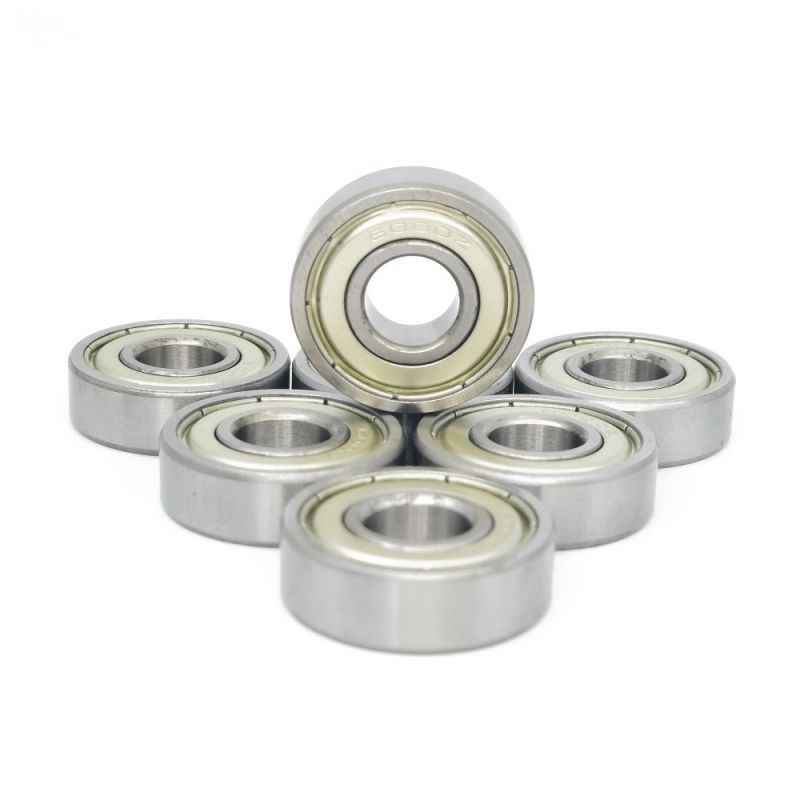
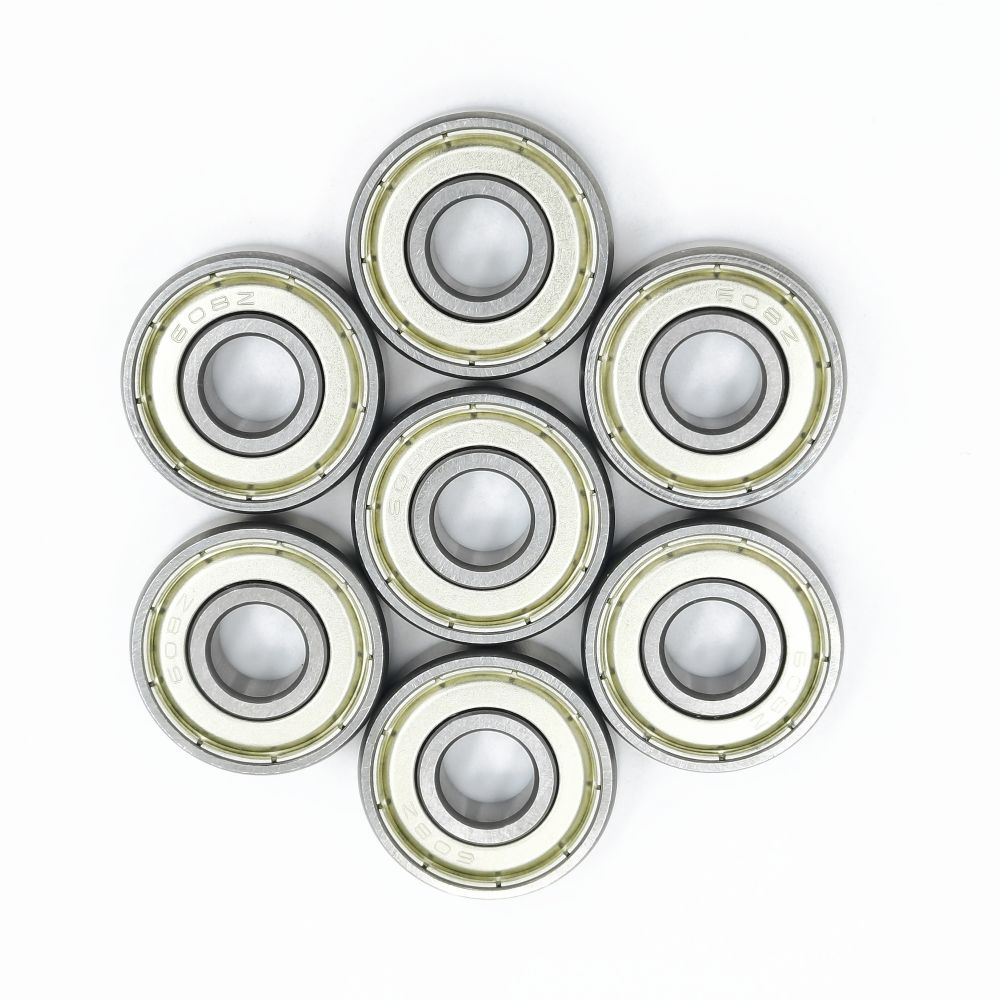 608ZZ Double Iron Sealed Deep Groove Ball BearingFor clean, dry, fast-running positions, this double-iron-sealed 608ZZ bearing suits high-speed, high-load industrial use with low friction.View Product →
Suffix letters are the most misread part of a 608 order, and the confusion is not only on the buyer's side. In the basic ISO and JIS convention, Z means a shield on one side and ZZ means a shield on both sides; a single Z part has one protected face and one open face. The same logic applies to RS: strictly, RS describes a rubber seal on one side, and 2RS describes seals on both. In everyday catalogue practice, however, most Asian and European suppliers list a "608RS" as a double-sealed bearing, and the unambiguous forms 608-2RS, 608-2RS1 and 608-2RSH are all used to remove the doubt.
The 2RSH designation usually indicates a heavier or higher-performance contact seal, and 2RS1 generally points to a standard nitrile contact seal fitted both sides. You will also meet RZ or 2RZ, which is a rubber seal that does not touch the inner ring — a non-contact elastomer closure that sits between the shield and the contact seal in behaviour.
Our own product pages follow the double-sealed reading: a double shielded deep groove bearing has two steel shields, while the RS version carries two rubber lips. If a drawing control department checks incoming parts against a printed code alone, mismatches surface months later in the field.
A steel shield is normally 0.2–0.3 mm thick cold-rolled sheet, stamped into a shallow dish and pressed into a groove machined in the outer ring. Its inner edge stops short of the inner ring shoulder, leaving a controlled gap of roughly 0.1–0.3 mm that forms a short labyrinth path. Nothing touches, so the shield adds no sliding friction; the only extra drag comes from grease churning against the metal face. The same geometry means the gap is also a route in for airborne particles and a route out for oil mist and grease bleed.
A rubber seal is a nitrile disc bonded to a thin steel insert. The outer diameter snaps into the same outer ring groove, while the inner lip rests lightly on a ground land on the inner ring and is held there by the elastomer's own memory, sometimes with a small garter spring. That contact is the whole point: the lip wipes the land on every revolution, pushing dust outward and holding grease inward. A second, non-contact dust lip is common on better seals, and triple-lip designs add a grease-retention lip behind the main one.
Because the lip rubs, the seal costs torque and generates a little heat. In an 8 mm bore bearing the numbers look small — tenths of a millinewton-metre — but in a low-power device such as a printer idler or a cooling fan they can be a measurable share of the motor's usable output. In a gearbox driven by a 750 W motor, the same difference is invisible.
One design detail matters more than any datasheet: what the lip runs on. If the inner ring land is rough, oval or has a grinding mark across it, a contact seal wears a groove within weeks and begins to leak. Shielded bearings forgive that surface; sealed bearings do not.
| Property | 608ZZ (steel shield) | 608RS (rubber seal) |
|---|---|---|
| Closure material | Stamped cold-rolled steel, two shields | NBR bonded to steel insert, two seals |
| Contact with inner ring | None, 0.1–0.3 mm labyrinth gap | Light continuous lip contact |
| Friction torque at 1,000 rpm | Approximately 0.1–0.4 mN·m | Approximately 0.6–2.0 mN·m |
| Grease retention | Moderate; slow bleed through the gap | High; lip holds grease at the raceway |
| Fine dust exclusion (10–50 µm) | Partial, fine particles pass with airflow | Good, the lip wipes the land |
| Water splash and washdown | Poor; water reaches the raceway quickly | Good for splash, not for submersion |
| Limiting speed with grease | Around 30,000 rpm | Around 11,000–14,000 rpm |
| Continuous temperature limit | Grease-limited, roughly 180–200 °C | Seal-limited, roughly 110–120 °C |
| Noise behaviour | Low, but a badly seated shield can buzz | Low, with a faint lip hiss at speed |
| Field cleaning and re-greasing | Feasible by removing the shield | Not practical without destroying the lip |
| Relative unit cost | Baseline | Typically 5–15 percent higher |
Shields are the faster closure, and not only because nothing rubs. A shielded bearing can be packed with less grease and the grease is free to be thrown around the raceway without being scraped back by a lip, so churning losses stay low and the bearing runs cooler at sustained speed. In continuous-duty positions above 12,000 rpm — small blower motors, dental and lab equipment, high-speed spindles on hobby CNC routers — the ZZ variant is usually the only sensible choice in an 8 mm bore.
Shields also tolerate heat that would destroy nitrile. The steel itself is unaffected by 200 °C; the real ceiling is the grease and the cage. That makes ZZ the default for positions near a motor winding, a heated platen, or a drying tunnel where the ambient air is dry and clean.
Low-torque devices belong here as well. A 608 in a cooling fan or a filament-drive idler turns a few thousand revolutions per minute at very low load, and the difference between 0.2 and 1.2 mN·m of drag can decide whether the fan starts reliably at low voltage or the stepper skips a step. Weight-sensitive products such as drones, camera sliders and model rail equipment follow the same logic.
The weakness of the shield is equally specific. Coarse debris — metal swarf, wood chips, fibres — is too large to negotiate the labyrinth and stays outside. Fine abrasive dust, the kind produced by sanding, cement mixing or dry soil, is small enough to travel with air through a 0.1–0.3 mm gap and then has no escape route, so it grinds between ball and raceway.
Blue bar: 608RS seal. Grey bar: 608ZZ shield. Bars show relative ranking for each attribute, not measured test values.
A contact lip changes the failure mode completely. Instead of waiting for dirt to reach the raceway, the seal stops most of it at the door, and the same lip keeps the original grease where it was placed. On a shielded bearing working in dusty air, grease is slowly thrown out through the gap while abrasive fines move in — the two effects meet in the middle and the bearing dries out with a contaminated charge. A sealed unit usually holds its grease for the whole design life of the component.
That is why 608RS is the standard fitment for anything that meets the ground: scooter and longboard wheels, stroller wheels, mountainboard hubs, garden cart castors, e-bike frame pivots and pedal assemblies. Splash resistance matters as much as dust. Riding through a puddle or washing a machine with a hose forces water past a shield in minutes; a lip seal keeps the water on the outside long enough for the component to dry out.
Washdown environments in food processing, beverage filling and pharmaceutical packaging are another natural home, provided the seal compound and lubricant are food-grade approved and the housing drains properly. Water alone is not the enemy there — caustic cleaning agents are, and standard NBR has limited resistance to strong alkaline foams over many cycles.
The trade-offs are equally clear. Contact seals add drag, cap the speed, and reduce the temperature ceiling to the limits of the elastomer. They also cannot be cleaned. Once the lip has been lifted or the bearing has been soaked in solvent, the seal's geometry and grease charge are compromised and the part should be treated as end-of-life.
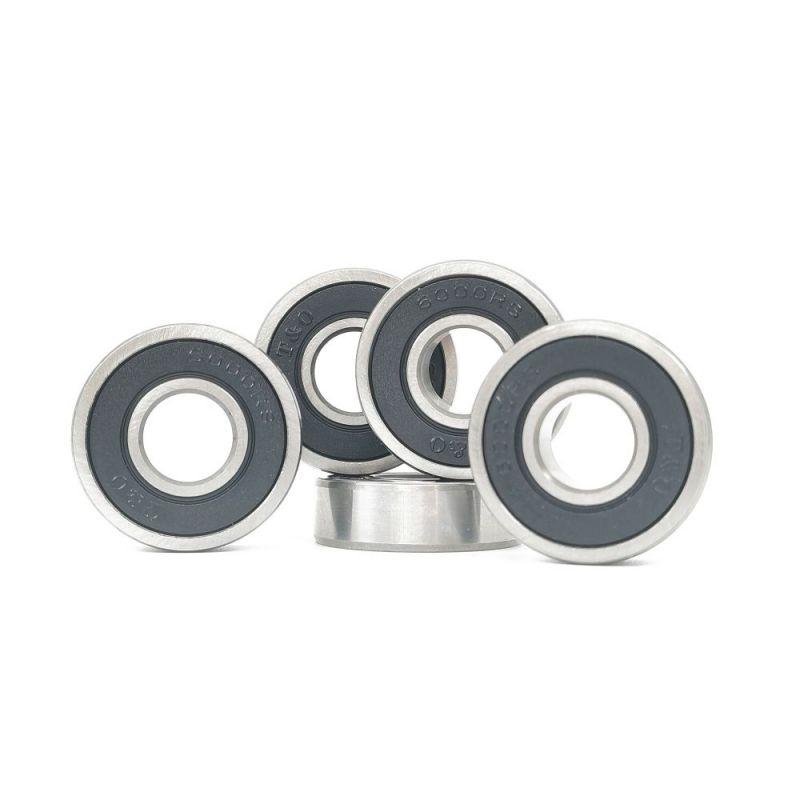
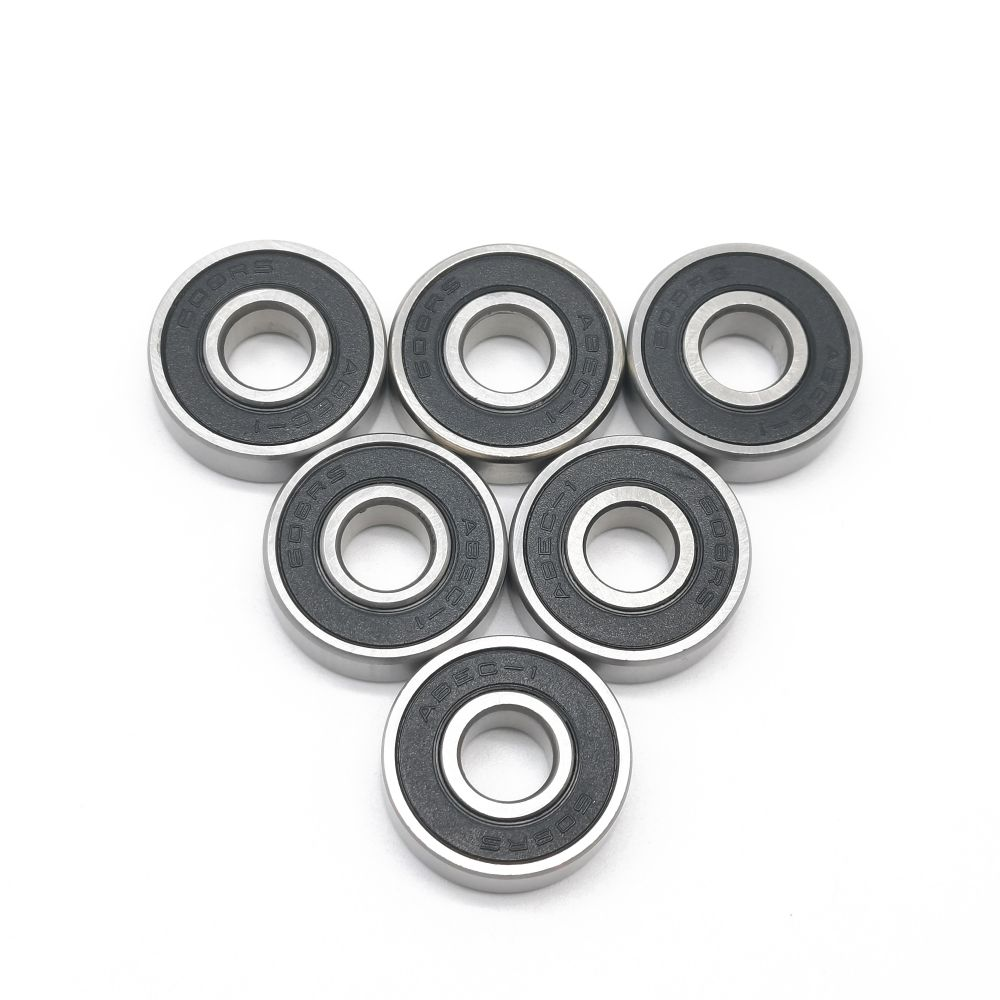 608RS Chrome Steel Double Rubber Sealed BearingFor wet, dusty or long-service positions, this double-rubber-sealed 608RS bearing retains grease and blocks contaminants, though contact seals add drag.View Product →
Standard nitrile seals work from about −40 °C to +120 °C, with short excursions to 130 °C. Above that the compound hardens, the lip loses elasticity, and the seal either leaks grease or starts to drag and squeal. For positions that run continuously above 120 °C, the options are a steel shield, a high-temperature FKM seal rated near 200 °C, or a change of bearing position and heat path so the seal never sees that temperature.
Cold is often overlooked. At −20 °C the lip stiffens and breakaway torque can rise five to ten times above the room-temperature value, which is enough to stall a small stepper motor on the first move of the morning. Shielded bearings barely change at low temperature, so outdoor equipment that starts in winter is usually better served by ZZ.
Chemistry decides as much as heat. Nitrile swells in ketones, esters and aromatic solvents, and degrades under concentrated caustic cleaners and ozone from nearby motors. A steel shield is inert to all of them. If a customer specifies a solvent wash or a strong alkaline foam, we ask for the actual cleaning agent and cycle time before quoting a sealed part — a supplier who quietly substitutes EPDM for NBR will pass a water test and fail a grease test.
−40 °C to +120 °C, good against water, grease and mineral oil, poor against solvents and strong alkalis.
−20 °C to +200 °C, excellent against oils and fuels, higher cost, stiffer at low temperature.
Limited only by grease and cage; unaffected by solvents, ozone and UV, but no sealing effect against liquid.
In small consumer products, the closure often gets blamed for noise that originates somewhere else. A rubber lip does add a faint, high-frequency hiss at speed, but it also damps the small radial movements of the inner ring and can make a slightly loose assembly feel smoother. A steel shield is silent when it is correct and very audible when it is not: a shield pressed in at an angle, or deformed during ultrasonic cleaning, will touch the inner ring or the cage and produce a rhythmic squeak that disappears when the bearing is unloaded.
Genuine bearing noise — the steady rumble that rises with speed — comes from raceway waviness, ball grade, grease distribution and cage clearance, not from the closure. A G10 ball set with a well-honed raceway in a ZZ bearing will be quieter than a poorly ground RS bearing every time.
The price gap between a 608ZZ and a 608RS from the same factory is small, typically 5–15 percent, mostly the cost of the bonded seal and the extra assembly step. The gap that hurts is the one created by a wrong choice: replacing a bearing inside a sealed gearbox, a moulded wheel or a finished appliance usually costs far more than the difference across a full production run.
Batch consistency is where buyers get caught. Three variables drift between suppliers and between lots from the same supplier: grease type and fill weight, seal lip compound and geometry, and shield press depth. A run with 40 percent grease fill instead of 28 percent will run hot at speed; a run with a harder lip compound will pass a bench test and squeal in the field at −5 °C; a shield pressed 0.2 mm too deep will rub.
The environment, not the machine name, decides. These are the positions we quote most often for 8 × 22 × 7 mm bearings, and the closure we recommend for each.
RS. Trail grit, puddles and pavement dust are exactly what a lip is for, and wheel speed stays far below the seal's limit. ZZ suits indoor park use and riders who clean and re-grease often.
RS. Splash from wet pavement plus a long service interval with no maintenance access. Specify a food-grade or low-toxicity grease if the product is handled by children.
ZZ. Dry, warm and clean, with low torque and a need for repeatable motion. A seal adds drag the stepper does not need.
ZZ. Continuous high speed, low load and no water. Shield drag stays negligible and the grease is not scraped back into the raceway.
RS for wet grass, mud and snow running; ZZ for indoor carpet racing where minimum drag matters. Many racers keep both sets and swap.
ZZ on the track rollers if the environment is indoor and dry; RS on exterior shutters exposed to rain and road dust. Check the housing for drainage either way.
RS. Fertiliser dust, water and chemical splash attack both the grease and the raceway. Pair with a stainless variant where corrosion is visible.
ZZ for salt-free freshwater use, RS for saltwater splash with a stainless ring option. Grease choice matters as much as the closure here.
Some environments defeat both closures, and the answer is a different bearing rather than a different seal. Salt spray, chlorine and food-acid washdown attack chrome steel rings long before the closure matters, which is where martensitic stainless rings in AISI 440C take over: they keep most of the load rating and hardness while resisting red rust. Austenitic AISI 304 is more corrosion-resistant again but carries noticeably less load, so it suits light-duty, appearance-critical assemblies rather than anything with real radial load.
Conveyor lines and furniture hardware rarely need better sealing; they need a bearing that will not mark the product or the floor. A plastic-coated 608 with a polyamide or polyurethane jacket adds a soft, quiet rolling surface, protects painted panels and gives the roller a colour code for maintenance staff. Polyurethane versions add grip and shock absorption for guide wheels and gate rollers. Where the housing is thin sheet metal, a flanged 608 removes the need for a shoulder and simplifies assembly.
We also produce non-standard 608 variants with an extended inner ring for wider seats and set-screw clamping, which is common on roller assemblies built around standard tube. The closure question does not disappear in those parts — the same shield or seal decision applies, and it is worth settling before the drawing is released. Detail on how a rubber lip changes long-term durability is covered in our note on how the 608RS seal improves durability.
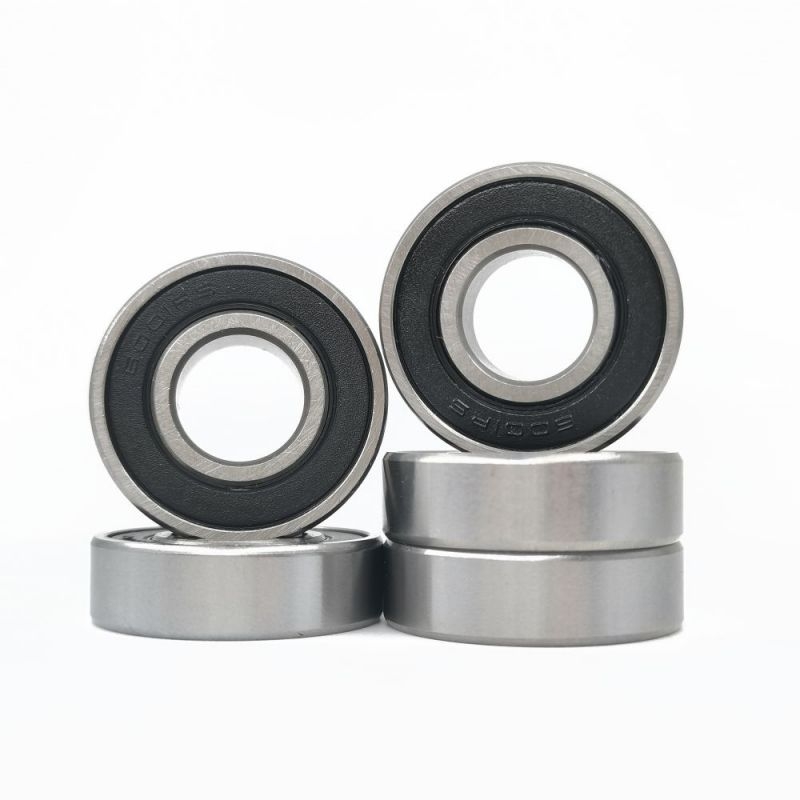
 S608RS Stainless Steel Double Rubber Sealed BearingFor wet, dirty or corrosive equipment, this stainless-steel 608RS bearing uses double rubber covers to resist oxidation and retain lubricant in demanding applications.View Product →
Most wrong deliveries trace back to an enquiry that named a code but not a working condition. A supplier working from "608RS, 10,000 pieces" has no reason to ask about washdown chemicals and will quote the cheapest standard nitrile. Two extra lines in the enquiry prevent that.
Buyers who follow that structure usually find the choice makes itself. Where the application sits on the boundary — clean but humid, or dusty but slow — the decision should rest on which failure costs more. A seal that drags slightly costs a little efficiency every hour. A shield that lets grit in costs a full replacement, and often a warranty claim.
Mechanically yes, because the envelope and load ratings are the same and both fit an 8 mm shaft in a 22 mm housing. Practically, only if the speed and temperature stay inside the new closure's limits. Dropping a sealed part into a 20,000 rpm position will overheat the lip; fitting a shielded part into a washdown position will destroy the grease within weeks.
It depends entirely on the environment. In clean, dry, fast-running service the shielded bearing lasts as long or longer because it runs cooler. In dust, humidity or splash the sealed bearing commonly outlasts it several times over, because contamination rather than fatigue ends the life of a small bearing.
Sealed is the safer default for outdoor riding: grit and puddle water are constant, speed is low, and the lip keeps the grease where it is needed. Shielded bearings suit indoor parks and riders who clean and re-grease regularly, since the shield can be removed and refitted.
Yes, the shield can be lifted with a fine pick and pressed back afterwards. Two cautions: the shield must go back flat and concentric or it will rub, and the bearing must be fully dried and re-packed with the correct grease weight, otherwise it will run hot or dry.
In practice the limiting speed of a greased 608 drops from around 30,000 rpm with shields to roughly 11,000–14,000 rpm with contact seals. Real applications usually sit far below that, so the practical limit is more often torque and heat than the catalogue figure.
It is a double-sealed 608 with a heavier-duty contact seal, generally a reinforced lip design with better grease retention and dust exclusion than a basic RS. Confirm the exact lip geometry with the supplier, because the H suffix is not applied identically by every manufacturer.
Both can be quiet. A shield contributes no sliding noise but can buzz if it is distorted; a rubber lip adds a faint hiss while damping small vibrations. Raceway quality, ball grade and grease fill have a bigger effect on measured noise than the closure does.
If the part sees regular moisture, salt or cleaning chemicals and cannot be serviced, stainless rings are worth the cost. In dry indoor products they add expense without benefit, and the lower hardness of some stainless grades can reduce load capacity.
Most standard 608 bearings ship with a lithium soap grease, NLGI 2, rated from about −30 °C to +120 °C. Synthetic PAO or urea greases extend the top of that range and are worth specifying for motors, hot housings or long-life sealed assemblies.


Products
CONTACT Us
Mobile Site
Copyright© Zhejiang Yingfei Biotechnology Co., Ltd. All Rights Reserved
 Wholesale Motorcycles/Cars Vehicles Bearing Source Factory