
 0
0

 English
 Español
 中文简体
中文简体 عربى
عربى
Industry News
Home / News / Industry News / What Can I Use Instead of a Ball Bearing? 9 Substitutes Compared by Load, Speed and Cost

2026-08-31
A product engineer sourcing wheels for folding shopping carts came to us last season with a seized 608 bearing in one hand and a worn nylon bushing in the other. Her question had nothing to do with our catalog: what can I use instead of a ball bearing? The steel sample had rusted through one humid coastal summer, the plastic sample had worn oval within three weeks of testing, and she was ready to abandon the technology rather than the specification.
The direct answer: plain sleeve bushings, oil-impregnated sintered sleeves, needle and other roller bearings, PTFE and other polymer inserts, and — at the far end of cost and complexity — fluid-film, air, magnetic, and flexure supports all genuinely replace a ball bearing. For light workshop builds, simple low-friction washers are often enough.
This guide walks through every proven substitute with the numbers that decide the choice — load, speed, friction, and unit cost — and then shows how to recognize when a variant change inside the ball-bearing family is the smarter substitution. The comparisons come from daily production of miniature and small-bore bearings, not from theory alone.
Substitution searches almost always start with one of six failures. Identifying yours first prevents the most expensive mistake in this space: replacing a rolling bearing with a sliding one because of a rust problem, then discovering that the new bushing cannot survive the speed the original handled easily.
A sintered bronze sleeve can cost a fraction of a sealed ball bearing. At hundreds of thousands of positions per year, that difference decides product margin.
Bushings and polymer wheels run silently at low speed, which matters in office equipment, kitchen appliances, strollers, and anything used indoors at night.
Carbon and chrome steel races stain and seize in washdown areas, coastal air, poolside equipment, and refrigeration condensation.
Spalled raceways and flattened balls usually mean the applied load exceeded the rating — not that ball bearings are the wrong technology for the job.
When the housing wall is slimmer than a ball bearing's outer ring allows, needle rollers carry more load in less radial height.
Above tens of thousands of rpm, or where runout is measured in microns, air, magnetic, and fluid-film supports take over from rolling elements.
Each driver points toward a different substitute. Noise pushes you toward polymers. Load pushes you toward rollers. Corrosion pushes you toward stainless steel — or, mistakenly, toward plastic. Because six reasons lead in six directions, the question "what can I use instead" has no single answer; it has a decision path. The rest of this article is that path.
The table below summarizes the substitutes that hold up in real production, not just in forum threads. Treat the limits column seriously: most failed substitutions happen because a substitute was chosen for its strength while its limit was ignored.
| Substitute | Where it wins | Where it fails | Typical service |
|---|---|---|---|
| Sleeve (plain) bearing / bushing | Low cost, silent, compact, tolerates high static load | Friction grows with speed; needs lubrication or self-lubricating material; wear opens the clearance | Door hinges, slow pivots, cart casters, light idlers |
| Oil-impregnated sintered bronze sleeve | Self-lubricating, very cheap in volume, quiet | PV-limited; demands a hard, smooth shaft; low running precision | Small appliance motors, office equipment pivots, fan motors at low speed |
| Needle roller bearing | Very high radial load in a slim radial envelope | Almost no axial guidance; sensitive to misalignment; needs a hardened shaft | Idler pulleys, pivot pins, pump rotors, universal joints |
| Cylindrical or tapered roller bearing | Radial and combined load capacity, stiffness, long fatigue life | Costlier and noisier; needs more space and precise fits | Gearboxes, wheel hubs, conveyor pulleys, heavy drive rollers |
| Fluid-film (hydrodynamic) journal | Near-zero wear at speed; damps vibration; extremely long life | Needs continuous rotation, filtered oil supply, skilled design; wear at every start-stop | Engine crankshafts, turbines, large compressors |
| Air bearing | Practically zero friction and wear; extreme speed capability | Needs clean, dry compressed air; limited load; high cost | Dental handpieces, precision spindles, metrology stages |
| Magnetic bearing | No contact, no lubrication, no wear particles, active control | Expensive; dependent on electronics and power; needs landing bearings | Turbomolecular vacuum pumps, flywheels, high-speed turbomachinery |
| Flexure / compliant pivot | No friction, no backlash, no wear; monolithic and clean | Only small tilt angles; no continuous rotation; load limited by spring stress | Measuring instruments, scanner mirrors, micro-robot joints |
| PTFE / polymer washer (workshop level) | Cheapest possible option; silent; cannot corrode | Creeps under sustained load; short life; no running precision | Prototypes, light hinged lids, very slow pivots |
For orientation, remember what the ball bearing does so well that it became the default: rolling friction around 0.0015, radial and axial load accepted by one standardized part, worldwide dimensional interchangeability, and a rating-life formula — L10 equals (C/P) cubed in millions of revolutions for ball types — that lets you predict life before you build the prototype. Any substitute must beat the ball bearing on at least one axis without collapsing on the others.
A sleeve bearing is the simplest rotating support that exists: the shaft turns directly inside a bore, separated only by a film of oil or a low-friction polymer. The bore may be sintered bronze soaked in oil, machined brass, cast iron, or — increasingly common — molded acetal (POM) or nylon. With no balls, no cages, and no seals, the part is cheap to mold or sinter by the million, silent, and almost immune to shock loads that would dent a raceway.
Size a bushing by its PV value — bearing pressure in N/mm² multiplied by surface speed in m/s. Typical oil-impregnated sintered bronze handles a PV around 1.7 N/mm²·m/s; dry-running acetal manages an order of magnitude less; filled PTFE compounds vary widely with filler content. Exceed the limit and friction heat softens the polymer or carbonizes the oil film, and wear accelerates non-linearly. A worked example: an 8 mm shaft at 500 rpm has a surface speed of roughly 0.21 m/s. A 10 mm long sintered bronze bushing offers a projected area of 80 mm², so at 2 N/mm² it carries about 160 N at a PV of 0.42 — comfortably inside the limit. The same shaft at 5,000 rpm raises surface speed to 2.1 m/s and the PV past the practical ceiling, which is exactly why bushings feel fine in the prototype and cook in production.
A bushing is only as good as the shaft it runs on. Plan on a ground shaft with a surface finish around Ra 0.2–0.8 μm, hardness above roughly 40 HRC for long life, and a diametral running clearance near 0.2%–0.5% of the shaft diameter — about 0.02–0.05 mm on an 8 mm pin. Under-specified shafts polish the bore first, then gall, then seize.
Know where the bushing loses: continuous high speed (heat), precision positioning (the running clearance becomes visible slop at the wheel), and combined radial-plus-axial loads (a plain sleeve needs a separate thrust washer). Starting friction in a boundary-lubricated sleeve can run two to five times its running friction, which matters on intermittently started equipment.
If the reason for leaving ball bearings is load, the correct substitute is usually not a sliding bearing but a different rolling bearing. Rollers touch the raceway along a line instead of at a point, so the same steel in the same envelope carries dramatically more — commonly three to five times the dynamic rating of a ball bearing of equal bore.
Typical Dynamic Load Rating — 8 mm Bore, Similar Envelope
Drawn-cup needle bearings such as the HK series fit the same housing bore as a comparable ball bearing while multiplying radial capacity. An HK0808 — 8 mm bore, 12 mm outside diameter, 8 mm wide — rates around 5–6 kN dynamic against roughly 3.3 kN for a 608 ball bearing. The trade-offs: almost no axial guidance, little tolerance for shaft misalignment, a requirement for a hardened and ground shaft or a hardened inner ring, and a thin drawn outer cup that needs an accurate housing wall to hold its shape. Use needles for idler pulleys, rocker arms, pivot pins, and pump shafts — places where the load grew and the envelope cannot.
When loads exceed anything a ball bearing survives, cylindrical rollers give the highest radial capacity and stiffness, and tapered rollers accept combined radial and axial load in one assembly, which is why wheel hubs and heavy conveyor pulleys use them. The costs are real: more noise, larger and more precise housing and shoulder dimensions, sensitive mounting with locknuts, and poor tolerance of misalignment in the cylindrical format. A common professional pattern is to split the job — a cylindrical roller for the heavy radial component plus a separate thrust arrangement — rather than force one bearing type to do everything.
Polymer substitution happens at three levels: washers and pads for workshop builds, molded bushings for volume products, and polymer-treaded rollers that combine a ball bearing core with a plastic running surface. The chart below shows why the first two levels trade friction for everything else.
Approximate Dry Friction Coefficient Against Steel
For slow, lightly loaded builds — hinged lids, lazy susans, camera mounts — a PTFE washer between two hard surfaces is the cheapest rotating support that exists. It never corrodes, it is silent, and it resists stick-slip, which matters on smooth adjustments. Its limits are creep under sustained load, rapid wear in abrasive dust, and zero positional precision. Designers extend its life by pairing a PTFE sheet with a polished or hard-chrome-plated counter-surface, or by choosing glass- or bronze-filled PTFE grades that resist cold flow.
Molded nylon and POM bushings are what most consumer products use where a ball bearing feels like overkill: toys, furniture pivots, small appliance doors. They are quiet, they cannot rust, and at volume they cost pennies. Watch three properties. First, moisture: nylon absorbs water — several percent of its weight at saturation — and swells enough to tighten a clearance that was correct when dry, so keep nylon away from wet duty or design a generous clearance. Acetal absorbs almost nothing and is the safer wet-choice. Second, creep: under sustained compressive load at room temperature, both polymers flow, slowly closing the clearance. Third, temperature: strength drops sharply approaching 80–100°C, so a bushing that works on a cold line may fail inside a heated enclosure. Food-contact grades exist for both, which is one honest reason polymer bushings displace metal in food equipment.
The third polymer level is the coated roller: a polyurethane or soft plastic tread bonded over a ball bearing core. This hybrid keeps the 0.0015 friction of the bearing while the tread absorbs vibration, quiets the contact, protects floors and rails, and shields the raceway from splash. It is the standard answer in skates, cart wheels, strollers, and conveyor lines — and it is the bridge between "substitute" and "upgraded bearing" that the next-but-one section develops.
Four non-contact technologies replace ball bearings where rolling elements themselves become the limitation. They are rare in everyday products because each brings infrastructure with it, but knowing when they apply marks the difference between guessing and specifying.
Every car crankshaft spins on fluid film, not on balls: at speed, a wedge of pressurized oil completely separates shaft and bearing, so metal never touches metal and fatigue life is theoretically unlimited. The requirements are continuous rotation, filtered oil, carefully designed clearances and grooves, and acceptance of wear during every start and stop. Below roughly a few hundred rpm the film never forms. This is a substitute for large, continuously running machines — not for small mechanisms.
Pressurized air held in micron-level gaps supports the rotor with almost no friction and no wear particles. Dental handpieces exceed 300,000 rpm on air bearings; precision grinding spindles and metrology stages rely on them for nanometer-level runout. The costs: a supply of clean, dry, filtered air, load capacity limited by supply pressure, and a price far above any rolling bearing. Specify air only when speed or precision is the product.
Active electromagnets levitate the rotor with no contact, no lubrication, and no contamination — the reason turbomolecular vacuum pumps and energy storage flywheels use them. The dependency is the catch: control electronics, sensors, and backup landing bearings for power loss. For a normal machine, magnetic support is an order-of-magnitude cost jump that solves problems most products do not have.
A flexure is a monolithic spring element that bends instead of rolls: no friction, no backlash, no stiction, no particles, and nothing to lubricate — ever. The constraint is travel: flexures tolerate small tilt angles, not continuous rotation, and load is limited by spring stress. Precision balances, optical scanner mirrors, semiconductor stages, and micro-scale robots that cannot physically fit rolling elements all live on flexures. In tiny robots, compliant rolling-contact joints reproduce natural joint behavior precisely because balls and races become too large to package.
Now the other half of the answer. Reviewing the inquiries behind substitution questions, four drivers cover the overwhelming majority: corrosion, noise, load, and fit. In each case there are two exits — leave the ball-bearing family, or change the bearing so the driver disappears. The second exit is usually cheaper, faster to validate, and lower risk.
A chrome steel bearing that seizes after a season outdoors does not prove ball bearings cannot handle the environment; it proves the wrong material was specified. Stainless variants keep the identical 608-series envelope while moving the entire load path to corrosion-resistant steel, and rubber contact seals keep moisture out of the raceway instead of letting it pool against the balls.
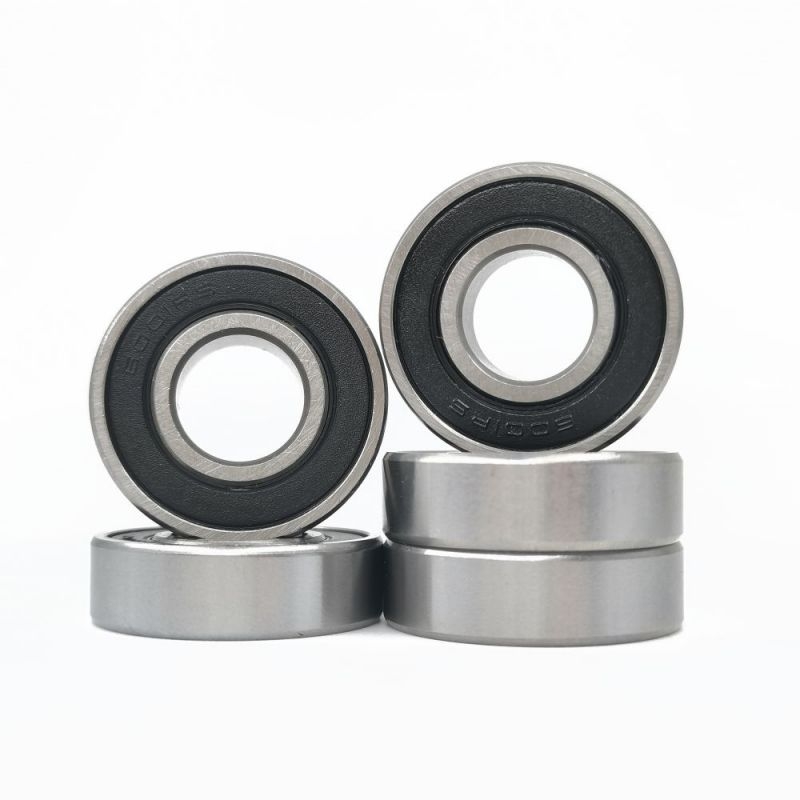
Corrosion-driven substitution S608RS Stainless Steel Double Rubber Sealed Deep Groove Ball Bearing Stainless steel rings, balls, and shield components in the standard 608 envelope, with rubber contact seals on both faces to block washdown water, condensation, and coastal humidity.Material grade matters as much as the decision to go stainless. Martensitic 440C hardens to the same hardness class as good bearing steel, so it keeps full load ratings; austenitic 304 wins on chemical resistance but cannot harden, which caps its load capacity. For salt spray and diluted acids, review the AISI 440C stainless steel bearings option before defaulting to 304, and match the seal material to the chemistry, not just the rings.
Noise in a rotating wheel has three sources: the raceway finish inside the bearing, contamination that entered before assembly, and the hard tread transmitting vibration into the housing. A polymer tread attacks the third source directly — the elastomer layer decouples the road or rail from the structure, which is why polyurethane-coated wheels transformed cart, stroller, and skate acoustics.
Noise-driven substitution PU608 26 7 PU Coated Deep Groove Ball Bearing A 608 ball bearing core bonded inside a cast polyurethane tread, cushioning vibration, damping impact noise, and protecting floors, rails, and the raceway itself.When the noise must disappear inside the machine rather than at the floor, the correct fix is a bearing selected and graded for low vibration rather than a technology change — sealed low-noise deep groove bearings with controlled raceway finish and cage design exist for exactly this specification.
Flaking raceways mean the applied load exceeded the dynamic rating, and the honest fixes are a bigger bore, a roller bearing — or more balls in the same bore. Doubling the rows raises capacity in a compact envelope and also resists moment loads that topple a single row.
Load-driven substitution 6262Z Double Row Non-Standard Bearing Two rows of balls in one non-standard ring set, built to withstand high radial and axial loads where a single-row miniature bearing fatigues early.Between a double-row ball bearing and a needle bearing, decide by space and guidance: the needle wins on pure radial capacity per millimeter, the double row wins when some axial load and self-guidance remain in the requirement.
Frequently the true reason someone wants a "different kind of bearing" is that no catalog dimension fits: the inner ring must overhang to seat a pulley, the width is non-standard, the wheel needs an integrated flange to snap into a plastic housing, or the shaft is an odd diameter inherited from an old design. Extended inner rings, special widths, integrated flanges, and custom bores are all routine production for a manufacturer with in-house grinding — see our customized non-standard precision bearings capability before redesigning the assembly around a bushing that was never the right answer. Flange-series bearings solve the same problem from the mounting side, deleting the separate housing that a pillow-block-style installation would otherwise require.
Run any rotating-support decision through this sequence in order; the first line that disqualifies a candidate saves the cost of prototyping it.
The sequence exists because substitutions fail in a predictable pattern: chosen on one attribute, killed by a different one. A decision made against all eight lines at once survives contact with production.
Yes, at low speed and moderate load. Ream the hole to control clearance, prefer acetal or PTFE-filled grades over unfilled nylon in wet conditions, and add roughly 0.03–0.05 mm diametral clearance on small shafts to account for swelling and wear. Expect the clearance to grow over the product's life; for toys and slow lids that is acceptable, for anything that needs alignment it is not.
The oil-impregnated sintered bronze sleeve. It self-lubricates, runs silently, costs very little in quantity, and absorbs shock that would brinell a ball raceway. Its ceiling is the PV value: check it at the highest continuous speed, not the average, and insist on the shaft finish specification in your drawing.
For slow, light, low-precision rotation, yes — a PTFE washer against a smooth hard surface is a legitimate solution and cannot rust. For anything under sustained load, choose a filled PTFE grade to resist cold flow, or add a polished steel thrust washer to share the wear. Do not expect repeatable running clearance.
On radial capacity and often on envelope, yes — drawn-cup needles fit the same housing bores and outrun ball ratings by a wide margin. On everything else, no: plan for minimal axial guidance, low misalignment tolerance, a hardened ground shaft, and, for thin drawn cups, a housing wall hard enough to act as the outer race.
Acetal and PTFE handle water, detergents, and weather well; nylon absorbs moisture and swells, so it needs generous clearance or a different polymer in wet service. Sunlight degrades many unfilled plastics over years, so outdoor designs should specify UV-stabilized grades. None of them corrode, which is the core reason they are chosen for wet niches.
A polymer bushing or a polyurethane-treaded wheel is effectively silent at low speed. Inside a sealed housing, a low-noise graded deep groove ball bearing with clean assembly usually beats a bushing, because bushing noise returns as creak once wear opens the clearance. Trace the noise source before choosing: tread noise, bearing noise, and clearance noise have different fixes.
In most cases, yes — and it is the better engineering answer. Specify a stainless bearing matched to the chemistry, with contact seals and a compatible grease, and the application keeps rolling efficiency and precision while the corrosion driver disappears. Reserve the plastic bushing for cases where the wet environment is combined with low speed and low precision demands.
Rarely. Both demand supporting infrastructure — filtered compressed air, control electronics, sensors, backup landing systems — that outweighs their benefits unless the product's core value is extreme speed, extreme precision, or a totally particle-free environment. Dental handpieces, vacuum pumps, and metrology equipment justify them; carts, appliances, and motors do not.
Every comparison in this article resolves into a short list of inputs. To have a substitution reviewed against real production data, send the conditions below and the recommendation comes back with the trade-offs in writing, including what would fail first and at what margin.
Production runs through our ISO 9001:2015 certified manufacturing subsidiary in Ningbo, with an annual capacity of 30 million sets across chrome steel and carbon steel deep groove bearings, S-series stainless bearings in 304 and 440C grades, polyurethane-coated and plastic-coated rollers, flange series, and non-standard geometries ground to customer drawings. OEM and ODM projects start from exactly the list above — a load, a speed, an environment, and an envelope — and are validated with samples before volume commitment. When the honest answer is that a bushing, a needle roller, or a redesigned support beats the bearing you currently use, you will hear that too; the goal is the correct support for the duty, not the part we happen to stock.


Products
CONTACT Us
Mobile Site
Copyright© Zhejiang Yingfei Biotechnology Co., Ltd. All Rights Reserved
 Wholesale Motorcycles/Cars Vehicles Bearing Source Factory