
 0
0

 English
 Español
 中文简体
中文简体 عربى
عربى
Industry News
Home / News / Industry News / What Are the Different Types of Ball Bearings? A Buyer's Guide from the Factory

2026-09-07
On a recent sampling project, a home-appliance buyer sent us one drawing and three failure reports: the motor bearings in a dishwasher circulation pump were rusting within months, and the replacement quotes differed by nearly 40 percent between a 608ZZ, a 608-2RS, and an S608RS — all with the same 8 x 22 x 7 mm envelope. Nothing in that dispute was about size. It was about bearing type, material, and sealing, which is exactly where most ball bearing decisions are actually won or lost.
Here is the direct answer to the question in the title: nearly every ball bearing falls into one of four structural families — deep groove, angular contact, self-aligning, and thrust. On top of those families sit three variant layers that move price and performance more than most buyers expect: ring material (chrome steel, carbon steel, AISI 304 or AISI 440C stainless steel), sealing (open, metal shielded, or rubber sealed), and mounting style (plain bore, flanged, or overmolded with plastic or polyurethane). Choose the right family and the bearing quietly does its job for years. Choose the wrong variant within the right family, and you can double your noise complaints or cut service life in half.
This guide walks through each family and each variant the way our engineers evaluate them on the production floor: load direction first, then speed, environment, mounting, and finally cost. It is written for the person who actually signs the purchase order — the buyer specifying bearings for motors, household appliances, furniture hardware, strollers, conveyors, or replacement parts programs.
Conclusion first: if you remember only one thing from this article, remember that ball bearing type is decided by the shape of the raceways, because raceway shape decides where the load enters the bearing. Deep groove bearings take mostly radial load, angular contact bearings take combined load with a strong one-way axial component, self-aligning bearings forgive a bent or misaligned shaft, and thrust bearings carry pure axial load at low to moderate speed. Everything else — seals, materials, coatings — tunes the bearing for the environment, not for the load path.
Point contact between balls and a deep raceway groove. Carries radial load plus a limited axial load in both directions. Lowest friction and highest speed of the four, at the lowest cost.
Best for: motors, fans, pumps, appliances, wheels.Raceways are offset so balls meet the rings at an angle, usually 40 degrees. Handles high one-direction axial load together with radial load, with excellent rigidity when paired.
Best for: spindles, precision pumps, compressors.Two rows of balls share one spherical outer raceway, so the inner ring can pivot. Compensates roughly 2 to 3 degrees of misalignment while running, continuously.
Best for: long shafts, fans, textile and farm machinery.Two washers with grooved raceways plus a ball-and-cage assembly. Carries axial load only — in one or both directions — and no meaningful radial load at all.
Best for: turntables, hoist hooks, valve actuators.A note on scope: ball bearings are one half of the rolling bearing world. The other half is roller bearings — cylindrical, tapered, needle, and spherical roller types — where the contact is a line instead of a point. Line contact carries heavier load but runs with more friction, which is why rollers dominate gearboxes and wheel hubs while balls dominate anything that spins fast. This article stays with ball types, because that is where our production lines and most appliance, furniture, and light machinery applications sit.
If you could stock only one bearing type, it would be deep groove. It is the most produced ball bearing in the world for three concrete reasons: a simple two-ring structure that automation can assemble quickly, the ability to carry radial load and a limited axial load in both directions at the same time, and friction low enough to support the highest speeds of any common ball bearing family.
The numbering looks cryptic until you see the pattern. The 60x, 62x, and 63x series are the light, medium, and heavy cross-sections that cover most industrial needs: a 608 bearing measures 8 x 22 x 7 mm, a 6201 is 12 x 32 x 10 mm, and a 6203 is 17 x 40 x 12 mm. The 68x and 69x series are thin-section bearings for compact housings, and the MR series covers micro sizes down to a 4 x 8 x 3 mm MR84 used in precision small devices. For a buyer, the practical takeaway is that once your shaft and housing dimensions are fixed, the series code tells you how much radial capacity you are buying per millimeter of width.
The suffix often matters more than the series in wet or dusty environments:
We covered this trade-off in depth in how the sealing system in deep groove ball bearings prevents contamination and extends life. The one-line version is that seals protect life but add heat, so the working environment — not habit — should make the call.
When a housing is too narrow for two single-row bearings but the radial load is too high for one, a double-row deep groove bearing answers both problems in the width of one. The appliance and automotive sectors also order extended inner rings — an inner ring that projects on one or both sides so a pulley, spacer, or gear seats directly on the bearing, removing a machining step from the customer's assembly. Both are routine catalog requests for a manufacturer with in-house grinding lines.
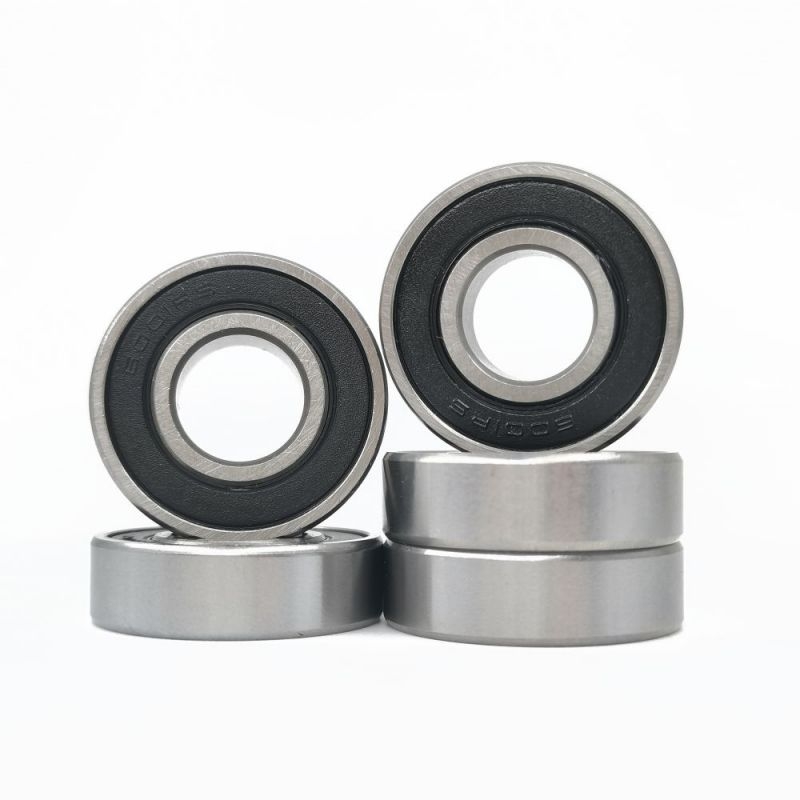
Featured from our production line 608ZZ Double Iron Sealed Deep Groove Ball Bearing 8 x 22 x 7 mm, chrome steel rings, double metal shields — the standard choice for motors, fans, and appliance drives. View specifications and customization optionsAngular contact bearings exist because a deep groove bearing becomes the weak point when the axial component dominates in one direction. The raceways are shifted so that each ball meets the rings along an angled line of action — commonly 40 degrees, with 15 and 25 degree variants for high-speed spindles — which lets the bearing carry a continuous one-way axial load together with radial load, at a rigidity a deep groove cannot match.
The catch is physics: a single angular contact bearing accepts axial load in only one direction, so it is almost always mounted in pairs. Three arrangements cover everything. Back-to-back (the DB or O arrangement) gives the highest resistance to tilting. Face-to-face (DF or X arrangement) tolerates more alignment error. Tandem (DT) doubles the axial capacity when the load only ever pushes one way. Assemblers preload the pair slightly, which removes internal clearance — and that preload is precisely what lets machine tool spindles, screw compressors, and high-speed pump shafts run without wobble.
From a purchasing perspective, expect three things: a higher unit price than an equivalent deep groove bearing, a mounting process that demands clean parts and controlled preload, and sensitivity to shaft deflection — the misalignment a self-aligning bearing would shrug off will cut an angular contact pair's life quickly. They earn their cost in spindles, precision pumps, and any rotating assembly where radial runout is measured in microns.
Wherever a shaft is long, thin, or loaded so that it bends, the type to reach for is the self-aligning ball bearing. Its structure is distinctive: two rows of balls running on a single spherical raceway in the outer ring, so the inner ring with its balls can pivot freely inside the outer ring. Depending on size, the bearing compensates roughly 2 to 3 degrees of static misalignment continuously while running.
That tolerance is not free. The spherical outer raceway produces a less efficient contact geometry than a deep groove, so radial capacity is somewhat lower for the same boundary dimensions, and axial capacity is limited. The reward shows up in total system cost instead: fan rotors on long shafts, textile machinery frames that flex, conveyor head pulleys, and agricultural equipment all keep running with bearings that would be edge-loading themselves toward failure if they were rigid types.
A practical warning drawn from warranty claims: a self-aligning bearing cannot rescue a badly machined housing seat. It compensates for dynamic misalignment — shaft bending, frame deflection, thermal growth — not for a housing bored a fraction of a millimeter off center. Treat it as insurance against the loads that show up after installation, not against errors made before it.
Thrust ball bearings are specialists with one of the narrowest job descriptions in the catalog: they carry axial load only, in one direction (single-direction types in the 51100 series) or in both directions (double-direction types in the 52200 series), and they accept essentially no radial load at all. The structure is two washers with grooved raceways plus a ball-and-cage assembly, usually separable into three parts for simple mounting against flat shoulders.
Two limits explain why they appear only at low and moderate speeds. First, at high rotational speed the balls are flung outward against the cage and raceway edges by centrifugal effect, which is why catalogs cap their speed well below deep groove values. Second, manufacturers specify a minimum axial load; below that threshold the balls skid instead of rolling, and skidding polishes the raceway into early failure.
Typical duty includes rotary tables, hoist hook blocks, valve stems and actuators, seat adjusters, jacks, and the vertical shafts of slow mixers — always paired with a separate radial bearing that carries the radial component. When an engineer asks us for a thrust bearing that also runs fast, the honest answer is usually an angular contact pair instead.
Material choice is where identical dimensions turn into different products. For the large majority of applications chrome steel is technically and economically correct; the stainless premium starts paying for itself the moment water, cleaning chemicals, salt, or food contact enter the picture. Carbon steel, finally, is a deliberate economy decision that suits short-life products — and a false economy almost everywhere else.
| Material | Typical ring hardness | Corrosion behavior | Relative cost | Best fit |
|---|---|---|---|---|
| Chrome steel (GCr15 / 100Cr6 / AISI 52100) | HRC 60-64 | Rusts without protection; needs oil or grease film | Baseline | Motors, gearboxes, general machinery |
| Carbon steel | Lower, varies by grade | Poor; surface plating is common | Lowest | Toys, light furniture casters, short-life consumer items |
| AISI 304 stainless | Not hardenable; moderate | Excellent general corrosion resistance | Mid to high | Food equipment, wet assemblies, lighter loads |
| AISI 440C stainless | HRC 58-62 | High corrosion resistance for a hard steel | Highest | Marine, chemical, washdown, corrosive load-bearing duty |
The stainless comparison inside that table is the one buyers most often get wrong. AISI 304 is austenitic: it resists corrosion superbly and is effectively non-magnetic, but it cannot be through-hardened by heat treatment, so its load capacity sits clearly below chrome steel. AISI 440C is martensitic: it hardens into the same range as bearing steels while still resisting rust, which is why it is the default recommendation for pumps and conveyor components that see regular washdown. We break down the hardening route in more detail on our AISI 440C stainless steel bearings page.
Two procurement checks follow directly from the table. First, ask for the material certificate with the shipment — hardness and chemistry are the two data points that separate genuine 440C from plated carbon steel sold as stainless. Second, remember that the cage and seals are often the corrosion weak point before the rings are: a 440C ring with a standard NBR seal still fails in caustic washdown, so specify the complete material set, not just the rings.
Featured from our production line S608RS Stainless Steel Double Rubber Sealed Deep Groove Ball Bearing 8 x 22 x 7 mm, stainless steel rings, 2RS contact seals — sized for wet, humid, and washdown environments. View material and sealing detailsA significant share of the bearings we ship never touch their housing directly. Overmolded bearings — the plastic coated BS series and the polyurethane PU series — wrap the outer ring in an engineered polymer layer, and the coating changes the application more than the bearing inside it.
A polyamide or similar engineering plastic layer over the outer ring delivers three benefits a bare steel ring cannot: quieter running against hard housings, surface protection for painted or anodized frames, and electrical insulation. The profile of the coating also defines the running track — V-groove versions guide sliding doors and shower enclosures, U-groove versions ride round guide rails, and flat-tread versions carry furniture, drawer systems, and conveyor lines. Colors are matched to the customer's product on volume orders, which is why white, black, and orange versions of the same 626-size bearing exist side by side.
Polyurethane adds what hard plastic cannot: elasticity. A PU tread absorbs shock, grips smooth floors, and protects tile or wood, which makes it the standard choice for baby stroller wheels, fitness equipment rollers, soft-rolling furniture casters, and warehouse conveyor rollers where noise and floor marking are the complaints to be engineered away. The hardness of the PU layer is a specification in its own right — softer treads grip and silence, harder treads carry and last.
The failure mode to ask any supplier about is delamination: a poorly bonded overmold separates from the ring under load cycling, and the bearing starts skating inside its own coating. Bond strength and concentricity after molding are process controls, not catalog numbers — a concrete reason to buy overmolded types from a factory that molds and grinds in the same plant rather than from an assembler of neither.
The third variant layer is how the bearing attaches to the machine. A plain deep groove bearing needs a machined housing with shoulders and a retaining method; a flanged bearing removes much of that machining by adding a radial flange with screw holes to the outer ring, so the bearing bolts directly into a punched sheet-metal housing and locates axially in a single operation.
The flange families mirror the deep groove series: F-prefixed metric flanged bearings follow the 60x and 68x envelopes, MF covers the smaller MF sizes, and FR covers inch sizes. An F684ZZ, for example, keeps the 4 x 9 x 4 mm envelope of a 684 but adds a flange, so one part mounts into printers, office equipment, small gearboxes, and medical device housings with three screws. For heavier assemblies, four-hole flange mount bearings and pillow block units move the same idea up in size.
Non-standard rings are the other frequent request. Extended inner rings — one side or both, from 1 mm to more than 10 mm — let an idler pulley or drive roller mount directly on the bearing; special bores and double-row non-standard versions handle combined loads in narrow spaces. The economic logic is simple: every feature machined into the ring at the bearing factory is a feature the customer does not have to machine, fixture, or buy separately — and it arrives with the bearing's own concentricity tolerances intact.
Featured from our production line F684ZZ Flanged Deep Groove Ball Bearing 4 x 9 x 4 mm with integral mounting flange, double metal shields — made for sheet-metal housings and compact assemblies. View dimensions and mounting drawingChoose by load direction first, environment second, and price last — that ordering prevents almost every selection mistake we see in returned samples. The chart below compresses the four families into an indicative comparison; treat the bars as relative guidance for typical catalog sizes, because a 63-series deep groove will out-load a miniature angular contact bearing every time simply by being bigger.
Indicative capability of the four ball bearing families, relative scale 0-100
| Type | Main load path | Axial load | Misalignment tolerance | Typical applications |
|---|---|---|---|---|
| Deep groove | Radial | Limited, both directions | Low | Motors, pumps, appliances, wheels |
| Angular contact | Combined, one-way axial | High, single direction; pairs share the load | Very low | Spindles, precision pumps, compressors |
| Self-aligning | Radial, two rows | Small | High, roughly 2-3 degrees | Fans, long shafts, textile and farm machinery |
| Thrust | Axial only | Full capacity, no radial | Very low | Turntables, hoist hooks, valve actuators |
Read the chart with your own application in hand. A horizontal washing machine drum sees mostly radial load with reversing axial components — deep groove. A lathe spindle needs one-direction axial stiffness — a paired angular contact set. A long conveyor drive shaft on a light frame — self-aligning. A hand-winched turntable — thrust. The environment then decides the seals and the material, and only after those three answers should unit price enter the conversation.
The fastest way to turn a small saving into a warranty problem is to compare bearings by dimension and price while ignoring the dynamic load rating. Ball bearing life follows a cubic law: the basic rating life is L10 = (C/P)^3 million revolutions, where C is the dynamic load rating and P is the equivalent load acting on the bearing. Double the load and rated life drops to one eighth; halve the load and it multiplies by eight.
Rated life falls steeply as load approaches the dynamic load rating
The curve explains field behavior that otherwise looks random. A fan running at 60 percent of its bearing's load rating can outlast the appliance it sits in; the same fan with a slightly heavier impeller at 110 percent loses two-thirds of its calculated life. For a buyer, the practical rule is to put the dynamic load rating on the comparison table next to the price — two quotations with identical dimensions can differ by 20 percent or more in C, and that difference is worth more than the unit price gap at almost any volume.
Misalignment shortens the same curve from another direction: edge loading concentrates the entire contact stress on one side of the raceway, so the effective load multiplies locally even when the calculated value looks safe. This is the hidden cost of skipping the self-aligning or flanged variant that the application actually needed.
Most bearing complaints we receive trace back not to the bearing itself but to a specification gap on the purchase order. Before you confirm any volume order, run the eight checks below — each takes minutes and eliminates a documented failure mode.
Production scale matters for two of these checks. A manufacturer running tens of millions of pieces per year under an ISO 9001:2015 quality system can hold clearance and noise class consistent across batches, because the grinding and assembly parameters are set once and audited regularly. A small mixed-source batch may not. When your product carries your brand into a customer's living room, batch consistency is a specification, not a bonus.
Deep groove. It combines radial capacity, two-direction axial capacity, high speed, and the lowest cost, which is why it is the default in electric motors, household appliances, fans, pumps, and wheels of every size, from MR micro bearings up to 63-series industrial sizes.
Yes, within limits, and in both directions. A common working approach is to keep the axial component well below the radial capacity of the bearing and confirm the exact ratio with the manufacturer, because a raised axial share increases friction, temperature, and grease stress. When the axial load is large and one-directional, an angular contact pair is the correct tool.
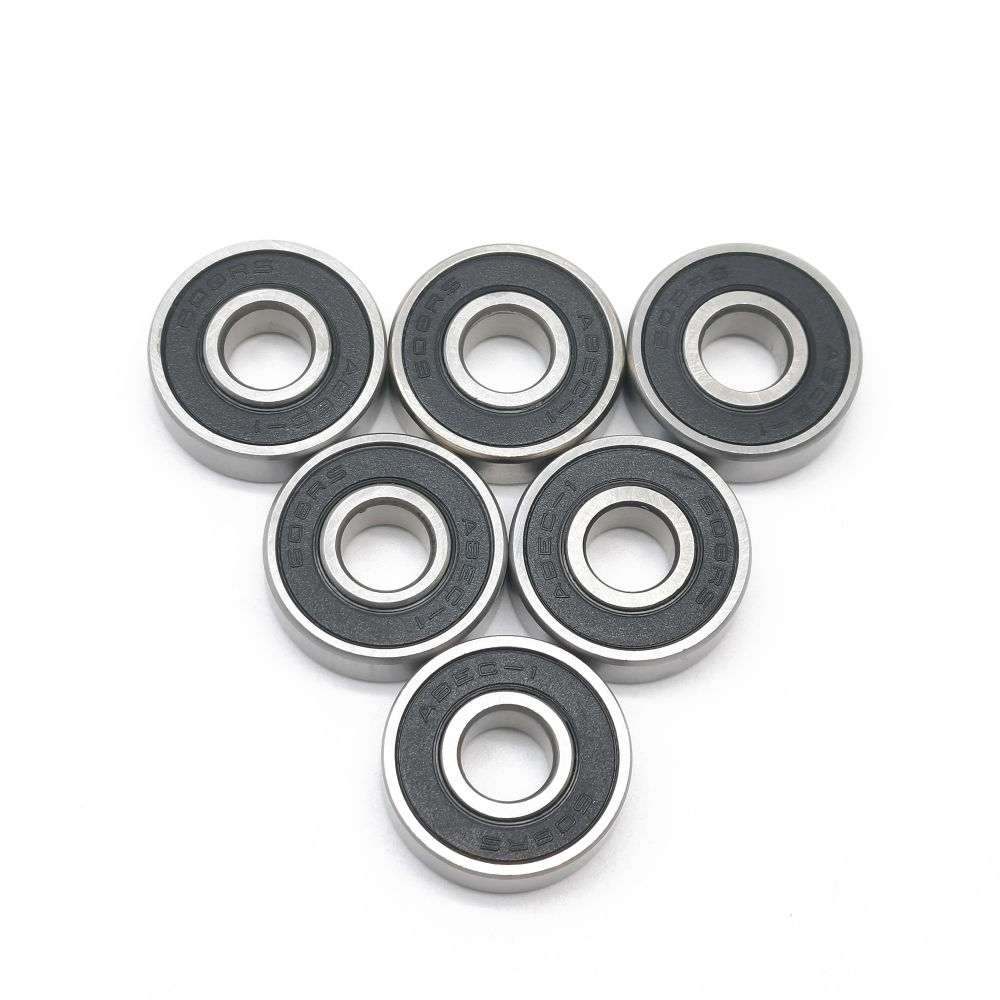
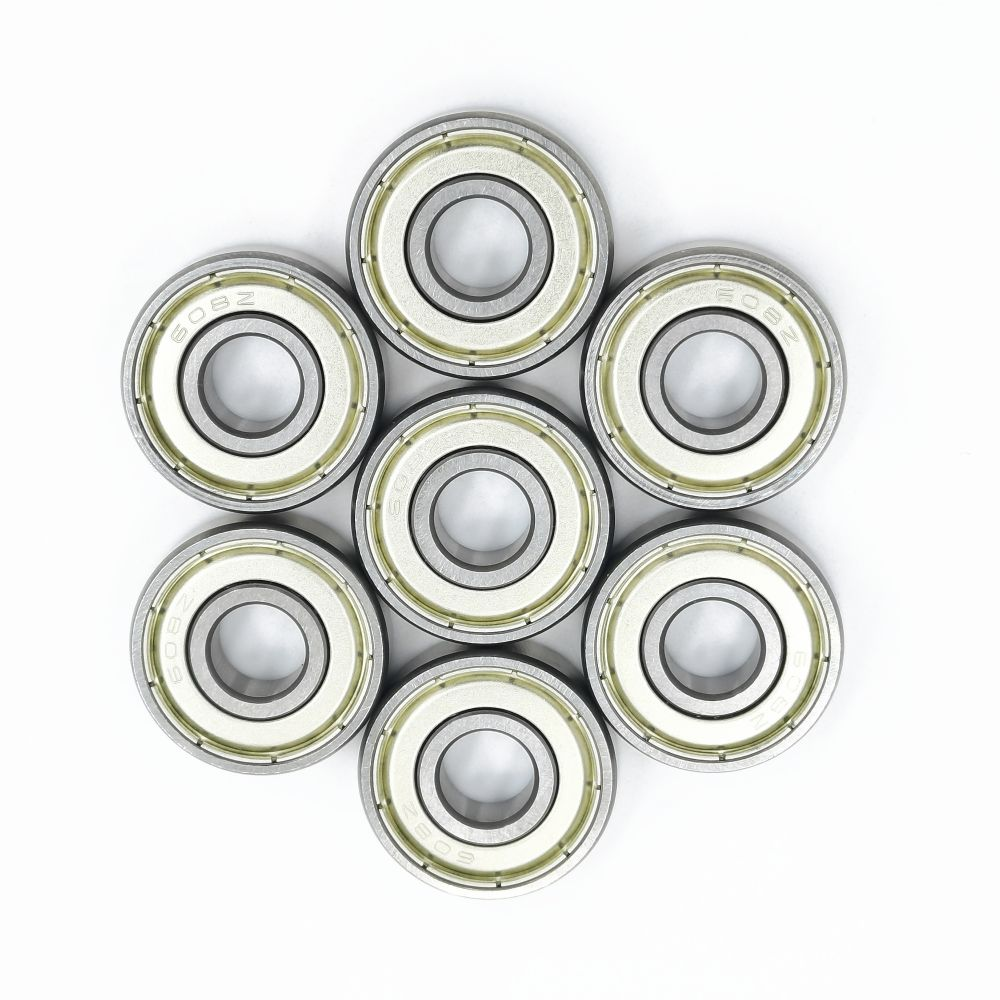
ZZ is a pair of non-contact metal shields: minimal friction and no rubber to age, but only gap-level protection against dust and none against water. 2RS is a pair of rubber contact seals that touch the inner ring: full protection against splash and fine particles, at the cost of slightly higher torque and a temperature ceiling set by the elastomer. Choose ZZ for clean, high-speed duty and 2RS for wet or dusty environments.
The self-aligning ball bearing, by design: two rows of balls share a spherical outer raceway and compensate roughly 2 to 3 degrees of misalignment while running. Flanged and standard deep groove types tolerate only fractions of a degree before edge loading begins.
AISI 304 versions, yes — the austenitic structure cannot be heat hardened, so load capacity is clearly lower. AISI 440C versions harden into roughly the same range as chrome steel, about HRC 58 to 62, while still resisting corrosion, so the gap narrows substantially; the remaining trade-offs are price and slightly lower maximum hardness than the best chrome steel.
The 6 marks a deep groove ball bearing, 2 the light-medium dimension series, and 03 is a bore code: 00 means 10 mm, 01 means 12 mm, 02 means 15 mm, 03 means 17 mm, and from 04 upward the bore equals the code times five. The suffix 2RS means rubber seals on both sides. The same logic reads 608 as a light-series 8 mm bore bearing and MR84 as a micro 4 x 8 x 3 mm bearing.
When the load is almost purely axial, the speed is low to moderate, and the housing can present the load against flat washers. The moment meaningful radial load or high speed appears, an angular contact pair takes over the job.
Because the rating is set by internal geometry — ball size and count, raceway curvature, steel cleanliness, and hardness — none of which show in the outer dimensions. Two factories can produce the same envelope with meaningfully different dynamic load ratings, which is exactly why the rating belongs on the purchase order next to the size.
If you are holding a failed bearing or a drawing and wondering which of the types above fits it, our engineers work from four numbers: load direction and magnitude, speed, environment, and the housing you have to mount into. Send those — or the failed part itself — and we will come back with a family recommendation, a material and sealing proposal, and sample lead times. Production runs on ISO 9001:2015-certified lines with an annual capacity of 30 million sets, so the sample you approve is the batch you receive.


Products
CONTACT Us
Mobile Site
Copyright© Zhejiang Yingfei Biotechnology Co., Ltd. All Rights Reserved
 Wholesale Motorcycles/Cars Vehicles Bearing Source Factory