
 0
0

 English
 Español
 中文简体
中文简体 عربى
عربى
Industry News
Home / News / Industry News / How Are Ball Bearings Made? The Complete Manufacturing Process, Step by Step

2026-09-21
A ball bearing becomes a bearing at the grinding stage, not before it. Forging, turning and heat treatment prepare hardened steel shapes; grinding and lapping then set the microns that decide how quietly the bearing spins, how much load it carries and how long it lasts. That ordering matters for anyone buying bearings, because it explains where the cost sits, why two quotes for the same size can differ so widely, and why quality problems usually trace back to a few specific, checkable stages.
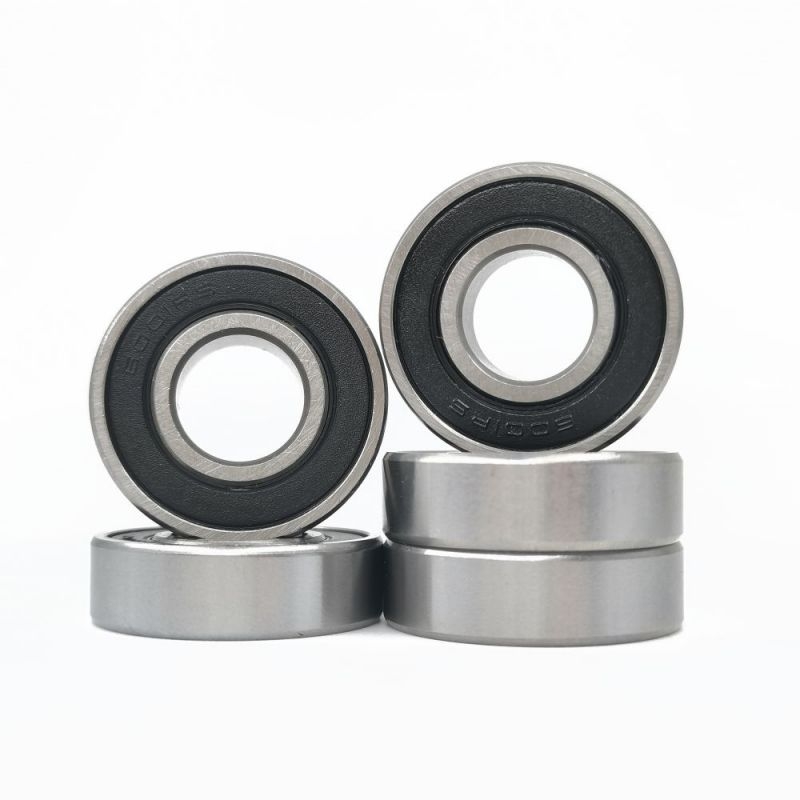
Open up a failed 608 bearing from a fan motor or a skateboard wheel and the anatomy is almost disappointingly simple: an inner ring, an outer ring, a row of hardened balls, a cage that keeps those balls from touching, and a film of grease. The manufacturing question is how those five basic things get made accurately enough to run at tens of thousands of revolutions per minute. The answer is two parallel production lines — one for rings, one for balls — that only meet at final assembly.
This guide follows the complete process the way a deep groove ball bearing factory actually runs it: raw material selection, forging, turning, heat treatment, ball making, grinding, superfinishing, assembly and batch testing. It also covers coated bearings, quality control, the checks that matter before ordering, and the questions buyers raise most often. The description reflects production under an ISO 9001:2015 quality system at a plant with an annual output of 30 million sets.
A deep groove ball bearing contains four solid components and one consumable, and each one follows a completely different production route. That split is the key to understanding quality differences between suppliers: every component carries its own failure modes, and one weak step — a dirty steel heat, a soft ball, a rough raceway — is enough to drag down the whole assembly.
The load path through these parts explains the precision requirement. Every unit of force passing from shaft to housing crosses two raceways, a set of balls and a lubricant film measured in microns. If a raceway is rough or a ball is out of round, the contact stress concentrates on microscopic high spots, and those spots become the first points of fatigue. This is why bearing production is less about shaping steel and more about removing the last traces of error.
Most deep groove ball bearings in the world start as chrome steel — a high-carbon chromium grade that travels under several national names: AISI 52100 in the United States, 100Cr6 in Germany, SUJ2 in Japan and GCr15 in China. The chemistry is deliberately plain, roughly 1% carbon and 1.5% chromium, because the value is not in exotic alloying but in cleanliness. Hard non-metallic inclusions in dirty steel act as stress concentration points, and in service they appear as noise and early fatigue spalling. This is why a serious factory verifies every incoming heat lot by spectral analysis instead of trusting the mill certificate alone.
Stainless grades serve corrosive environments, and they split into two very different options. AISI 440C is a martensitic stainless steel that hardens like chrome steel, holding 56-60 HRC while resisting rust, which makes it a standard choice for food equipment, washdown areas and humid outdoor products. AISI 304 cannot be hardened by heat treatment at all — it stays soft, below roughly 200 HB — so 304 bearings trade load capacity for maximum corrosion resistance. Carbon steel sits at the other end of the scale: it lowers cost for light-duty products such as toys and low-speed casters, but it cannot match chrome steel on hardness or fatigue life.
| Material | Key traits | Typical hardness | Common uses |
|---|---|---|---|
| Chrome steel (AISI 52100 / GCr15) | High carbon plus about 1.5% chromium; excellent rolling fatigue life | 60-64 HRC after heat treatment | Motors, appliances, power tools, pumps, automotive parts |
| Carbon steel | Lower cost, lower precision and shorter fatigue life | Below hardened chrome steel | Toys, casters, light-duty hardware |
| AISI 304 stainless | Austenitic; cannot be through-hardened; maximum corrosion resistance | Under about 200 HB (soft) | Food equipment, wet and washdown areas with modest loads |
| AISI 440C stainless | Martensitic; hardenable stainless with strong corrosion resistance | 56-60 HRC after heat treatment | Food-grade and outdoor products needing real load capacity |
Ring production and ball production run as two parallel lines that converge only at assembly. On the ring line the sequence is forging, annealing, turning, heat treatment and grinding; on the ball line it is cold heading, flashing, heat treatment, grinding and lapping. The overview below follows the order used on the shop floor of a deep groove ball bearing plant.
Traceability runs through every stage. Each billet keeps its heat number, each batch records its furnace run, and each packing list references the production batch, so a finished bearing can be traced back to its steel certificate. Under an ISO 9001:2015 system this is not optional paperwork: when a customer reports noise months later, traceability determines whether the cause sits in one steel lot, one heat treatment run or one assembly setting — and that distinction decides whether the right response is sorting, rework or a process correction.
Bearing balls are never cut into spheres. They are struck close to round, then rolled against each other under abrasive until every surface averages out — a self-correcting process that turns hard steel wire into balls round within a fraction of a micron. Because the parts are work-hardened steel, cutting tools would wear instantly; abrasive shaping is the only practical route.
The reason the process works is geometry: a ball has no fixed axis. It tumbles freely in the grooves and presents every point of its surface to the abrasive, so a high spot is always the next thing to be worn away. The ball that sticks out gets hit next; the process removes its own errors. This is what makes it possible to mass-produce spheres more accurately than almost any other machined part.
The grading system puts numbers on roundness. In the standard ball grading convention, the grade number is the maximum allowed deviation from a perfect sphere in microinches, so Grade 100 permits about 2.5 microns, Grade 25 permits 0.64, Grade 10 permits 0.25 and Grade 5 permits only 0.13. Most commercial deep groove bearings run on Grade 100 balls; quiet appliance motors and precision spindles justify Grade 10 or better. Every step down the grade scale adds lapping time and inspection cost, which makes ball grade one of the quiet cost drivers inside any bearing quote.
Roundness alone is still not enough — the balls must also match their rings. Since no grinding process is perfectly repeatable, finished balls are sorted into size groups measured in fractions of a micron, and rings ground in the same batch are paired with the group that restores the designed internal clearance. This selective assembly is standard practice across the industry, and it is one more reason bearing factories measure everything twice: once to sort, and once to prove.
Grinding shapes the steel, but heat treatment decides whether it survives. A perfectly ground raceway without the correct hardness would dent and flake under load within days, so the furnace — not the grinding machine — is where a piece of shaped steel actually becomes bearing material.
For chrome steel, ring blanks and balls are heated to around 840 °C until the structure transforms to austenite, quenched in oil fast enough to lock in hard martensite, then tempered near 160 °C to relieve internal stress. The result is 60-64 HRC: hard enough to resist rolling contact fatigue, tough enough not to crack under shock. Skip the temper and the parts stay brittle; over-temper and the hardness falls along with the service life.
Control at this stage is invisible on a finished part and expensive to fake. Furnace temperature uniformity, quench oil condition and soak time decide whether an entire batch lands in specification or drifts soft. Distortion needs managing too: heat-treated rings warp slightly, and the process must hold that warp inside the grinding allowance, otherwise the grinding line pays for the furnace's error in extra cycles. Precision grades add one more step — a deep cold treatment that transforms retained austenite and stabilizes dimensions over years of service.
Hardness targets after heat treatment: chrome steel (AISI 52100 / GCr15) reaches 60-64 HRC; AISI 440C stainless reaches 56-60 HRC; AISI 304 stainless is not through-hardenable and stays below about 200 HB.
This is also where the stainless split becomes physical. 440C parts pass through the same furnaces and come out with usable hardness, while 304 rings cannot harden at all. That single metallurgical fact explains why 304 bearings suit wet, corrosion-heavy applications with modest loads, and why 440C is the answer when an application needs corrosion resistance and real load capacity at the same time.
Every ring arrives at the grinding line deliberately oversize. Grinding removes that allowance and, at the same time, defines the tolerances a buyer is actually paying for, which makes it the most influential stage in the entire production chain.
The sequence is fixed: grind the faces first to create a reference plane, then the outside diameter and bore, then the raceway. Coolant runs constantly, because a momentarily dry wheel can burn the surface and create micro-cracks that hide inside an apparently good part until it fails early. After raceway grinding, a superfinishing pass with fine stones drops the surface roughness well below 0.1 microns Ra — a finish that looks like a mirror and, more importantly, lets the lubricant film form and carry load properly. Skipping or shortening the superfinish is one of the classic ways to cut cost invisibly, and it always reappears later as noise and shortened life.
| ISO class | ABEC equivalent | What it tightens | Typical applications |
|---|---|---|---|
| P0 | ABEC 1 | Standard dimensional tolerances | General motors, appliances, power tools, pumps |
| P6 | ABEC 3 | Tighter runout and width tolerance | Better motors, electric tools, gearboxes |
| P5 | ABEC 5 | Micron-level runout control | Machine tool spindles, precision instruments |
| P4 | ABEC 7 | Very tight geometry for high speed | High-speed spindles, aerospace, dental handpieces |
Choosing a class is a cost decision, not a status symbol. An appliance motor, water pump or power tool normally runs correctly on P0 (ABEC 1); paying for P5 buys tolerance the application never uses. Machine tool spindles, high-speed motors and measuring instruments are the cases where P5 and P4 genuinely earn their price. When two quotes for the same size differ sharply, tolerance class is one of the first items to confirm in writing — right behind the steel specification.
Assembly is short in time and long in consequences. Two parallel production lines converge, and the least expensive parts of the bearing — cage, grease and seals — end up deciding much of its real-world behavior.
Stamped steel cages are the default in small deep groove bearings: inexpensive, rigid and riveted together from two halves. Nylon cages run quieter and cannot rust, which is why they dominate low-noise appliance bearings, with the tradeoff of a temperature ceiling around 120 °C. Brass appears in larger or special bearings where strength and heat resistance matter together.
The rings and balls meet in matched groups. The ball size group is selected against the measured raceways so the assembled bearing lands inside its designed internal clearance — the tiny free movement between rings that shrinks as the bearing is mounted and heats up. Standard clearance (C0) suits most applications; a larger C3 clearance is specified when the inner ring runs hot or fits tightly on the shaft. Balls are loaded into the gap between the shifted rings, spaced evenly, and the cage pockets are snapped or riveted around them before the assembled bearing goes through its final wash — because grinding residue left inside is a noise source no seal can remove.
Grease fills roughly a quarter to a third of the free internal space. Too little and the bearing runs toward metal contact at speed; too much and churning raises temperature and noise. For buyers, the grease specification is worth confirming explicitly, because it sets the speed limit, the low-temperature behavior and the maintenance-free life of the finished product.
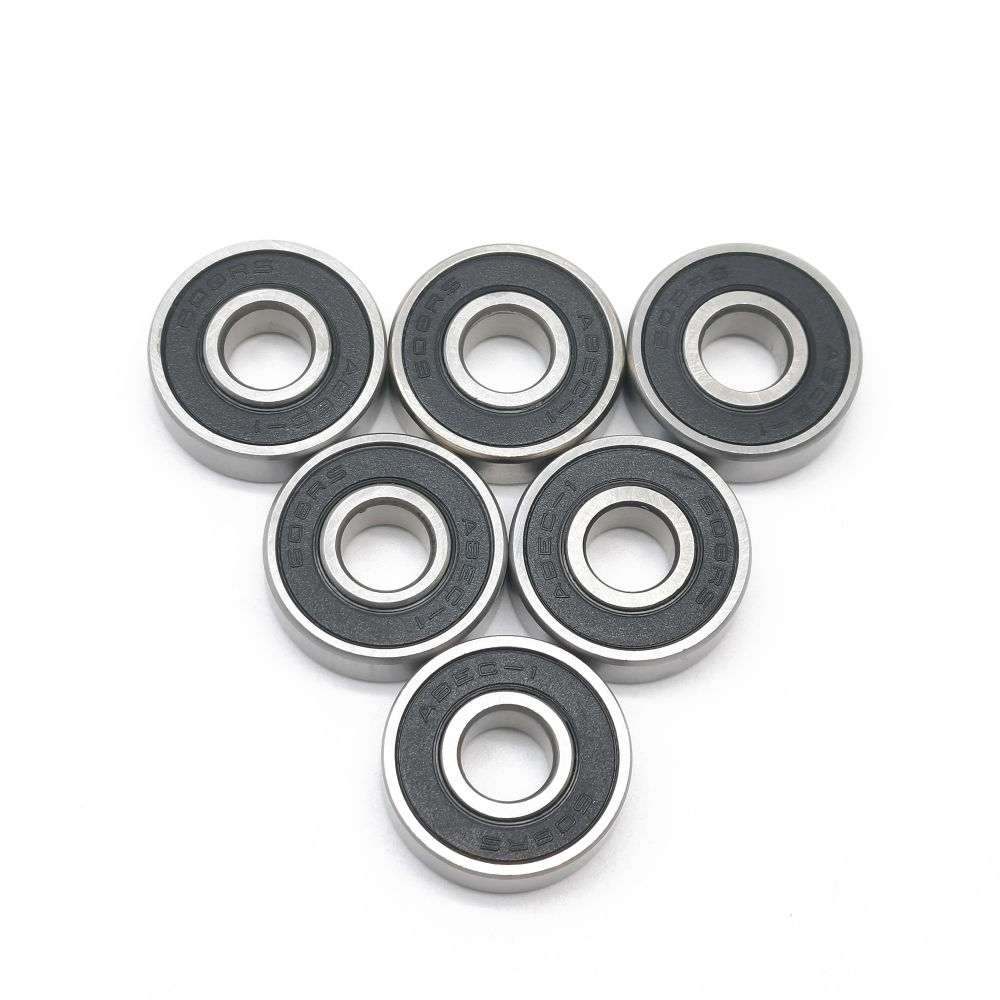
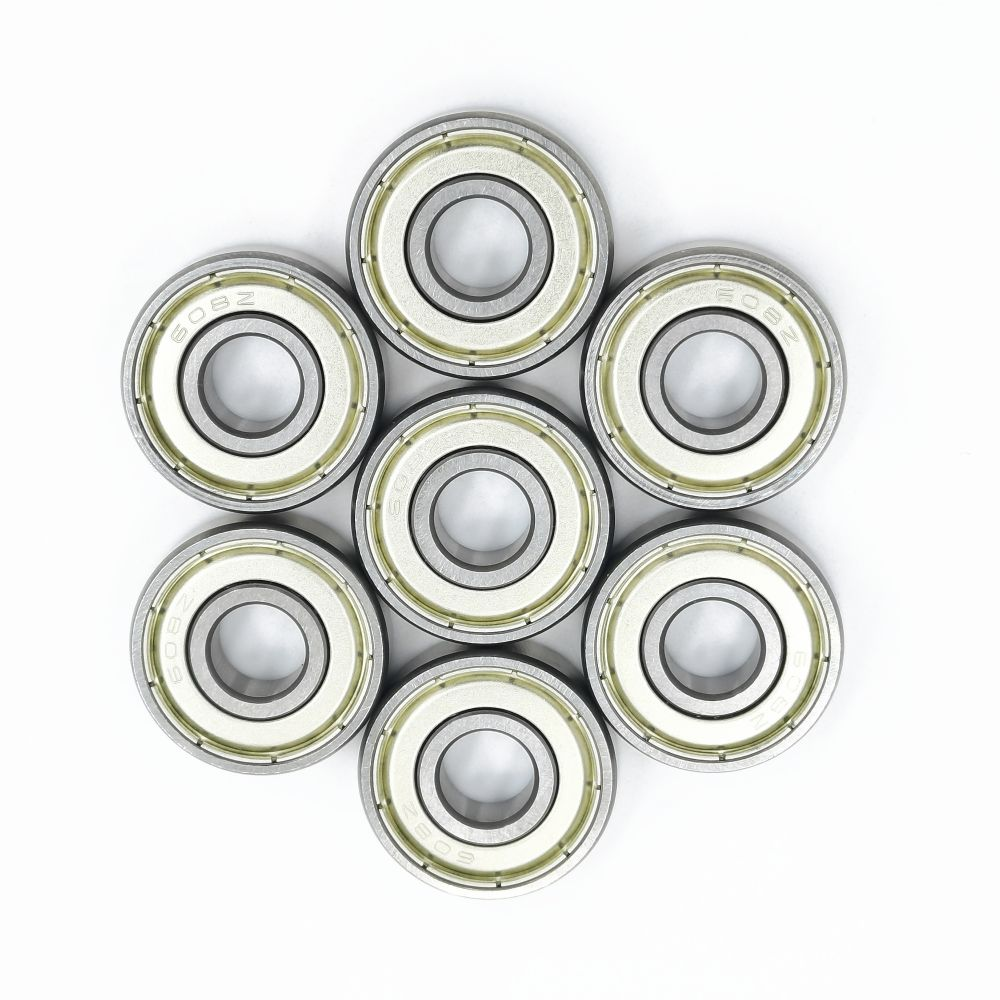
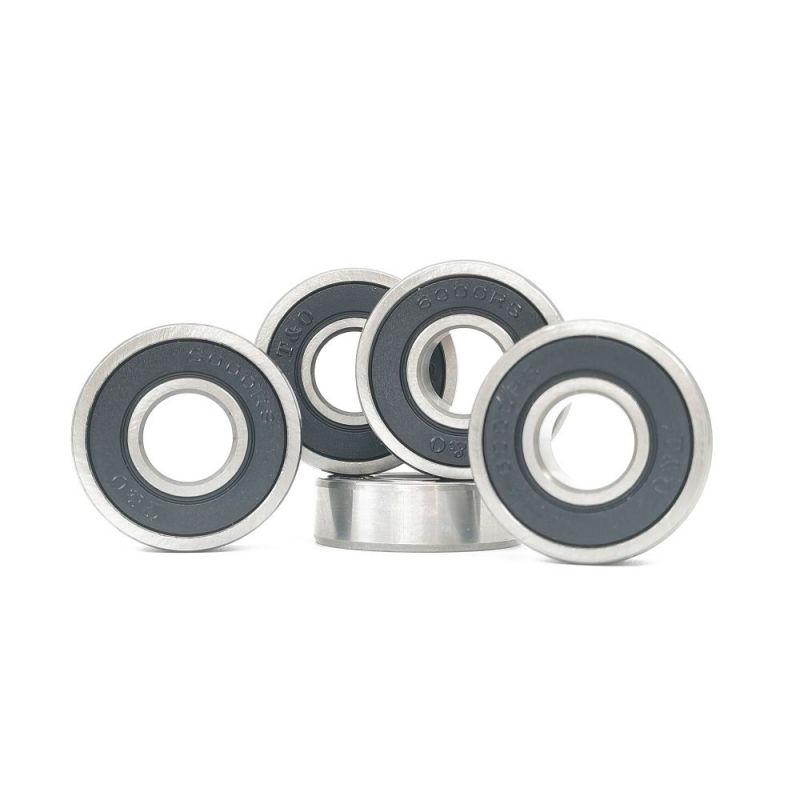
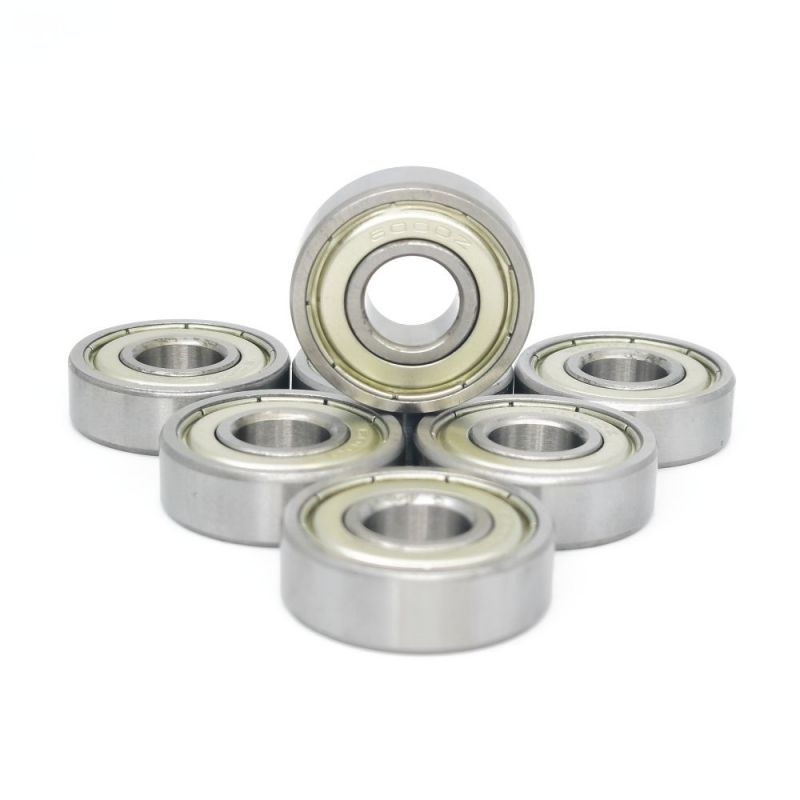
ZZ means two metal shields: non-contact, minimal drag, effective against coarse dust, moderate against water. 2RS means two rubber seals, usually NBR, in light contact with the inner ring: far better against fine dust and moisture, slightly higher running torque, and a practical temperature ceiling around 110 °C. The right choice is environmental — dry, fast and clean conditions lean toward ZZ; wet, dusty or washed-down equipment leans toward 2RS.
The classic result of this process 608ZZ Double Iron Sealed Deep Groove Ball Bearing 8 x 22 x 7 mm chrome steel bearing with double metal shields — the most common small size in motors, tools and hardware. View product specificationsBefore packing, low-noise grades pass 100% vibration testing while standard grades are checked by sampling. Every bearing receives a film of rust-preventive oil and a sealed package. Preservation is part of manufacturing, not an afterthought: a dimensionally perfect bearing that rusts in a humid warehouse before installation still counts as a defective delivery.
Some bearings are engineered to be quiet and surface-friendly rather than maximally hard, and that is achieved with a second molding process that wraps the outer ring in plastic or polyurethane.
The base bearing — commonly a 608, 626 or 6000 series size — is washed and mounted into a mold core. Molten plastic or thermoplastic polyurethane is injected around the outer ring, bonds to it as it cools, and comes out with the working profile formed in the same step: a flat tread for rollers, a V-groove or U-groove for sliding tracks, in colors such as white, black, orange and green that customers use to keep their product lines identifiable at a glance.
The coating changes the behavior of the whole wheel. Plastic and PU layers dampen the metallic noise that hard steel transmits into furniture frames, sliding doors, windows and conveyor structures; they protect the surfaces the bearing rolls against from scratching and wear; and polyurethane adds grip plus shock absorption for trolley and transport wheels, typically specified in the 85-95 Shore A hardness band. In furniture, baby products and home hardware, the coated layer is often the difference between a product that feels cheap and one that feels finished.
The engineering risk is adhesion. A badly bonded coating can delaminate after weeks of rolling, and although the failure appears to be a coating problem, the root cause is usually surface preparation, bonding chemistry or mold design. Reliable producers treat coating as a process with its own inspections — pull tests on samples, mold maintenance schedules and hardness checks on the cured layer — rather than as a simple dipping operation.
Coated bearing example PU608267 PU Coated Deep Groove Ball Bearing A 608 base bearing with a molded polyurethane layer for quiet running and surface protection in rollers and sliding systems. View product specificationsA dependable factory tests three times: on incoming steel, at the critical machining steps, and on finished bearings. Removing any of the three layers to save cost eventually shows up as noise complaints, shortened life or field returns.
Noise deserves special attention because it is the most common quality complaint from finished products, and it is decided by combinations of factors — ball grade, raceway finish, cleanliness and grease — rather than by any single measurement. Grading 100% of low-noise production is what separates a bearing that hums from one that whines, and the techniques behind it form a discipline of their own; this article on how factories control the noise and vibration of deep groove ball bearings covers them in detail.
Batch traceability closes the loop. Each production batch links forward from the steel heat number and backward from the packing list, so when a customer reports a problem months after delivery, the factory can isolate the affected batches instead of guessing. That capability stays invisible until the day it is needed — and on that day it decides whether a claim is settled in days or argued about for months.
Two quotes for the same 608 size can differ by a third, and both suppliers can be completely honest. The difference almost always hides in five places, so the practical habit is to pin each one down in writing before comparing prices.
Each unchecked line is a documented procurement risk. Underspecified steel turns into noise complaints in finished motors; missing vibration grading turns into returns from retail products; the wrong seal turns into grease washout in wet equipment. None of these risks appear on a price list, which is exactly why they belong in the order confirmation instead.
A useful exercise is to ask each supplier the same three questions — what steel, what hardness, what vibration grade — and to request the reports that back the answers. Suppliers who test regularly answer with documents in hours; suppliers who rely on claims answer with adjectives. The speed and substance of that reply tells you more about the factory than any catalog page.
Standard catalog sizes cover most applications, but the highest-value orders often begin with a customer drawing that no catalog matches — and that is where a factory's process depth becomes visible.
Non-standard work follows a fixed route: drawing or sample review, feasibility confirmation on material and tolerance, tooling preparation, sample production, approval, then batch manufacturing with the same inspection system as standard parts. Typical requests include inner rings extended on one or both sides for special mounting arrangements, double-row versions of small sizes, special widths, and coated bearings with custom tread profiles or colors.
The decision to customize is mostly economic. If a standard bearing can be adapted with a spacer or a minor design change, that route is usually cheaper and faster. If the machine architecture depends on the special part — as it often does in motors, sliding systems and conveyor equipment — then a proven non-standard source beats redesigning the product around a catalog size. The range of extended-ring, special-dimension and precision-ground parts available as customized non-standard precision bearings shows how wide that category runs in practice.
Most are made from high-carbon chrome steel, grade AISI 52100 (also sold as 100Cr6, SUJ2 or GCr15), heat treated to 60-64 HRC. Corrosive environments use AISI 440C stainless for hardness with rust resistance, or AISI 304 when maximum corrosion resistance matters more than load capacity. Carbon steel appears mainly in light-duty, low-cost products.
Balls are cold headed from wire with a flash seam, flashed smooth, heat treated, then ground and lapped between grooved plates. Because the balls rotate freely and randomly in those grooves, every point of the surface meets the abrasive equally, and high spots wear away until the sphere averages out. The result is graded: Grade 100 allows about 2.5 microns of deviation, Grade 10 allows 0.25.
Higher means more precise, not universally better. ABEC (or ISO P) classes define dimensional and running tolerances only — not steel quality, noise, seals or lubrication. Most motors, pumps and appliances run correctly on P0/ABEC 1; paying for P5 or above makes sense mainly for high-speed or precision spindles. Match the class to the application and put it in writing on the order.
ZZ uses two non-contact metal shields: low drag, good against coarse dust, modest water protection. 2RS uses two rubber contact seals that touch the inner ring: much better against fine dust and moisture, slightly higher torque, and a practical temperature ceiling around 110 °C. Dry, fast, clean environments suit ZZ; wet or dusty environments suit 2RS.
The coating, molded around the outer ring, dampens noise, protects the surfaces the bearing rolls against, and — with PU — adds grip and shock absorption for trolleys and conveyors. Profiles such as V-grooves, U-grooves and flat treads are formed directly in the mold, and colors help identify product lines. Coating quality depends mainly on adhesion, which is why sample pull testing matters.
Yes. Factories with non-standard capability routinely make extended inner rings, special widths, double-row versions and coated or grooved designs from customer drawings or samples. The route is drawing review, feasibility and tooling, sample approval, then batch production — so the practical questions to ask a supplier are about sample lead time and the inspection applied to the custom batch.


Products
CONTACT Us
Mobile Site
Copyright© Zhejiang Yingfei Biotechnology Co., Ltd. All Rights Reserved
 Wholesale Motorcycles/Cars Vehicles Bearing Source Factory