
 0


 English
 Español
 中文简体
 عربى
Industry News
Home / News / Industry News / PU Bearings: Polyurethane Coated Ball Bearings - Data, Selection and Custom Builds

2026-10-19
A PU bearing is a composite rolling element: a standard deep groove ball bearing core, usually from the 608, 6000, 6200, 626 or 625 series, with a precision-molded polyurethane tread bonded to the outer ring. The steel core carries radial and axial loads, defines the rotational accuracy, and sets the speed limit. The polyurethane layer handles the surface side of the job. It deforms under load to widen the contact patch, dampens vibration before it reaches the frame, and protects the outer ring from abrasive contact with a rail, track or roller. If you are specifying a PU covered bearing for a conveyor roller, a sliding door hanger or a drive wheel, the first decision is not the tread color or hardness. It is the core bearing, because the core governs load capacity and running accuracy.
Bonding quality separates a durable PU bearing from a short-lived one. A low-priced construction stretches a polymer sleeve over the steel outer ring; under radial load the sleeve can slip, generate internal friction heat and rotate out of phase with the core. Our process degreases and phosphates the outer ring, applies an adhesion promoter, then injection-molds the polyurethane under controlled pressure and temperature. After curing, every batch passes a torsional bond check: the tread must not rotate on the ring when the specified torque is applied in either direction. This test is a pass-or-fail gate before samples are approved for shipment.
Standard PU bearing families cover bore sizes from 4 mm to 20 mm, with molded polyurethane outer diameters roughly 2 mm to 10 mm larger than the steel ring outer diameter. A 608 core (8 x 22 x 7 mm), for example, is commonly overmolded to a 26 mm PU outside diameter, and a 6000 core (10 x 26 x 8 mm) is often overmolded to 30 or 35 mm. These dimensions are not cosmetic. The ratio between PU outer diameter and steel outer diameter changes rolling resistance, heat build-up and load distribution, so it should be selected for the actual working condition rather than copied from a similar-looking product.
| Core series | Bore (mm) | Steel OD (mm) | Typical PU OD (mm) | Width (mm) | Core dynamic load (N) | Seal options |
|---|---|---|---|---|---|---|
| 608 | 8 | 22 | 26 - 27 | 7 - 11 | 2,900 | RS / ZZ |
| 626 | 6 | 19 | 25 - 26 | 6 - 8 | 2,250 | RS / ZZ |
| 6000 | 10 | 26 | 30 - 35 | 8 - 11 | 4,520 | RS / ZZ |
| 6201 | 12 | 32 | 36 - 40 | 10 - 18 | 7,150 | RS / ZZ |
| 624 | 4 | 13 | 17 - 18 | 5 - 7 | 940 | ZZ |
| 625 | 5 | 16 | 20 - 22 | 5 - 7 | 1,080 | ZZ |
Polyurethane is specified in coated bearings when the application needs a combination of abrasion resistance, cushioning and load capacity that single materials do not provide. The chart below compares the relative sliding-abrasion resistance of common polymer materials, with an 85 Shore A thermoplastic polyurethane referenced as 100.
Natural rubber is more elastic than PU but wears about three times faster in continuous sliding contact. Nylon resists wear well but is stiff, so it transmits noise and vibration instead of absorbing them. PVC is economical but weak under dynamic load and low-temperature impact. Polyurethane covers the widest operating range: from roughly 70 Shore A for quiet, low-force duties to 95 Shore A for applications that need a hard, dimensionally stable tread with a degree of elasticity.
The second advantage is contact pressure management. When a hard steel bearing runs directly on a thin metal track, the contact area is small and local pressure can be extremely high, marking the track and generating noise. The PU tread increases the contact patch, so the same bearing can run on painted steel, anodized aluminum or polymer tracks without damaging the mating surface. Buyers often select PU covered bearings not because the bearing itself would fail, but because a bare steel bearing is destroying the track or making the product too loud to sell.
| Property | PU, 85 Shore A | Natural rubber | Nylon | PVC |
|---|---|---|---|---|
| Abrasion resistance | Excellent | Fair | Good | Poor |
| Load capacity | High | Medium | High | Low |
| Noise damping | Good | Excellent | Poor | Fair |
| Continuous temperature range | -20 to +80 deg C | -30 to +70 deg C | -40 to +90 deg C | -10 to +60 deg C |
| Oil and grease resistance | Good | Poor | Good | Good |
| Relative material cost | Medium | Low | Medium | Low |
The operating envelope of a PU bearing comes down to four numbers: hardness, load, temperature and speed. They interact, so changing one usually shifts the others. A harder tread can support more load but transmits more vibration. A softer tread is quieter but deflects more and builds up more heat at high speed. The values below are typical for standard molded polyurethane on a deep groove ball bearing core.
Hardness is the first specification to fix. The range from 70 to 80 Shore A suits furniture rollers and sliding doors, where grip, quietness and tolerance of minor misalignment matter. The band from 80 to 90 Shore A is the general-purpose zone for conveyor rollers and guide wheels, balancing deflection against wear life. The range from 92 to 95 Shore A is for heavy wheels, clamping rollers and high-load transfer sections, where the tread must hold its shape and resist cutting or tearing.
| Hardness (Shore A) | Typical applications | Key characteristics |
|---|---|---|
| 70 - 75 | Light rollers, sliding doors, furniture | High grip, quiet, more deflection |
| 80 - 85 | Conveyor idlers, guide rollers, general industrial | Best compromise between wear and comfort |
| 90 - 95 | Heavy-duty wheels, high clamping rollers | Low deflection, long wear, more transmitted noise |
Temperature is limited by the PU compound, not by the steel bearing. Standard polyurethane runs continuously from -20 deg C to +80 deg C. Brief excursions to +110 deg C are tolerable in most formulations, but prolonged heat hardens the tread, accelerates cracking and weakens the bond to the ring. If the application involves steam cleaning, hot water or continuous radiant heat, the design should use a heat-stable grade or an uncoated steel bearing in that zone.
Speed is also limited by the tread. The PU layer increases the effective rolling diameter and adds centrifugal stress, so a coated bearing cannot run at the same rotational speed as its uncoated core. As a practical rule, keep the surface speed below about 2 m/s for soft treads and below 5 m/s for hard treads, then measure the temperature rise during the first hours of operation. If the time-based speed requirement is dominant, for example a motor with the bearing mounted directly on the shaft, the tread thickness must be reduced or the core internal clearance and grease must be specified for the actual speed.
PU covered bearings are produced in several geometric forms. A flat cylindrical tread is the standard for straight rollers and conveyor wheels. A V-groove tread centers the bearing on V-rails and keeps the assembly aligned without additional guide flanges. U-groove or concave profiles run on round tubes and wire guides. Crowned tread shapes handle angular misalignment between adjacent rollers and reduce edge loading. The profile is machined into the mold, so changing from flat to grooved does not change the core bearing, price or delivery time significantly.
Colors and material grades can be customized without changing dimensions. Black PU is the industrial default because carbon black improves wear consistency and UV resistance. Orange and green treads are used in safety zones or to identify a roller function on a production line. White PU is available for food-related areas where color transfer must be avoided, though the formulation must be checked against the operating temperature and the cleaning chemicals used.
Three representative series from the catalog show the range: PU 608-267, a 608-core bearing with a 26 mm PU outside diameter and 7 mm width; PU 626-268, a 626-core series also offered with an extended steel shaft for direct roller mounting; and PU 6201-4018, a 6201-core series with a 40 mm PU outer diameter and 18 mm width for heavier clamping rollers and transfer trays.
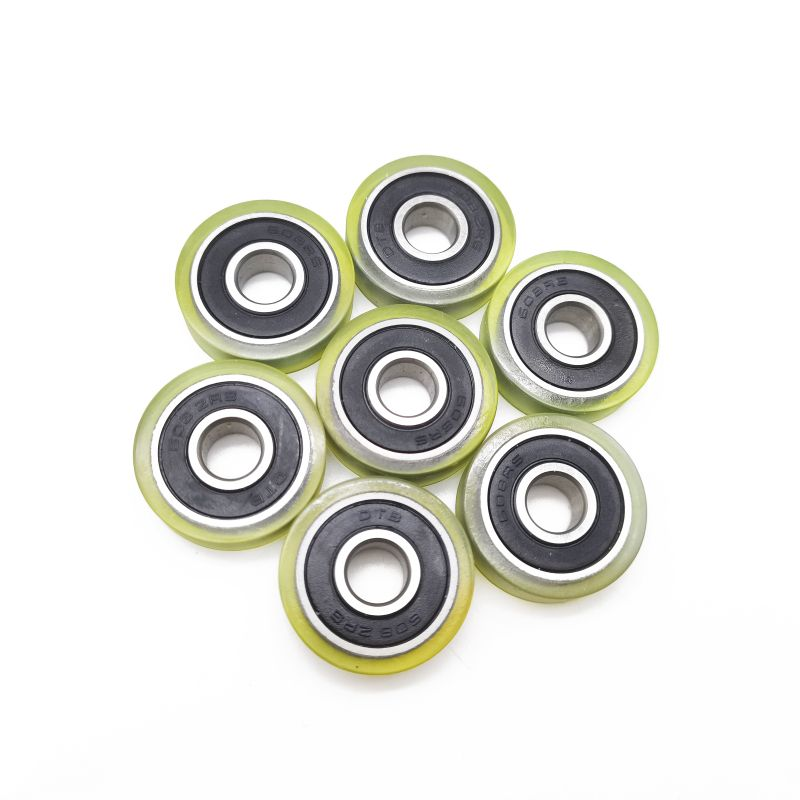 PU 608-267 Coated Deep Groove Ball Bearing for Versatile ApplicationsThis 608-core bearing with 26 mm PU outer diameter suits frequent operation and corrosive environments, offering low noise and wear resistance as highlighted in the catalog series.View Product →
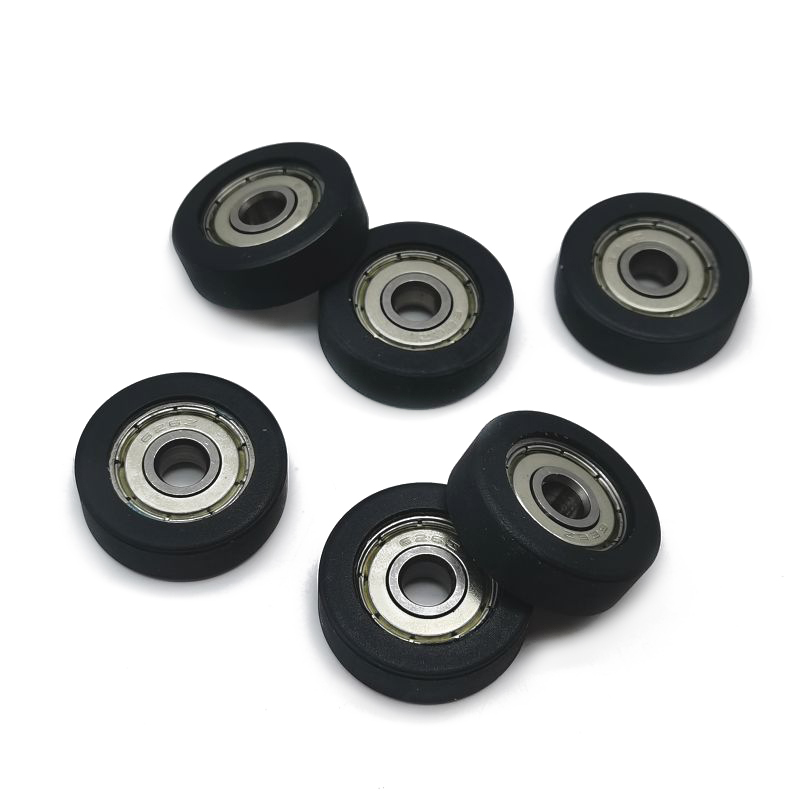 PU 626-268 Black PU Deep Groove Ball Bearing with Extended Shaft OptionFeaturing a 626-core and black PU coating, this model resists moisture and corrosion, with an extended steel shaft available for direct roller mounting in transfer systems.View Product →
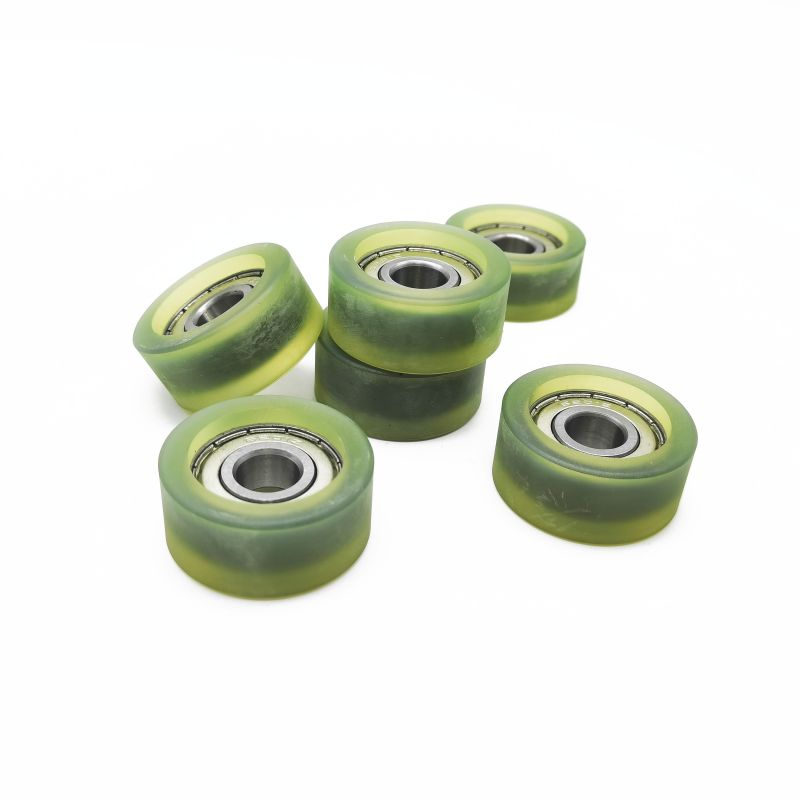 PU 6201-4018 Heavy-Duty PU Coated Bearing for Clamping RollersWith a 40 mm PU outer diameter and 18 mm width, this 6201-core bearing handles heavier loads, reducing friction and noise for industrial transfer trays and machinery.View Product →
All of these can be assembled with rubber seals (RS) or steel shields (ZZ) on the steel core. Sealed versions are recommended for dusty workshops, woodworking lines, wet areas or any environment where the grease inside the core must stay clean to preserve the low-noise behavior of the assembly.
Applications fall into four groups: moving heavy parts quietly, guiding products along a track, running in damp or dusty conditions, and protecting a costly mating surface. In every case the bearing does two jobs at once, carrying the load and managing the surface contact, which is why it is specified instead of a plain steel bearing.
PU covered bearings on gravity conveyors grip the goods without marking cases or boxes. For accumulating sections where packages stop and restart, the heavy-duty PU bearing series provides the extra abrasion resistance needed at the contact zone.
The tread runs quietly on aluminum rails and does not scratch the anodized surface. The grip prevents the door from shimmying in wind, while the sealed core keeps dust and moisture out of the bearing.
Drawer slides, sofa-bed pivots and TV-stand wheels use PU bearings because they are quiet, low-friction and do not leave black streaks on wood or laminate floors.
Cable machine pulleys and treadmill rollers run at moderate speed with frequent reversals. PU cushions the impact and keeps the pulley quiet while the core bearing handles the radial load.
PU treaded wheels absorb the shock of rough sidewalks and provide grip on both hard floors and soft ground. The tread does not scuff interior surfaces when the stroller is folded.
Printers, copiers and paper-feed mechanisms use small PU bearings in the 624, 625 and 608 series for a silent transport path and to prevent slipping of the paper drive rollers.
Selecting a PU bearing means matching four variables at once: core bearing size, PU hardness, tread profile and seal type. The table below gives a workable starting point for the most common requirements.
| Requirement | Recommended hardness | Tread profile | Core series |
|---|---|---|---|
| Quiet sliding door on an aluminum rail | 75 - 80 Shore A | Flat or V-groove | 608, 626 |
| Conveyor roller with continuous load | 85 - 90 Shore A | Flat or crowned | 6000, 6201 |
| V-rail trolley wheels | 80 - 85 Shore A | V-groove | 608, 625 |
| Round tube guides | 75 - 80 Shore A | U-groove | 624, 626 |
| Heavy transfer tray | 90 - 95 Shore A | Flat | 6201, 6000 |
Mounting method is the next consideration. If the bearing is pressed onto a steel shaft, the bore tolerance of the core bearing controls the fit. Standard deep groove cores are made to ISO tolerance systems; for PU roller assemblies we recommend P6 bore tolerance or better, and the shaft should follow the h7 tolerance recommendation for that bore. During sample testing, verify the following checklist:
PU bearing quality is decided in the molding process. Temperature, injection pressure, mold closing speed and curing time all influence final dimensions and bond strength. Our production line operates under ISO 9001:2015 procedures, with material-lot traceability for every batch of steel cores and polyurethane raw material. The manufacturing subsidiary holds the GB/T 19001-2016 quality system certification, and the annual capacity for precision bearings and fasteners is 30 million sets.
Incoming inspection covers the steel core: bore diameter, outer ring diameter, radial clearance, noise and seal condition. After molding, the PU tread is measured for outer diameter, width, roundness and concentricity to the bore. Typical tolerances are +/-0.15 mm on the PU outside diameter and no more than 0.1 mm run-out. Each batch is also checked for tread hardness at the specified Shore value, and a destructive bond test is run on a sample from every mold cavity.
What to request in a sample report
A reliable PU bearing sample report should include the measured PU outer diameter and width, bore diameter, radial run-out, Shore hardness reading, bond torque result, and a clear photo of the molded tread surface. If the supplier cannot provide these numbers, the sample is not yet ready for production approval.
Export packing keeps the treads from deforming in transit. Bearings are placed individually in trays, then boxed and palletized for sea or air freight, with soft separators between layers to prevent flat-spotting of the PU during long container journeys.
The most frequent custom requests we process are a specific PU outer diameter to match an existing track gap, a wider or narrower tread, an extended inner ring on one or both ends, a pressed-in steel shaft, and a colored tread for product identification. Customization does not require a new bearing design, because the core remains a standard deep groove series; only the mold geometry and molding parameters change. The PU layer can also be combined with a shaft as a single roller unit, which simplifies assembly for the customer.
When engineers specify a polyurethane bearing for a new machine, the fastest route is to start with a standard core and adjust the PU dimensions during the sample phase. Practical advice on comparing materials, hardness grades and application limits is covered in our guide on how to choose the right PU deep groove ball bearing.
For non-standard cores, such as double-row bearings, stainless steel cores or bore sizes outside the standard range, we treat these as dedicated projects with their own sample-approval procedure. Customized non-standard precision bearings are a separate product line because the machining, heat treatment and inspection steps are different from standard PU molding. Providing a drawing with the required load direction, mounting style and environmental conditions is enough to start a quotation.
Most PU bearing failures are installation-related. Pressing a covered roller onto an oversized shaft, or hammering on the outer ring instead of the inner ring, damages both the tread and the steel core. The following procedure covers most PU roller assemblies:
In service, check for three symptoms: relative movement between tread and ring, flat spots, and noise. Tread separation usually indicates an oversized press fit, an overheated running condition or exposure to an incompatible chemical. Flat spots appear when a soft tread is left under static load for a long period, or when the roller drags instead of rotating. Noise almost always comes from the core bearing: once water or dust passes the seal, the grease degrades and the bearing becomes audible even if the tread still looks correct.
Clean PU covered bearings with mild soap and water, or with the same solvent used around the equipment, after verifying solvent compatibility with polyurethane. Do not soak the bearing in petroleum-based degreasers for long periods; they can plasticize the tread and change its hardness permanently.
Standard rubber-coated bearings made of natural rubber, EPDM or SBR provide high elasticity and good grip, and their raw material cost is lower. Polyurethane offers roughly twice the abrasion resistance, higher tear strength and a wider hardness range. For a roller that runs continuously, for example a conveyor roller carrying abrasive packaging, PU typically lasts several times longer before surface wear changes the running diameter. Rubber remains a good choice for very soft, high-grip rollers at very low speed, but PU covers most industrial and furniture applications with a longer service life.
Use 70 to 75 Shore A when the bearing runs on a fragile track, needs high grip, or must cushion a light assembly against vibration. Use 80 to 85 Shore A for general-purpose rollers, sliding doors, drawers and conveyor idlers. Use 90 to 95 Shore A for heavy loads, high clamping forces and applications where dimensional stability matters more than noise absorption. When in doubt, send your load and speed data and ask for samples in two hardness grades; the measurable difference in wear and rolling resistance will decide quickly.
Standard PU itself resists moisture, aqueous detergent and many oils. The weak point is the core bearing: if water enters an unsealed bearing, the steel races corrode and the grease deteriorates. Specify RS rubber-sealed versions for wash-down environments and check that the seal lip does not protrude beyond the PU tread. For chemical exposure, test the specific fluid because strong acids, hot alkali and some solvents can swell or soften the polyurethane tread.
A smoothly molded polyurethane tread does not normally mark clean floors or anodized aluminum tracks. Marking appears when the tread picks up hard particles such as sand or metal chips and presses them into the floor. For environments with foreign matter, use a slightly harder tread around 90 Shore A and keep the rolling path clean; periodic wiping of the tread surface prevents particle embedding.
Custom options include PU outer diameter, tread width, tread profile, tread color, bore size, extended inner ring and a pressed-in shaft. Minimum order quantities typically start at 500 to 1,000 pieces per size for standard custom colors, and development samples can be made with the actual mold. Non-standard core designs such as double-row bearings or stainless steel cores are available for special projects and are quoted separately after drawing review.
Service life is determined by the core bearing when the tread is correctly selected. A sealed deep groove core under normal load can run for thousands of hours. The PU tread should be inspected for flat spotting, cracking and diameter reduction. In conveyor applications with an 80 to 85 Shore A tread at moderate speed, the tread typically outlasts the maintenance interval of the equipment. The most reliable way to estimate life is a prototype test on your actual track, with measured tread diameter and noise recorded at regular intervals.


Products
CONTACT Us
Mobile Site
Copyright© Zhejiang Yingfei Biotechnology Co., Ltd. All Rights Reserved
 Wholesale Motorcycles/Cars Vehicles Bearing Source Factory